
In This Article
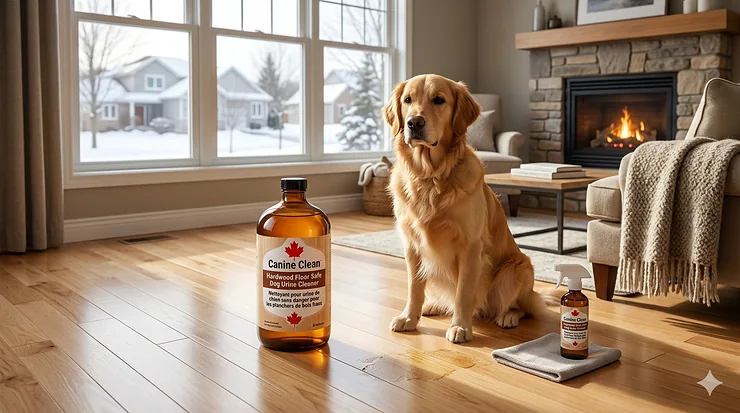
You love your dog. You also love your hardwood floors. But when Buddy decides the living room corner looks like the perfect spot for an emergency bathroom break, those two loves suddenly clash in the worst way possible.
I’ve been there. Standing in my kitchen at 6 AM, coffee in hand, staring at a fresh puddle on my newly refinished maple floors. The panic sets in—will this stain? Will the smell ever leave? Did I just lose hundreds of dollars worth of flooring?
Here’s the thing about dog urine on hardwood: it’s not just about the visible stain. Urine seeps into those tiny cracks between boards, soaks into unsealed edges, and leaves behind uric acid crystals that keep releasing that unmistakable ammonia smell every time humidity rises. Traditional cleaners might mask the odour temporarily, but they often leave residue that attracts your pup back to the same spot—or worse, they damage your floor’s finish.
What is hardwood floor safe dog urine cleaner? A hardwood floor safe dog urine cleaner is a specialized cleaning solution formulated with enzymes or bio-enzymatic ingredients that break down uric acid crystals and organic matter in pet urine without damaging sealed wood surfaces. Unlike harsh chemical cleaners, these products are pH-balanced and free from ammonia, bleach, and other substances that can strip floor finishes or harm pets.
Canadian pet owners face unique challenges too. Our extreme temperature swings mean floors expand and contract, creating more gaps for urine to seep into. Long winters keep dogs indoors longer. And with limited ventilation during those -30°C days, odours linger stubbornly.
The good news? The right hardwood floor safe dog urine cleaner can eliminate both stains and smells completely—without harming your floors or your furry family member. This guide covers everything Canadian pet parents need to know, from understanding how enzyme cleaners actually work to choosing products readily available on Amazon.ca.
Quick Comparison Table: Top Hardwood Floor Safe Cleaners
| Product | Price (CAD) | Best For | Key Feature | Rating |
|---|---|---|---|---|
| Rocco & Roxie Professional Strength | $38-$45 | All-around performance | CRI Seal of Approval | 4.5/5 |
| Nature’s Miracle Hard Floor Cleaner | $18-$25 | Budget-friendly | Dual-action formula | 4.3/5 |
| Simple Solution Hard Floor | $22-$28 | Sealed hardwood | 3-in-1 nozzle | 4.2/5 |
| Hepper Advanced Bio-Enzyme | $35-$42 | Premium choice | Eco-friendly formula | 4.6/5 |
| Angry Orange Pet Odor Eliminator | $28-$35 | Strong odours | Natural citrus power | 4.4/5 |
| Zep Urine Remover | $32-$40 (gallon) | Large areas | Commercial strength | 4.3/5 |
| Unique Hard Floor Cleaner | $26-$33 | Wood seams | Targets grout/crevices | 4.2/5 |
💬 Just one click – help others make better buying decisions too!😊
Top 7 Hardwood Floor Safe Dog Urine Cleaners: Expert Analysis
1. Rocco & Roxie Professional Strength Stain & Odour Eliminator
If there’s one enzyme cleaner that dominates Canadian pet owner discussions, it’s Rocco & Roxie. With over 119,000 ratings on Amazon and a spot as the #1 bestseller, there’s a reason this bottle shows up in so many homes from Vancouver to St. John’s.
The secret lies in its professional-strength bio-enzymatic formula. Natural bacteria activate on contact, literally feasting on the ammonia crystals left behind in dog urine until they’re completely eliminated. Not masked—eliminated. The enzymes break down proteins and organic matter at a molecular level, which means both the stain and the source of the odour disappear.
Key Specifications:
- Size: 32 oz (946 mL) or 1-gallon options
- Formula: Enzymatic bacteria blend
- pH: Neutral, safe for sealed hardwood
- Certification: Carpet and Rug Institute (CRI) Seal of Approval
Price in Canada: $38-$45 CAD for 32 oz on Amazon.ca
Canadian customers particularly love that it works in our cold basements and during winter when proper ventilation is impossible. One Toronto reviewer mentioned using it on 100-year-old oak floors without any finish damage. Another from Calgary noted it completely eliminated odours from her shepherd’s repeated accidents during a polar vortex when outdoor walks were impossible.
The chlorine-free, colour-safe formula means you can use it confidently on sealed hardwood without worrying about discolouration. Plus, it’s safe around kids and pets once dry—crucial for households where your pup might investigate their own accident site.
✅ Pros:
- Certified safe by CRI for all carpets and floors
- Works on old and new stains equally well
- Available in gallon size for multi-pet homes
❌ Cons:
- Slight licorice-like scent (some find pleasant, others don’t)
- Premium pricing compared to basic cleaners
2. Nature’s Miracle Hard Floor Cleaner
For budget-conscious Canadian pet parents who refuse to compromise on quality, Nature’s Miracle delivers impressive results without the premium price tag.
This dual-action cleaner combines bio-enzymatic technology with traditional cleaning agents, making it particularly effective on sealed wood, linoleum, vinyl, and even concrete. The formula penetrates deep to remove both surface stains and embedded odours—including those stubborn accidents that happened weeks ago and are now mysteriously announcing themselves on humid days.
Key Specifications:
- Size: 24 oz (710 mL)
- Formula: Bio-enzymatic with pro-bacteria
- Scent: Light lavender
- Safe for: Sealed wood, tile, vinyl, concrete
Price in Canada: $18-$25 CAD on Amazon.ca
What sets Nature’s Miracle apart is its prevention feature. The formula contains ingredients that discourage re-soiling by breaking down the pheromones that signal to your dog “this is the bathroom spot.” This is particularly helpful during puppy training or when introducing a rescue dog to your home.
Canadian reviewers from Halifax to Edmonton consistently praise its effectiveness on various floor types. One Manitoba customer mentioned successfully using it on her cabin’s vintage pine floors, while a British Columbia reviewer appreciated how it handled accidents on her radiant-heated bamboo flooring without affecting the heating system.
The light lavender scent is meant to have a calming effect on pets, though opinions vary—some find it soothing, others prefer unscented options.
✅ Pros:
- Excellent value for money
- Works on multiple hard surface types
- Prevents repeat accidents
❌ Cons:
- Smaller bottle size
- Lavender scent not everyone’s preference
3. Simple Solution Hard Floor Pet Stain and Odour Remover
Simple Solution brings something unique to Canadian homes: a patented 3-in-1 nozzle that gives you multiple application options depending on the mess you’re facing.
Stream setting for targeted cleaning of specific accidents. Spray for broader coverage. And foam for deep-cleaning grout lines or the tiny gaps between hardwood planks where urine loves to hide. This versatility makes it particularly useful for Canadian homes with mixed flooring—transition from hardwood to tile to stone all with the same bottle.
Key Specifications:
- Size: 32 oz (946 mL)
- Formula: Dual-action cleaner
- Nozzle: Adjustable 3-in-1
- Made in: USA
Price in Canada: $22-$28 CAD on Amazon.ca
The dual-action formula works immediately on contact but continues working for hours, with enzymes breaking down organic matter long after you’ve walked away. This extended action is particularly valuable for accidents you might not discover immediately—like when your dog sneaks into the guest room and you don’t realize it until the smell announces itself days later.
Canadian customers appreciate the “Made in USA” manufacturing given our proximity and easier returns if needed. One Ontario reviewer loved how the foam setting worked perfectly for her dog’s habit of peeing right along the baseboard, where liquid cleaners just run underneath. A Quebec customer found it ideal for her open-concept loft with concrete-look porcelain tiles that mimic wood grain.
The product ships from Amazon Fulfillment centres across Canada, typically arriving in 1-3 business days even to more remote locations.
✅ Pros:
- Versatile 3-in-1 nozzle system
- Immediately effective with continued enzyme action
- Ships quickly within Canada
❌ Cons:
- Nozzle can sometimes clog with foam setting
- Less concentrated than professional options
4. Hepper Advanced Bio-Enzyme Pet Stain & Odour Eliminator Spray
When you want the environmental friendliness of a boutique brand with the cleaning power of industrial-strength products, Hepper delivers. This eco-friendly enzyme cleaner has become increasingly popular among environmentally conscious Canadian pet owners.
The advanced bio-enzyme formula penetrates to the molecular level, breaking down uric acid, proteins, and organic compounds that create both stains and odours. What makes it special is the complete absence of harsh chemical smells—just a fresh, clean scent that dissipates quickly, leaving no lingering fragrances that might trigger allergies or bother scent-sensitive pets.
Key Specifications:
- Size: 32 oz (946 mL)
- Formula: Advanced bio-enzyme blend
- Scent: Fresh, natural (non-toxic)
- Guarantee: 100% satisfaction or money back
Price in Canada: $35-$42 CAD on Amazon.ca
Hepper backs their product with a 100% satisfaction guarantee, which gives Canadian buyers confidence when trying it for the first time. The company will actually refund you if it doesn’t work—though based on customer reviews, few people need to take them up on that offer.
Canadian customers particularly appreciate its gentle formulation for households with multiple pets, children, or family members with chemical sensitivities. One Alberta reviewer mentioned using it successfully on her asthmatic dog’s accidents without triggering any respiratory issues. A Saskatchewan customer loved that it worked equally well on her century home’s original oak floors and her basement’s laminate.
The product is safe for sealed hardwood, carpet, upholstery, and even pet bedding—basically anywhere your dog might have an accident.
✅ Pros:
- Eco-friendly and non-toxic formula
- Money-back satisfaction guarantee
- No harsh chemical smell
❌ Cons:
- Higher price point
- May require heavier application for very old stains
5. Angry Orange Pet Odour Eliminator
Sometimes you need nature’s power, and Angry Orange delivers it in concentrated citrus form. This isn’t your typical enzyme cleaner—it uses the natural deodorising power of cold-pressed orange oil to eliminate odours at the source rather than masking them.
The formula works through a two-step process: the orange oil breaks down odour molecules while the cleaning agents lift stains. It’s particularly effective for Canadian homes where winter humidity causes old accidents to mysteriously smell fresh again. The natural d-limonene in orange oil has powerful odour-neutralising properties that work even in damp basements or poorly ventilated mudrooms.
Key Specifications:
- Size: Concentrate makes up to 1 gallon
- Active ingredient: Cold-pressed orange oil
- Formula: Natural citrus-based
- Dilution: 1:7 ratio
Price in Canada: $28-$35 CAD for concentrate on Amazon.ca
What sets Angry Orange apart is its simplicity—just water, orange oil, non-ionic surfactant, orange fragrance, d-limonene, and a few natural compounds. No harsh chemicals, no synthetic fragrances, no mystery ingredients. This makes it ideal for households with chemical sensitivities or pet parents who prefer knowing exactly what they’re using on their floors.
The concentrate format provides excellent value. One bottle makes a full gallon (roughly 4 litres) of cleaner, which Canadian customers appreciate given shipping costs to more remote areas. One Yukon reviewer mentioned a single bottle lasting her entire winter with three large dogs. An Ottawa customer loved using it in her downtown condo where ventilation is limited and strong chemical smells linger.
The fresh orange scent is refreshing rather than overwhelming, though some dogs seem fascinated by it—you might find your pup sniffing areas you’ve just cleaned.
✅ Pros:
- Natural, simple ingredient list
- Concentrate provides excellent value
- Pleasant, fresh orange scent
❌ Cons:
- Requires mixing before each use
- Not technically enzymatic (different cleaning mechanism)
6. Zep Urine Remover
For Canadian homes with multiple pets, large dogs, or repeated accidents in the same areas, sometimes you need commercial-grade power. Zep Urine Remover brings professional cleaning strength to residential use.
This enzyme-activated formula is trusted by veterinary clinics, kennels, and professional cleaners across Canada. It breaks down urine at the source, eliminating even the toughest stains and odours from both pet and people sources. The formula works on an impressive range of surfaces—tile, vinyl, sealed hardwood, concrete, carpets, upholstery, even mattresses.
Key Specifications:
- Size: 1 gallon (3.78 L)
- Formula: Enzyme-activated
- Professional grade: Commercial use approved
- Safe for: Multiple surfaces including sealed wood
Price in Canada: $32-$40 CAD per gallon on Amazon.ca
The gallon size might seem excessive for single-pet homes, but multi-pet households find it economical. One British Columbia customer with four rescue dogs calculated she saved over $100 compared to buying smaller bottles throughout the year. A Nova Scotia boarding facility owner mentioned using it daily on their facility’s sealed concrete and wood transition areas with excellent results.
Canadian customers particularly appreciate the residue-free finish. Unlike some commercial cleaners that leave floors sticky or dull, Zep dries clean without affecting floor finish or creating a film that attracts dirt. It’s also excellent for those challenging situations—like when you discover your new rescue marked every corner of your basement rec room before you caught on.
The enzyme formula prevents re-soiling by completely breaking down the pheromones in urine rather than just masking them.
✅ Pros:
- Professional-grade effectiveness
- Excellent value in gallon size
- Residue-free finish
❌ Cons:
- Large bottle may be too much for small households
- Industrial packaging less convenient
7. Unique Hard Floor Cleaner
Unique takes a specialized approach—their formula specifically targets the tricky problem of urine that seeps into wood seams, grout lines, and treated floor surfaces. If your hardwood has visible gaps between boards or your home has mixed surfaces with tile grout, this is worth considering.
The bio-enzymatic blend is designed to penetrate deep into porous surfaces and crevices where traditional cleaners can’t reach. It’s particularly effective on the challenging combination of wood and grout that many Canadian homes have—like kitchen islands with wood surrounding tile, or entryways where hardwood transitions to stone.
Key Specifications:
- Size: 24 oz (710 mL) spray
- Formula: Bio-enzymatic concentrate
- Specialty: Wood seams and grout
- Safe for: Treated and sealed floors
Price in Canada: $26-$33 CAD on Amazon.ca
The formula eliminates odours without leaving residue or lasting fragrances—it simply breaks down the source of the smell and disappears. This is particularly useful in Canadian homes where we often close up for winter, and any lingering scents become magnified in stale indoor air.
Unique is a small business brand, which Canadian customers often appreciate supporting. One Manitoba reviewer loved how it handled her lab’s accidents along the grout lines of her kitchen’s wood-look tile. A Toronto customer found it perfect for her Victorian home’s original hardwood with its characteristic wide gaps between boards.
The spray works whether the accident just happened or it’s been there for months, slowly releasing odour. The enzymes are patient and thorough, working until the job is done.
✅ Pros:
- Specifically formulated for wood seams and grout
- Works on old and new stains
- Small business support
❌ Cons:
- Smaller bottle size
- More specialized than all-purpose cleaners
✨ Don’t Miss These Exclusive Deals!
🔍 Take your hardwood floor care to the next level with these carefully selected products available in Canada. Click on any highlighted item to check current pricing and availability on Amazon.ca. These cleaners will help you create an odour-free home your family will love!
Understanding How Enzyme Cleaners Actually Work
If you’ve ever wondered why some cleaners just mask dog urine smell while others eliminate it completely, the answer lies in the science of enzymes. Let me break this down without getting too deep into biology class.
Traditional chemical cleaners work by dissolving or covering up stains. They might bleach the visible mark or add a strong fragrance that temporarily overwhelms the urine smell. But here’s the problem—they don’t actually remove the source. Uric acid crystals remain embedded in your floor, ready to release that ammonia smell whenever humidity rises or the fragrance wears off.
Enzyme cleaners work fundamentally differently. Enzymes are biological molecules—usually proteins—that act as catalysts to speed up chemical reactions. In cleaning products, these enzymes are specifically chosen to break down organic materials like proteins, fats, and uric acid.
When you spray an enzymatic hardwood floor safe dog urine cleaner on an accident, several things happen simultaneously. The enzymes immediately start breaking down large urine molecules into smaller, simpler compounds. This is the “bio” part of bio-enzymatic—living bacteria in the formula then consume these smaller molecules, literally eating the source of the stain and odour.
The bacteria continue multiplying and working as long as moisture and “food” (urine components) remain present. This is why you often need to keep the area damp for enzymatic cleaners to work fully—the bacteria need that moisture to survive and do their job. Once all the organic matter is consumed, the bacteria population naturally decreases and can be easily wiped or mopped away.
According to research on detergent enzymes, different types of enzymes target different types of organic matter. Proteases break down proteins (found in urine, faeces, blood), amylases target starches, and lipases attack fats and oils. Quality hardwood floor safe dog urine cleaners typically contain a blend of these enzymes to handle the complex mix of compounds in pet accidents.
This enzymatic action is why these cleaners are so effective at preventing repeat marking. Dogs return to previously soiled spots because they can smell the pheromones in their urine—even when humans can’t detect anything. Chemical cleaners might satisfy your nose but leave enough molecular traces for your dog’s powerful sense of smell to detect. Enzyme cleaners eliminate these pheromones at the molecular level, genuinely removing the “come pee here again” signal.
The process typically takes anywhere from a few minutes to several hours, depending on how old and set-in the stain is. Fresh accidents clean up quickly—often within 5-10 minutes. Old stains that have penetrated deep into wood grain or between floorboards might require 24-48 hours of enzyme action, which is why you sometimes need to reapply and keep the area damp.
For Canadian pet owners dealing with basement accidents or winter indoor-only periods, understanding this science helps explain why patience pays off. That stubborn urine smell in your rec room isn’t being difficult—it’s just deeply embedded, and the enzymes need time to reach and break down every last crystal.
How to Remove Dog Urine Smell from Concrete (Garages, Basements & Patios)
Concrete presents unique challenges that hardwood doesn’t. While hardwood is relatively non-porous when properly sealed, concrete is extremely porous—like a rock sponge. Dog urine doesn’t just sit on top; it soaks deep into those microscopic pores, making odour removal particularly challenging for Canadian garage floors, unfinished basements, and patio areas.
The first critical step is identifying all affected areas. This might seem obvious for fresh accidents, but old urine stains in concrete can be nearly invisible to the naked eye. Invest in an inexpensive UV blacklight (available on Amazon.ca for $15-25). In a darkened garage or basement, old urine stains glow yellowish-green under UV light, revealing accidents you never knew existed. I learned this the hard way when I bought my house—the previous owner’s dog had apparently treated the entire basement laundry area as a bathroom.
Step 1: Remove Surface Contamination Before applying any cleaner, soak up fresh urine with absorbent towels. For dried accidents, scrub the area with a stiff brush and warm water to remove surface debris. This ensures the enzyme cleaner can penetrate rather than just sitting on dirt and grime.
Step 2: Saturate with Enzyme Cleaner Here’s where concrete differs from hardwood—you need to absolutely saturate the area. The enzymatic solution must penetrate as deeply as the urine has soaked in. For concrete, this often means using 2-3 times more product than you would on hardwood. Products like Zep Urine Remover or Rocco & Roxie work excellently on concrete when applied generously.
Step 3: Keep It Wet This is crucial for concrete. Cover the saturated area with plastic sheeting to slow evaporation and keep the enzymes active longer. Canadian winters make this easier indoors where humidity is low, but summer concrete in direct sun will dry quickly—requiring re-misting every few hours or overnight coverage.
Step 4: Extend Contact Time Allow the enzyme cleaner to work for at least 24 hours on concrete. For severe odour problems or very old stains, 48-72 hours produces better results. The porous nature of concrete means uric acid crystals can hide deep in the material, and rushing this process leaves odours behind.
Step 5: Blot and Repeat After the first application, blot up the liquid. Don’t be alarmed if it smells worse than before—this is actually a good sign that enzymes are pulling uric acid to the surface. Reapply the enzyme cleaner and repeat the process. Most concrete situations require 2-3 applications for complete odour removal.
Step 6: Consider Sealing Once the odour is completely gone, consider sealing your concrete. Products like Odor Shield (mentioned in professional concrete cleaning guides) create a barrier that prevents future urine from penetrating deeply. This is particularly valuable for Canadian garage floors where winter salt and moisture already stress the concrete.
For outdoor patios and pathways where you can’t easily control moisture, timing matters. Apply enzyme cleaners during dry weather with several days of no rain forecasted. Canadian spring and fall often provide ideal conditions—warm enough for enzyme activity but not so hot that evaporation happens too quickly.
Unfinished basement concrete presents a special challenge during Canadian winters when forced-air heating creates very dry indoor air. Consider using a humidifier in the affected area while enzymes work, or cover larger areas with dampened towels under plastic sheeting to maintain the moisture enzymes need.
Floor Specific Pet Cleaners: Matching Product to Surface
Not all floors are created equal, and using the wrong cleaner on the wrong surface can cause more problems than the original accident. Let’s break down how to match your hardwood floor safe dog urine cleaner to your specific flooring type—crucial knowledge for Canadian homes with mixed flooring throughout.
Sealed Hardwood Floors Most modern hardwood has a polyurethane or similar protective finish. These sealed floors are relatively forgiving—products like Rocco & Roxie or Nature’s Miracle Hard Floor work beautifully without damaging the finish. The key is avoiding anything with ammonia or bleach, which can dull or strip the protective coating. Always test any new product in an inconspicuous area first, perhaps under a rug or inside a closet.
Unsealed or Oiled Hardwood Some Canadian heritage homes feature oiled hardwood or areas that have lost their finish over time. These floors are far more delicate. Water-based enzyme cleaners can still work, but they must be used sparingly—apply just enough to treat the urine without over-saturating the wood. Products specifically designed for hard floors with minimal moisture content, like Simple Solution Hard Floor, are safer choices. After enzyme treatment, consider reapplying oil or finish to protect the treated area.
Engineered Hardwood Engineered wood features a thin hardwood veneer over plywood layers. It’s less moisture-tolerant than solid hardwood. Use enzyme cleaners designed for hardwood, but apply them more conservatively. Spray onto a microfibre cloth rather than directly onto the floor when possible, then gently blot the accident area. Hepper Advanced Bio-Enzyme works well with this method since it’s less watery than some competitors.
Laminate Flooring Despite looking like wood, laminate is actually a photograph of wood printed on composite material. It’s quite moisture-sensitive—water seeping into seams can cause swelling and permanent damage. Use hardwood-safe enzyme cleaners very sparingly on laminate, and always dry the area thoroughly afterward. Some enzyme cleaners specifically state “safe for laminate”—verify this before use.
Tile and Grout Ceramic or porcelain tile itself is non-porous, but the grout between tiles is incredibly absorbent. Unique Hard Floor Cleaner excels here because it’s specifically formulated to penetrate grout lines. Apply liberally to grout, less so to tile. Some Canadian homes feature wood-look porcelain tile that mimics hardwood perfectly—treat these like regular tile, not like actual wood.
Luxury Vinyl Plank (LVP) This increasingly popular flooring is waterproof and generally quite forgiving. Most enzyme cleaners safe for sealed hardwood work perfectly on LVP. The challenge with LVP is that it’s often installed with click-lock seams that can let urine seep underneath if not properly sealed. Focus enzyme application along seams and edges where urine might have penetrated.
Stone Floors (Slate, Marble, Travertine) Natural stone varies wildly in porosity. Slate and marble are relatively dense; travertine is extremely porous. All require pH-neutral cleaners to avoid etching. Most enzyme cleaners are pH-neutral, but verify before use. For very porous stone like travertine, treat it almost like concrete—saturate thoroughly and allow extended working time.
Bamboo Flooring Bamboo technically isn’t hardwood, but sealed bamboo floors clean similarly. The strand-woven variety is quite durable; horizontal or vertical grain bamboo is more moisture-sensitive. Use standard hardwood-safe enzyme cleaners, but avoid over-saturation. Canadian homes with radiant floor heating under bamboo require extra caution—excessive moisture combined with heat can cause problems.
Cork Flooring Cork is naturally somewhat antimicrobial but also quite absorbent. Enzyme cleaners work well, but like with engineered wood, apply them conservatively. Spray onto a cloth rather than directly onto cork, and dry the area thoroughly afterward.
One pro tip for multi-surface Canadian homes: keep different cleaning methods for different rooms rather than trying to find one universal product. Your kitchen tile can handle a soaking with enzyme cleaner; your antique oak living room floor cannot. Tailor your approach to each surface, and you’ll avoid the “I fixed the stain but ruined the floor” scenario.
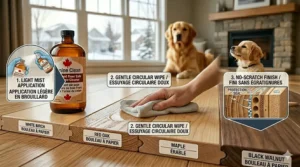
Wood Floor Pet Stain: Prevention and Long-term Protection
Dealing with existing stains is one thing. Preventing future damage is another—and it’s honestly more important. As someone who’s refinished hardwood floors before (expensive, disruptive, time-consuming), I can confidently say that prevention is worth ten times its weight in cure.
Immediate Response is Everything The single most important habit you can develop is immediate cleanup. Dog urine causes exponentially more damage the longer it sits. Within the first 5 minutes, it’s mostly surface-level and easy to clean. After 30 minutes, it’s started seeping into micro-scratches and grain patterns. After a few hours, it’s beginning to penetrate beneath the finish. By the next day, you’re dealing with potential wood discolouration and finish damage.
Keep cleanup supplies in multiple locations throughout your home. I have a stash under every sink: paper towels, a spray bottle of enzyme cleaner, and microfibre cloths. When an accident happens, you can respond immediately regardless of which room you’re in.
Strategic Rug Placement Canadian homes often have hardwood in main living areas and bedrooms. Consider placing washable area rugs in “high-risk zones”—near doors where dogs wait to go outside, in bedrooms where older dogs might have nighttime accidents, or in the dining area where spills attract investigation. These rugs act as both protection and early warning systems. Dogs often prefer soft surfaces anyway, so a strategically placed washable rug can redirect accidents away from hardwood.
Protective Finish Maintenance Your floor’s protective finish is your first line of defense. Maintain it religiously. For polyurethane finishes, this might mean screening and recoating every 3-5 years rather than waiting for the finish to completely fail. Oiled floors need reapplication annually or even more frequently in high-traffic areas.
Canadian climate extremes stress floor finishes more than moderate climates do. Winter heating creates dry indoor air that can cause finish to crack. Spring humidity brings moisture that tests finish waterproofing. Regular maintenance keeps your protective barrier strong.
Pet-Specific Floor Coatings Some flooring companies now offer pet-specific finishes with enhanced stain and odour resistance. If you’re refinishing or installing new floors, ask about these options. They cost more upfront but can save significant headaches long-term. Aluminum oxide finishes, for example, are extremely durable and resistant to both scratches and moisture penetration.
Training and Behavioral Approaches This isn’t strictly about cleaning, but it’s worth mentioning—addressing the root cause prevents countless accidents. Consistent bathroom breaks, proper crate training for puppies, scheduled feeding times, and understanding your dog’s “I need to go” signals all reduce accidents.
For older dogs with incontinence issues, talk to your vet. Medical interventions like hormone therapy or medication can significantly reduce accidents. Dog diapers or belly bands work for some situations, though they’re admittedly not convenient for active dogs.
Motion-Activated Deterrents For dogs that repeatedly mark specific areas, motion-activated air sprayers can break the habit. These devices detect movement and emit a harmless puff of air that startles the dog. After a few encounters, most dogs avoid that area entirely. This prevents the reinforcing cycle of accident → clean → dog smells residue → marks again → stronger smell → more accidents.
Flooring Insurance and Documentation This might seem excessive, but hear me out. If you have valuable hardwood floors and a young puppy or aging incontinent dog, consider whether your home insurance includes accidental damage coverage. Document your floors’ condition with photos before problems start. Some insurance policies will cover refinishing or replacement if pet damage exceeds certain thresholds.
Also keep receipts for all enzyme cleaners and cleaning supplies. If you ever need to make an insurance claim, proving you took reasonable steps to prevent and address damage strengthens your case.
Seasonal Considerations for Canadian Homes Winter presents unique challenges. Dogs hate going outside in -25°C weather—who can blame them? Anticipate more indoor time and more accidents. Some Canadian dog owners create temporary indoor potty areas during extreme cold snaps—balconies with dog litter boxes, washable pads in mudrooms, or even patches of real grass in garages. These solutions protect hardwood by redirecting bathroom behaviour to acceptable indoor spots.
Summer humidity can reactivate old urine smells you thought were gone. If previously treated areas suddenly smell again, it’s not necessarily new accidents—it might be residual crystals releasing odour in humid air. A maintenance cleaning with enzyme cleaner usually resolves this.
Safe for Sealed Floors: Understanding Finish Compatibility
The term “sealed floors” appears everywhere in product descriptions, but what does it actually mean, and why does it matter so much for choosing your hardwood floor safe dog urine cleaner?
A sealed floor has a protective topcoat—usually polyurethane, though sometimes varnish, lacquer, or other finishes—that creates a moisture barrier between the wood and anything spilled on it. This seal is your floor’s immune system. Damage it, and you’ve exposed vulnerable wood to moisture, stains, and deterioration.
Not all cleaners respect this seal. Ammonia-based products can dull polyurethane finishes. Acidic cleaners (like straight vinegar) can etch them. Highly alkaline cleaners can lift or soften them. Even some “natural” cleaners containing citrus oils can degrade certain finishes over time.
This is why product labels specifically state “safe for sealed floors”—they’re promising their pH level, chemical composition, and cleaning mechanism won’t attack your protective finish. Let’s break down what makes an enzyme cleaner truly safe for sealed hardwood.
pH Neutral Formulations The sweet spot for wood floor cleaners is pH 6-8—essentially neutral. Products like Rocco & Roxie and Nature’s Miracle maintain neutral pH, which means they won’t chemically react with polyurethane or other common floor finishes. Too acidic (pH below 5), and you risk etching. Too alkaline (pH above 9), and you might soften or lift the finish.
Residue-Free Formulas Even if a cleaner doesn’t damage your finish directly, it can cause problems if it leaves residue. This residue attracts dirt, creates a dull film, and can even make floors slippery—dangerous for both humans and dogs navigating smooth hardwood. Quality enzyme cleaners are designed to break down completely, leaving nothing behind but clean wood.
Water-Based vs. Solvent-Based Most enzyme cleaners are water-based, which is generally safer for sealed floors than solvent-based products. Solvents can sometimes penetrate or soften polyurethane finishes. Water-based formulas clean effectively without these risks, provided you don’t use excessive amounts that sit on the floor for extended periods.
Testing Protocol Even products labeled safe for sealed floors should be tested before widespread use. Choose an inconspicuous area—inside a closet, under furniture, or in a corner. Apply the product according to directions and let it dry completely. After 24 hours, inspect for any dullness, discolouration, or finish damage. If the test area looks perfect, proceed with confidence.
Specific Finish Types Different finishes have different vulnerabilities:
Polyurethane (most common in Canadian homes) is quite durable and compatible with most pH-neutral enzyme cleaners.
Oil-based finishes require more careful product selection. They’re more permeable than polyurethane, so cleaners need to be used more sparingly.
Wax finishes (rare in modern homes but present in heritage properties) can actually be damaged by water-based cleaners. If you have waxed floors, consult a flooring specialist before using enzyme products.
UV-cured finishes are extremely durable and generally compatible with all standard hardwood-safe enzyme cleaners.
Signs Your Cleaner Isn’t Safe Stop using a product immediately if you notice:
- Dull spots where the cleaner was applied
- White hazy appearance (moisture trapped under finish)
- Sticky residue that attracts dirt
- Roughened texture (finish beginning to lift)
- Discolouration that doesn’t match natural wood tones
Canadian Climate Considerations Our extreme seasons add another layer to finish compatibility. Winter’s dry air can make finishes more brittle and susceptible to damage from harsh cleaners. Summer humidity can make finishes slightly softer and more vulnerable. Choose cleaners that work with your floor’s protective seal year-round, not just in ideal conditions.
The investment in a truly finish-safe enzyme cleaner pays dividends. Refinishing damaged hardwood costs $3-8 per square foot in Canada—potentially thousands of dollars for an average home. Spending $35 on Hepper Advanced Bio-Enzyme or Rocco & Roxie instead of $15 on a questionable product is the smart financial move.
✨ Transform Your Pet Cleanup Routine!
🏡 Keep your hardwood floors looking beautiful while maintaining a pet-friendly home. These enzyme cleaners available on Amazon.ca deliver professional results without harsh chemicals. Your floors and your furry friends will thank you!
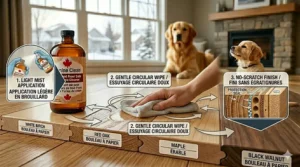
Multi-surface Enzyme Cleaner: When Versatility Matters
Canadian homes rarely feature just one type of flooring. Your kitchen might have tile, your living room hardwood, your basement concrete, and your bathroom vinyl. Hauling around different cleaners for each surface is impractical—which is where multi-surface enzyme cleaners earn their keep.
A true multi-surface enzyme cleaner must balance seemingly contradictory requirements. It needs to be gentle enough for delicate surfaces like unsealed stone yet powerful enough for porous concrete. It must maintain safe pH levels for hardwood while still breaking down uric acid crystals in carpet. And it should work effectively across temperature ranges—crucial for Canadian homes where basement concrete might be 15°C while main floor hardwood sits at 22°C.
What Makes a Cleaner Multi-Surface Compatible?
The secret lies in carefully balanced formulation. Products like Rocco & Roxie Professional Strength and Zep Urine Remover achieve versatility through neutral pH, carefully selected enzyme blends, and surfactants that adjust to different surface tensions.
These cleaners typically contain:
- Multiple enzyme types to handle various organic compounds
- Surfactants that work on both porous and non-porous surfaces
- pH buffers to maintain neutrality across different materials
- Minimal additives that might react with specific surface types
Surface-Specific Application Techniques
Just because a cleaner is safe for multiple surfaces doesn’t mean you use it identically on each:
On hardwood: Spray onto a cloth, then apply to the floor—avoiding excess moisture.
On tile: Spray liberally, especially into grout lines, allowing deeper penetration.
On carpet: Saturate the area thoroughly, as you need to reach carpet backing and padding.
On concrete: Flood the area—seriously, use 2-3 times what you’d use on hardwood.
On upholstery: Test for colour-fastness first, then apply sparingly.
Limitations to Acknowledge
Even the best multi-surface cleaners have limits. They may not be optimal for:
- Unfinished stone (requires stone-specific pH balance)
- Antique or especially delicate woods (need gentler formulation)
- Some textiles (silk, wool, certain blends need special care)
- Waxed surfaces (water-based cleaners don’t play well with wax)
For these cases, you’ll still need specialized products. But for the 80% of surfaces in a typical Canadian home, a quality multi-surface enzyme cleaner handles everything from that accident on your hardwood entry to the spot in the basement where your dog marked the concrete.
Cost-Benefit Analysis
Initially, multi-surface cleaners may seem expensive—Rocco & Roxie at $38-45 CAD isn’t cheap. But consider the alternative: separate cleaners for hardwood ($25), carpet ($28), upholstery ($22), and concrete/tile ($30). That’s over $100 in specialized products, plus the organizational headache of keeping track of which bottle goes where.
A single multi-surface cleaner simplifies both purchasing and usage. One bottle handles every accident, wherever it happens. No more running to different rooms searching for the right product while urine soaks deeper into your floor.
Canadian Home Application Scenarios
Open-concept living: Many Canadian homes feature flowing layouts where hardwood transitions to tile to carpet within one large space. When your puppy has an accident near the kitchen island, you might be cleaning hardwood, tile grout, AND the edge of your area rug simultaneously. Multi-surface cleaners make this common scenario manageable.
Finished basements: Canadian basements often combine concrete, vinyl plank, carpet tiles, and sealed wood stairways. A multi-surface enzyme cleaner handles the entire space without product switching.
Mudrooms: These high-traffic Canadian home staples typically mix flooring types—tile near the door, hardwood or vinyl transitioning to the main house, and often an area rug for wiping paws. Multi-surface capability is essential here.
Seasonal transitions: Spring and fall in Canada mean muddy paws bringing dirt (and occasionally accidents) from garage concrete to hardwood entry to carpeted living room in one wet, chaotic trail. Having one cleaner that handles the entire path saves time when you’re already dealing with the mess.
The right multi-surface enzyme cleaner becomes your household’s universal problem-solver—the product you reach for automatically because you know it works on whatever surface needs cleaning.
The Role of pH Balance in Floor-Safe Cleaners
pH might seem like chemistry class trivia, but it’s actually crucial for understanding why some cleaners damage floors while others don’t. Let me explain this without turning it into a science lecture.
pH measures how acidic or alkaline a solution is, on a scale of 0-14. Pure water is neutral at pH 7. Below 7 is acidic (lemon juice is around pH 2). Above 7 is alkaline or basic (baking soda dissolved in water is around pH 8).
Wood and its protective finishes are surprisingly pH-sensitive. Most polyurethane finishes are designed to resist pH levels between 6-8. Go too far in either direction, and you risk chemical reactions that can dull, etch, or even dissolve the protective coating.
Why Acidic Cleaners Can Be Problematic
Highly acidic solutions (pH below 5) can etch hardwood finishes, creating a dull, rough appearance. This is why straight vinegar (pH 2-3), despite being natural, isn’t ideal for regular hardwood cleaning. While it won’t instantly destroy your floor, repeated use can gradually degrade the finish.
Some enzyme cleaners deliberately include mild acids to help break down alkaline components in urine. These work fine if the overall pH remains near-neutral, but cheap formulations sometimes skimp on pH buffers, allowing acidity to spike.
Alkaline Cleaners and Finish Damage
Strong alkaline cleaners (pH above 9) pose different risks. They can soften or lift polyurethane finishes, making floors feel sticky or tacky. This is why traditional ammonia-based cleaners (pH 11-12) are terrible for hardwood despite being effective on windows and counters.
Interestingly, fresh dog urine is actually slightly acidic to neutral (pH 5.5-7), but as it ages and bacteria break down urea, it becomes increasingly alkaline. Old dried urine can reach pH 9 or higher. This is why old stains sometimes require multiple treatments—you’re fighting increasingly alkaline compounds.
The Neutral Sweet Spot
Quality hardwood floor safe dog urine cleaners maintain pH between 6-8. Nature’s Miracle, Rocco & Roxie, and Hepper all formulate within this range. They achieve effective cleaning through enzyme action rather than relying on extreme pH to dissolve stains.
This neutral pH provides several benefits:
- Safe for polyurethane and most other floor finishes
- Won’t etch stone or tile
- Gentle on grout
- Less likely to cause skin irritation if you’re cleaning by hand
- Safe around pets once dried
pH Testing at Home
If you’re using a cleaner without clear pH information, you can test it yourself. Inexpensive pH test strips (available at aquarium supply stores or Amazon.ca for under $10) provide reasonably accurate readings. Dip a strip in the undiluted cleaner and compare the colour change to the included chart.
If the cleaner tests above pH 8 or below pH 6, use it cautiously. Above pH 9 or below pH 5? I’d skip it entirely for hardwood, regardless of what the label claims.
Canadian Hard Water Considerations
Many Canadian regions have hard water (high mineral content), which tends to be slightly alkaline. If you’re diluting a concentrate with hard tap water, you might be inadvertently raising the pH of your final cleaning solution. For areas with very hard water, consider using distilled water for dilution, or add a few drops of white vinegar to neutralize some of the alkalinity.
Surface-Specific pH Tolerance
Different surfaces tolerate different pH ranges:
- Sealed hardwood: pH 6-8 (strict)
- Laminate: pH 6-9 (fairly forgiving)
- Tile: pH 5-10 (very tolerant)
- Natural stone: pH 7-8 (vary by stone type)
- Concrete: pH 6-12 (extremely tolerant)
- Carpet: pH 5-9 (quite forgiving)
This variability is another reason multi-surface enzyme cleaners maintain neutral pH—it’s the safe zone for all common household surfaces.
Understanding pH helps you make informed choices. When a product boasts “powerful cleaning action” but doesn’t mention pH, that’s a red flag. Truly floor-safe formulations proudly advertise neutral pH because it’s a key selling point to educated consumers.
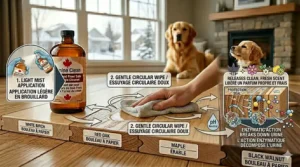
Frequently Asked Questions
❓ How long does it take for enzyme cleaners to completely eliminate dog urine odour from hardwood floors?
❓ Are enzyme-based hardwood floor cleaners safe to use around pets and children in Canada?
❓ What's the price range for effective hardwood floor safe dog urine cleaners in Canada?
❓ Can I use the same enzyme cleaner on both my hardwood floors and concrete garage in Canadian winters?
❓ Why does my hardwood floor smell like dog urine again after cleaning, especially during humid Canadian summers?
Conclusion: Protecting Your Investment While Loving Your Dog
Your hardwood floors represent a significant investment—thousands of dollars in materials and installation, plus the aesthetic value they bring to your Canadian home. Your dog represents an even greater investment of love, time, and companionship. The good news is you don’t have to choose between these two treasures.
The right hardwood floor safe dog urine cleaner makes coexistence not just possible, but easy. Products like Rocco & Roxie Professional Strength, Nature’s Miracle Hard Floor Cleaner, and Hepper Advanced Bio-Enzyme eliminate accidents completely rather than merely masking them. The science behind enzyme cleaning—breaking down organic matter at the molecular level—means both stains and odours disappear permanently when used correctly.
Canadian pet owners face unique challenges our American or European counterparts don’t necessarily encounter. Our extreme winters keep dogs indoors longer, increasing accident probability. Our temperature swings cause floors to expand and contract, creating more crevices for urine to penetrate. Our hard water affects cleaning product performance. Our long distances and higher shipping costs make product selection more critical—you can’t afford to experiment with five different cleaners when returns cost $15-20 each.
This is why choosing the right product from the start matters so much. Invest in quality enzyme cleaners that Canadian customers have proven effective. Read reviews from fellow Canadians dealing with similar climates and flooring types. Buy from Amazon.ca sellers with strong ratings and reasonable shipping times.
Remember that prevention and quick response beat even the best cleaners. Keep supplies accessible in multiple locations. Respond to accidents within minutes rather than hours. Maintain your floor’s protective finish. Consider behavioural training and medical interventions that reduce accident frequency.
Your floors will eventually need refinishing regardless of how well you clean—that’s the nature of hardwood in active homes. But proper enzyme cleaning can extend that timeline from 3-5 years to 10-15 years, saving thousands in refinishing costs. More importantly, it maintains a clean, odour-free home where both you and your dog feel comfortable.
Canadian homes are meant for living, not museum preservation. Your hardwood floors exist to be walked on, played on, and yes, occasionally peed on by beloved family members who happen to have four legs. With the right cleaning products and proper techniques, you can enjoy both beautiful floors and the unconditional love only dogs provide.
Take the knowledge from this guide, choose the enzyme cleaner that fits your needs and budget, and clean with confidence. Your floors—and your nose—will thank you.
Recommended for You
- 7 Best Carpet Cleaners for Pet Accidents Canada 2026
- 7 Best Enzyme Cleaners for Dog Urine in Canada 2026
- 7 Best Poop Bag Dispensers with Carabiner Clip Canada 2026 Guide
Disclaimer: This article contains affiliate links to Amazon.ca. If you purchase products through these links, we may earn a small commission at no additional cost to you.
✨ Found this helpful? Share it with your friends! 💬🤗
