
In This Article
Picture this: it’s -25°C in Winnipeg, and your loyal companion is shivering outside. If this scenario makes your heart sink, you’re not alone. Canadian winters are notoriously brutal, and while we bundle up in our cozy homes, our outdoor dogs face temperatures that can lead to frostbite, hypothermia, and serious health complications within minutes.
Here’s the reality – according to the Canadian Veterinary Medical Association, dog and cat haircoats often provide insufficient protection against extreme cold. Tails, ear tips, and toes are particularly vulnerable to frostbite. When temperatures drop below freezing, pets should not be left outside for extended periods, yet many working dogs, farm dogs, and outdoor-loving breeds need safe outdoor shelter year-round.
A heated outdoor dog house isn’t just a luxury—it’s potentially life-saving equipment for Canadian pet owners. These specialized shelters combine insulation, weatherproofing, and thermostatically controlled heating to maintain safe temperatures even when the mercury plummets. Whether you’re in rural Alberta dealing with -40°C windchills or coastal BC managing wet, bone-chilling cold, the right heated kennel can mean the difference between a comfortable, healthy dog and one suffering from cold-related illnesses.
In this comprehensive guide, I’ll walk you through seven top-rated heated outdoor dog houses available on Amazon.ca in 2026, complete with Canadian pricing, safety certifications, and real customer experiences. We’ll also explore essential factors like energy efficiency, proper insulation techniques, and CSA safety standards that every responsible Canadian dog owner should understand.
Quick Comparison Table 📊
| Product | Size Range | Heating Type | Insulation | Price (CAD) | Best For |
|---|---|---|---|---|---|
| K&H Lectro-Soft Outdoor Heated Bed | Small-XL | Thermostat Pad (20-60W) | External | $69-$139 | Budget heating solution |
| Aivituvin Heated Dog House AIR7021 | Large (55.9″L) | Built-in Pad (89-116°F) | 6-sided liner | $399-$499 | All-weather protection |
| PETNF Dog House Heater 500W | Universal mount | Wall heater (41-113°F) | Add-on device | $159-$189 | Existing structures |
| Petmate Indigo + Heater | M-XL (25-125 lbs) | Separate pad | Structural foam | $189-$319 | Igloo-style classic |
| Aivituvin AIR80 Metal Frame | Extra Large (50.9″L) | Thermostat pad | Metal + wood | $459-$549 | Chew-resistant |
| K&H Outdoor Kitty House (Large) | 19″x22″x17″ | 20W MET-listed | Polyester walls | $139-$169 | Small-medium dogs |
| MEDEHOO Insulated Heated Kennel | Large (48″L) | Adjustable pad | Triple-layer | $379-$429 | Extreme cold zones |
💬 Just one click – help others make better buying decisions too! 😊
Top 7 Heated Outdoor Dog Houses: Expert Analysis 🏆
1. K&H Lectro-Soft Outdoor Heated Bed – Best Budget Heating Solution
The K&H Lectro-Soft Outdoor Heated Bed isn’t technically a complete dog house, but it’s the most affordable way to add safe, MET-certified heating to your existing shelter. This orthopedic heated pad uses only 20-60 watts (depending on size) and costs less to run than a nightlight.
Key Specifications:
- Internal thermostat maintains 102°F when pet is resting
- Soft PVC waterproof exterior with removable fleece cover
- MET-certified for USA/CA electrical safety standards
- Available in Small (14″x18″), Medium (19″x24″), and Large (25″x36″)
Price Range: $69.99 – $139.99 CAD
Canadian Customer Feedback: Ontario buyers particularly appreciate the low energy costs during long Canadian winters. One Toronto reviewer noted it kept their doghouse at 15-20°F above ambient temperature even during January cold snaps. The steel-wrapped 5.5-foot cord resists chewing – crucial for power-chewing breeds.
✅ Pros:
- Extremely energy-efficient (20-60W usage)
- MET safety certified for North America
- Removable, machine-washable cover
❌ Cons:
- Requires existing shelter structure
- Not suitable for extreme -40°C without additional insulation
2. Aivituvin Heated Dog House AIR7021 – Best All-Weather Protection
This Aivituvin Heated Dog House represents the gold standard for Canadian winters. Featuring a reinforced metal frame, asphalt roof, and removable 6-sided insulated liner, it’s engineered specifically for harsh weather conditions.
Key Specifications:
- Built-in heating pad with thermostat (89-116°F range)
- Triple-layer insulation (solid wood + plywood + liner)
- Metal frame construction prevents chewing damage
- Dimensions: 55.9″L x 37.4″W x 35.8″H
Price Range: $399.99 – $499.99 CAD
Canadian Customer Feedback: Alberta ranchers report this house performs exceptionally well in -30°C temperatures. The 6.5-foot chew-resistant cord survived multiple prairie winters. British Columbia owners appreciate how the asphalt roof handles heavy rain and snow load without leaking.
✅ Pros:
- Six-sided insulation traps heat effectively
- Metal frame withstands aggressive chewers
- Removable liner allows summer/winter configurations
❌ Cons:
- Higher price point
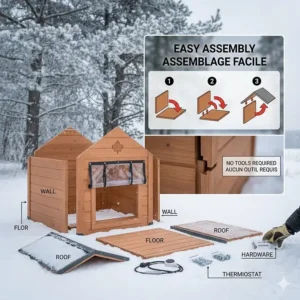
- Assembly requires 2 people (approximately 45 minutes)
3. PETNF Dog House Heater 500W – Best Add-On Heater
Perfect for Canadians who already have a quality doghouse but need supplemental heating, the PETNF Dog House Heater offers WiFi app control and precise temperature management from 41°F to 113°F.
Key Specifications:
- 500W ceramic PTC heating element
- WiFi app control with 24-hour timer
- External temperature probe for accurate readings
- 6.5-foot anti-chew metal-armored cord
Price Range: $159.99 – $189.99 CAD
Canadian Customer Feedback: Saskatchewan owners love the app control feature – they can monitor and adjust temperatures remotely during extreme cold warnings. One Yukon customer noted the external probe provides more accurate temperature readings than competitor models with internal sensors. However, several reviews mention it lacks CSA certification, which is worth considering for insurance purposes.
✅ Pros:
- Smart app control from anywhere
- External probe for precise temperature monitoring
- ECO mode reduces electricity costs by 30%
❌ Cons:
- Not CSA/UL certified for Canada
- Requires drilling installation in existing structure
4. Petmate Indigo Dog House – Best Classic Igloo Design
The Petmate Indigo is a Canadian winter staple. This iconic igloo-shaped house uses structural foam insulation and natural thermal dynamics. While it doesn’t include heating, it pairs perfectly with heated pads and is “Made in the USA.”
Key Specifications:
- Structural foam construction (warmer in winter, cooler in summer)
- Extended offset doorway blocks wind and rain
- Patented dome design sheds snow naturally
- Available: Medium (25-50 lbs), Large (50-90 lbs), XL (90-125 lbs)
Price Range: $189.99 – $319.99 CAD (house only, heated pad separate)
Canadian Customer Feedback: Manitoba customers report snow slides off the dome design effortlessly. When combined with a K&H heated pad, interior temperatures stay above freezing even at -25°C. The raised floor with drainage moats prevents moisture buildup – critical in wet coastal climates.
✅ Pros:
- Proven design used by Canadian kennels for decades
- Structural foam provides excellent passive insulation
- Tool-free snap assembly
❌ Cons:
- Heating pad sold separately
- Plastic construction less durable than wood/metal alternatives
5. Aivituvin AIR80 Metal Frame Heated House – Best Chew-Proof Design
For dogs who destroy everything, the Aivituvin AIR80 combines a solid metal frame with removable insulated liner and built-in heating pad. It’s virtually indestructible.
Key Specifications:
- All-around metal frame construction
- Heating pad with temperature control (32-122°F)
- 6-sided insulated liner with high-density foam
- Dimensions: 50.9″L x 32.7″W x 35.4″H
Price Range: $459.99 – $549.99 CAD
Canadian Customer Feedback: Owners of Huskies, Malamutes, and German Shepherds report zero destruction even after multiple winters. The metal frame eliminates chewing damage entirely. Ships from Canadian warehouse, arriving in 3-5 business days across most provinces.
✅ Pros:
- Indestructible metal frame
- Ships from Canada (faster delivery)
- Temperature range handles extreme variations
❌ Cons:
- Premium price point
- Heavier than alternatives (requires permanent placement)
6. K&H Outdoor Kitty House (Heated, Large) – Best for Small-Medium Dogs
Don’t let the name fool you – this K&H Outdoor Heated Kitty House works beautifully for small to medium dogs up to 35 pounds. It features a 20-watt MET-listed heated bed and dual exit doors.
Key Specifications:
- 600-denier polyester water/weather-resistant construction
- Insulated walls and roof
- 20W MET safety-listed heating pad included
- Dimensions: 19″W x 22″D x 17″H
Price Range: $139.99 – $169.99 CAD
Canadian Customer Feedback: Perfect for Terriers, Corgis, and similar breeds. Quebec customers note the dual-exit design prevents predator entrapment. The removable door flaps can be adjusted for ventilation during milder weather. Hook-and-loop assembly requires no tools.
✅ Pros:
- Lightweight and portable
- MET-certified electrical safety
- Dual exits enhance safety
❌ Cons:
- Size limited to small-medium dogs only
- Fabric construction less durable than hard-sided options
7. MEDEHOO Insulated Heated Kennel – Best for Extreme Cold Zones
Engineered specifically for Canadian winters, the MEDEHOO Insulated Heated Kennel features triple-layer insulation and a powerful adjustable heating system designed for regions experiencing -40°C temperatures.
Key Specifications:
- Triple-layer insulation (wood + plywood + foam liner)
- Adjustable heating pad (temperature and timer controls)
- Reinforced metal frame with wood panels
- Dimensions: 48″L x 30″W x 33″H
Price Range: $379.99 – $429.99 CAD
Canadian Customer Feedback: Northern Ontario and Northwest Territories owners report exceptional performance in extreme conditions. The triple-layer design maintains interior temperatures 40-50°F above ambient. Ships from Canadian warehouse, which reduces customs delays and duties.
✅ Pros:
- Engineered for Canadian extreme cold
- Canadian warehouse shipping
- Adjustable heating accommodates varying climates
❌ Cons:
- Moderate assembly difficulty
- Liner requires periodic cleaning
✨ Don’t Miss These Exclusive Deals!
🔍 Take your dog’s winter comfort to the next level with these carefully selected products available in Canada. Click on any highlighted item to check current pricing and availability on Amazon.ca. These solutions will help you create a safe, warm outdoor haven your furry friend will love!
Understanding Heated Outdoor Dog House Technology 🔬
How Thermostatically Controlled Heating Works
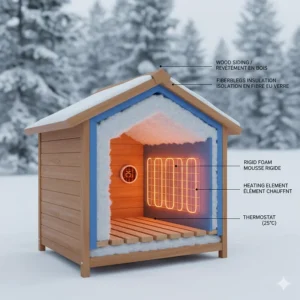
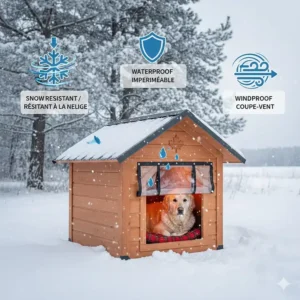
Modern heated outdoor dog houses use sophisticated thermostat technology vastly different from traditional space heaters. These systems employ internal sensors that detect your dog’s body temperature and ambient conditions, automatically adjusting heat output accordingly.
When your dog lies on a thermostatically controlled heating pad, the surface warms to approximately 102°F (39°C) – matching a dog’s natural body temperature. Once the set temperature is reached, the system reduces or stops heating, preventing overheating while conserving energy. When your pet moves away, the pad cools to just 10-15°F above ambient temperature, again saving electricity.
K&H Pet Products explains that MET-certified thermostatic heating pads undergo rigorous safety testing to ensure they never exceed safe temperatures. This technology is crucial in Canada, where outdoor temperatures can swing 40°C between day and night during shoulder seasons.
The key advantage over radiant heat lamps is direct contact heating. Pads transfer warmth through conduction, making them far more energy-efficient than trying to heat an entire enclosure with radiant elements. A quality 40-watt heated pad costs approximately $2-4 per month to operate continuously – less than most Canadians spend on daily coffee.
Energy-Efficient Heating Panels vs. Traditional Methods ⚡
Canadian winters are long, and heating costs matter. Let’s break down the energy consumption and cost comparison of different heating approaches for outdoor dog houses.
Energy-Efficient Heating Panels (20-60W):
- Monthly cost: $2-7 CAD (based on average Canadian electricity rates of $0.13/kWh)
- Heat distribution: Direct contact, minimal waste
- Safety features: Auto-shutoff, chew-resistant cords
- Lifespan: 5-10 years with proper maintenance
Traditional Heat Lamps (250W):
- Monthly cost: $30-40 CAD
- Heat distribution: Radiant (40-60% heat lost to air)
- Safety concerns: Fire hazard, no auto-shutoff
- Lifespan: 6-12 months (bulb replacement needed)
The mathematics are compelling. Over a 6-month Canadian winter (October-March), an energy-efficient heating panel costs approximately $12-42 CAD total. The same period with a heat lamp runs $180-240 CAD – nearly 15 times more expensive.
Beyond cost, safety certifications matter immensely. The Ontario SPCA emphasizes that improper heating equipment poses fire risks and can cause severe burns. MET and CSA-certified heating panels include automatic temperature regulation, preventing dangerous overheating that can occur with unregulated heat sources.
Modern ECO modes found in products like the PETNF heater reduce energy consumption by an additional 30%. The system “learns” your dog’s routine, heating only when sensors detect presence and ambient temperatures drop below the set threshold.
Insulated Dog House Construction: What Actually Works 🏗️
Not all insulation is created equal, especially when battling Canadian winters. Understanding R-values and material science can save you from purchasing inadequate shelters.
The Science of R-Values
R-value measures thermal resistance – higher numbers mean better insulation. Canadian building codes require walls to have R-values of 20-24 in most regions. While dog houses don’t follow the same codes, the principle remains: aim for maximum resistance to heat transfer.
Common Dog House Insulation Materials:
Styrofoam/EPS Foam (R-3.6 to R-4.0 per inch):
- Lightweight and affordable
- Water-resistant
- Common in products like Petmate Indigo
- Best for moderate climates (-10°C to -20°C)
High-Density Polyurethane Foam (R-6.0 to R-7.0 per inch):
- Found in premium models like Aivituvin
- Superior cold resistance
- More expensive but handles -30°C to -40°C
- Used in Aivituvin’s 6-sided liner design
Structural Foam Construction:
- Petmate Indigo uses this approach
- Entire shell acts as insulation (R-10 equivalent)
- Excellent for passive insulation without heating
- Dome shape minimizes heat loss through geometry
Six-Sided Insulation vs. Traditional Four-Wall Design
Traditional dog houses insulate four walls and sometimes the roof, leaving floors exposed. Heat rises, but in winter, cold radiates upward from frozen ground. The Canadian Food Inspection Agency notes that ground temperatures can be 10-15°C colder than air temperatures during winter months.
Six-sided insulation (walls, roof, AND floor) creates a complete thermal envelope. Products like the Aivituvin AIR7021 and MEDEHOO kennels employ this approach, using removable liners that cover all surfaces. The floor insulation is particularly critical – it prevents thermal bridging where heat escapes through direct contact with frozen ground.
Real-World Temperature Differences:
- Four-wall insulation: Interior 15-20°F above exterior
- Six-wall insulation: Interior 25-35°F above exterior
- Six-wall + heating pad: Interior maintains 50-70°F regardless of exterior conditions
For Canadian climates, six-sided insulation combined with even modest heating (20-40W) outperforms four-wall designs with powerful heaters. The insulation reduces heating demands, while the heater provides precise temperature maintenance.
Dog House Heater Safety Standards in Canada 🛡️
Safety certifications aren’t just bureaucratic stamps – they represent extensive testing that can prevent house fires, electrical shocks, and pet injuries. Canadian standards are among the strictest globally.
CSA (Canadian Standards Association) Certification
When shopping for heated dog products in Canada, look for the CSA mark. This certification indicates the product has been tested to Canadian electrical safety standards. According to CSA Group standards, certified products undergo:
- Thermal resistance testing (exposure to extreme heat)
- Flammability assessments
- Performance evaluation under stress conditions
- Factory audits for quality control
- Ongoing quarterly compliance inspections
Products without CSA certification may technically function, but they haven’t been verified for Canadian electrical standards. This matters for insurance purposes – some home insurance policies specifically exclude coverage for fires caused by non-certified electrical devices.
UL and MET Laboratory Certifications
While CSA is Canada-specific, UL (Underwriters Laboratories) and MET Laboratory certifications are recognized across North America. K&H Pet Products exclusively uses MET-certified products, which means:
- Testing to USA/CA electrical safety standards
- Two follow-up factory inspections annually
- Compliance with OSHA-approved testing protocols
- Coverage for both 110V and 120V systems
The critical distinction: a product might advertise “UL-listed components” while the complete assembly remains untested. Only purchase products where the entire unit carries MET, UL, or CSA certification – not just individual parts.
Essential Safety Features to Verify
Beyond official certifications, look for these built-in safety mechanisms:
Chew-Resistant Cords: Steel-wrapped or armoured cords prevent electrocution if your dog chews wiring. Products like K&H and PETNF include 6-6.5 foot metal-clad cords.
Automatic Shut-Off: Overheating protection that cuts power if temperatures exceed safe thresholds (typically 158°F/70°C for heating elements).
Ground Fault Protection: Essential for outdoor use. Ensures the unit shuts down immediately if water contact occurs.
Low-Voltage Options: Some newer models (like certain Aivituvin units) operate on 12V systems, dramatically reducing shock risk compared to 120V alternatives.
Best Heated Kennels for Extreme Canadian Cold (-30°C and Below) 🥶
Living in Yellowknife, Fort McMurray, or northern prairie regions where -40°C temperatures occur regularly? Your heating requirements differ drastically from moderate Canadian climates.
Calculating BTU Requirements for Extreme Cold
British Thermal Units (BTU) measure heating capacity. For doghouses, calculate needed BTUs using this formula:
BTU = (Desired temp – Ambient temp) × House volume (cubic feet) × 0.133
Example for a 40 cubic foot doghouse at -40°C (-40°F) maintaining 50°F (10°C):
- Temperature differential: 90°F
- 90 × 40 × 0.133 = 479 BTU/hour required
Most thermostatically controlled pads provide 60-100 BTU/hour. To handle extreme cold, you need either multiple heating sources or exceptional insulation that reduces actual heat loss.
Recommended Solutions for -30°C and Colder
1. MEDEHOO Triple-Layer + Dual Heating Pads ($379-429 CAD): Install two K&H 40W heated pads – one on the floor, one mounted on the sidewall. The triple insulation captures heat, while dual sources maintain consistent warmth even when your dog isn’t lying on one pad.
2. Aivituvin AIR80 + PETNF 500W Wall Heater ($619-738 CAD combined): Combine the well-insulated Aivituvin structure with a mounted wall heater. The 500W heater provides ambient heating, while the built-in floor pad offers direct warmth. This combination maintains 15-20°C interiors even at -45°C exterior temperatures.
3. Insulated Petmate Indigo + Thermal Barrier ($189-319 CAD + $50 materials): Wrap the Petmate dome in a reflective thermal barrier (like those used for camping), creating an air gap for additional insulation. Add a high-wattage heated pad. Northern Manitoba customers report this budget approach works surprisingly well, maintaining just-above-freezing temps in -35°C conditions.
Supplemental Insulation Techniques
Straw Bedding: The Ontario SPCA recommends straw (not hay, which moulds) as bedding. Straw creates air pockets that trap heat. Combine with heated pads for maximum efficiency.
Door Flaps: Heavy-duty vinyl or insulated fabric door flaps reduce heat loss by 40-60%. Ensure they’re not so heavy that your dog can’t push through easily.
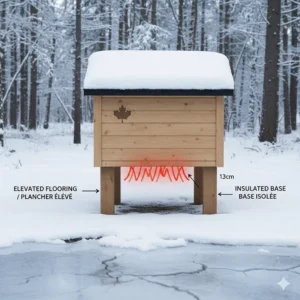
Elevated Platforms: Raise the entire structure 4-6 inches off frozen ground using treated lumber. This prevents ground-contact thermal bridging and allows air circulation underneath.
Windbreaks: Position houses with doors facing away from prevailing winds (typically northwest in most of Canada). Construct simple plywood or fence panel windbreaks on the weather side.
Choosing the Right Size Heated Dog House 📏
Bigger isn’t always better when it comes to heated dog shelters. Understanding proper sizing can mean the difference between efficient heating and wasted energy.
The Goldilocks Principle
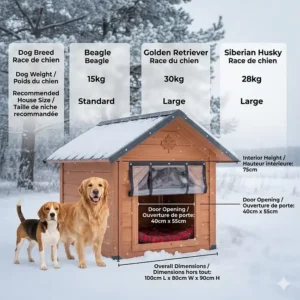
A doghouse should be large enough for your pet to stand up, turn around, and lie down comfortably – but not so large that their body heat can’t warm the space. Excessive volume requires more heating energy and reduces your dog’s natural ability to use body heat for warmth.
Measurement Guidelines:
Height: Measure your dog standing from paw to shoulder (not head). Add 3-4 inches. Example: A 24-inch-tall dog needs a 27-28 inch interior height.
Length: Measure your dog from nose to base of tail while lying down. Add 12 inches for stretching. Example: A 30-inch-long dog needs a 42-inch interior length.
Width: Measure shoulder width and multiply by 2.5. Example: An 18-inch-wide dog needs a 45-inch interior width.
Breed-Specific Recommendations
Small Breeds (Under 25 lbs – Terriers, Corgis, Beagles):
- K&H Outdoor Kitty House (19″x22″x17″)
- Aivituvin AIR73 Small (33.5″L)
- Interior volume: 4-8 cubic feet
Medium Breeds (25-60 lbs – Border Collies, Bulldogs, Cocker Spaniels):
- Petmate Indigo Medium (38″L x 33″W x 26″H)
- Aivituvin AIR74 Medium (43.3″L)
- Interior volume: 12-18 cubic feet
Large Breeds (60-90 lbs – Labs, Golden Retrievers, German Shepherds):
- Petmate Indigo Large (43.8″L x 34″W x 25.8″H)
- Aivituvin AIR7021 (55.9″L)
- MEDEHOO (48″L)
- Interior volume: 20-30 cubic feet
Giant Breeds (90+ lbs – Great Pyrenees, Newfoundlands, Mastiffs):
- Petmate Indigo XL (51.5″L x 39.3″W x 30″H)
- Aivituvin AIR80 (50.9″L)
- Custom-built solutions with add-on heating
- Interior volume: 35-50 cubic feet
Multiple Dog Considerations
For households with multiple outdoor dogs, separate houses often work better than one large structure. Dogs generate body heat, but they also require personal space. Two dogs in properly-sized individual heated houses will be warmer and more comfortable than two dogs sharing an oversized unit.
If you must house multiple dogs together, ensure the structure accommodates each dog’s individual measurement calculations separately, then add 20% for spacing. Two 50-lb dogs need approximately 40-45 cubic feet combined, not 25-30.
Installation and Placement Best Practices 🧭
Even the best heated dog house fails if poorly positioned. Strategic placement and proper installation dramatically improve performance and safety.
Optimal Positioning Strategies
Wind Direction: In most of Canada, prevailing winter winds blow from the northwest. Position the entrance facing southeast or east. This blocks cold winds while allowing morning sunlight to naturally warm the entrance area.
Elevation: Raise the structure 4-6 inches above ground using treated lumber blocks, pavers, or purpose-built platforms. This prevents:
- Ground moisture from seeping into flooring
- Snow accumulation blocking the entrance
- Thermal bridging with frozen ground
- Pest intrusion from below
Sunlight Exposure: Morning and midday sun exposure helps with passive solar heating. However, avoid full south-facing positions in regions with intense summer sun – you’ll need year-round shelter, not just winter protection.
Drainage: Place houses on slight grades (1-2 degree slope) so melting snow and rain drain away from the entrance. Never position shelters in low-lying areas where water pools during thaws.
Electrical Safety Requirements
GFCI Outlets: All outdoor electrical connections MUST use Ground Fault Circuit Interrupter outlets. These shut down power within milliseconds if water contact occurs. According to Travel.gc.ca guidelines, this protection is non-negotiable for pet safety.
Weatherproof Covers: Use outdoor-rated outlet covers (the flip-up type that seals when not in use). Canadian winters bring freezing rain, blowing snow, and extreme conditions that can damage standard indoor outlets.
Extension Cord Prohibition: Most MET-certified products explicitly warn against extension cord use. If the dog house is too far from an outlet, install a dedicated outdoor outlet. Extension cords create voltage drops and connection points where moisture can cause shorts.
Cord Protection: Route power cords through PVC conduit where possible. Bury underground portions 12-18 inches deep. Surface portions should be secured out of paw reach and protected from snow shovel damage.
Seasonal Adjustments
Winter Configuration:
- Install door flaps for draft protection
- Add straw bedding above heated pads
- Position windbreak materials on prevailing wind sides
- Check insulation monthly for settling or gaps
Summer Configuration:
- Remove or unplug heating elements
- Open ventilation if applicable
- Remove heavy winter door flaps
- Ensure adequate shade coverage prevents overheating
Maintenance and Troubleshooting Guide 🔧
Proper maintenance extends the lifespan of your heated outdoor dog house and ensures safe operation throughout Canadian winters.
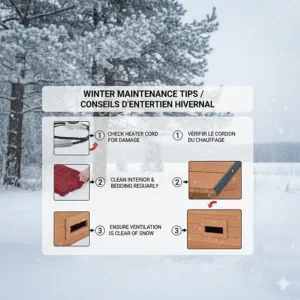
Monthly Inspection Checklist
Heating Element Testing: Plug in the system and verify warmth after 15-30 minutes. Thermostatically controlled pads may feel only slightly warm to the touch when unoccupied – this is normal. Place your hand on the surface for 30 seconds; you should feel noticeable warmth.
Cord Inspection: Check the entire length for:
- Chew marks or exposed wiring
- Cracks in insulation (common in extreme cold)
- Secure connections at both plug and unit
- No kinks or sharp bends
Insulation Integrity: Remove liners (if applicable) and inspect for:
- Moisture buildup or dampness
- Compressed or settled areas
- Tears, rips, or missing sections
- Mould or mildew growth
Structural Soundness: Examine wood for rot, metal for rust, and plastic for cracks. Canadian freeze-thaw cycles stress materials. Apply weatherproof sealant to any compromised areas immediately.
Common Issues and Solutions
Problem: Heater Not Warming
- Check GFCI hasn’t tripped (reset button on outlet)
- Verify thermostat settings (some have seasonal adjustments)
- Ensure dog’s weight activates pressure-sensitive pads
- Test outlet with a different device to rule out power issues
Problem: Excessive Energy Bills
- Non-thermostatically controlled heaters run constantly
- Upgrade to MET-certified thermostatic models
- Add additional insulation to reduce heating demand
- Check for air leaks around doors/seams and seal with weatherstripping
Problem: Condensation Inside House
- Indicates poor ventilation despite heating
- Add small roof vent (1-2 inch diameter)
- Ensure drainage channels aren’t blocked
- Reduce heating slightly to decrease humidity buildup
Problem: Dog Won’t Use Heated House
- Temperature may be too warm (dogs prefer cool-to-moderate)
- Place treats or familiar bedding inside
- Gradually introduce over several days
- Ensure entrance isn’t intimidating (remove heavy door flaps temporarily)
Cleaning and Sanitization
Heated Pad Care: Most heated pads should NOT be machine washed. Instead:
- Unplug and let cool completely
- Wipe with damp cloth and pet-safe disinfectant
- Air dry thoroughly before reconnecting
- Removable covers CAN be machine washed (check labels)
Structure Cleaning: Quarterly deep cleaning prevents bacteria and parasite buildup:
- Remove all bedding and liners
- Vacuum debris and cobwebs
- Wash walls with pet-safe cleaner (vinegar and water solution works well)
- Disinfect with diluted bleach (1:32 ratio) if needed
- Air out completely before reassembling
Cost Analysis: Initial Investment vs. Long-Term Savings 💰
Understanding the true cost of heated outdoor dog houses requires looking beyond sticker prices. Let’s break down real Canadian costs over a typical 5-year ownership period.
Total Cost of Ownership Comparison
Budget Approach: Petmate Indigo + K&H Heated Pad
- Initial cost: $189.99 (Indigo Medium) + $79.99 (K&H pad) = $269.98
- Monthly electricity (Oct-Mar, 6 months): $3/month × 6 = $18/year
- 5-year electricity cost: $90
- Replacement pad (year 6): $79.99
- Total 5-year cost: $439.97
Mid-Range: Aivituvin AIR7021 Heated House
- Initial cost: $449.99
- Monthly electricity: $4/month × 6 = $24/year
- 5-year electricity cost: $120
- Maintenance/liner cleaning: $40 over 5 years
- Total 5-year cost: $609.99
Premium: Aivituvin AIR80 + PETNF 500W
- Initial cost: $499.99 + $179.99 = $679.98
- Monthly electricity: $8/month × 6 = $48/year (higher wattage)
- 5-year electricity cost: $240
- WiFi connectivity/app (no extra cost)
- Total 5-year cost: $919.98
Hidden Savings Considerations
Veterinary Costs Avoided: According to the Canadian Veterinary Medical Association, treating frostbite, hypothermia, and cold-related illnesses can cost $300-1,500 per incident. A single emergency vet visit for cold exposure more than pays for a quality heated shelter.
Reduced Indoor Heating Demands: Dogs accustomed to warm homes require more indoor time during winter, increasing home heating costs. Outdoor dogs comfortable in properly heated shelters reduce household heating demands by 3-7% based on usage patterns.
Extended Structure Lifespan: Quality heated houses with proper insulation last 8-12 years versus 3-5 years for basic shelters. Amortized over time, the premium models actually cost less per year than repeatedly replacing budget options.
Heated Dog House vs. Indoor Alternatives: When Each Makes Sense 🏠
Not every dog should live outdoors, even in a heated shelter. Understanding which situations justify outdoor housing helps ensure your pet’s safety and wellbeing.
Dogs Well-Suited for Heated Outdoor Houses
Working Dogs: Livestock guardians, farm dogs, and sled dogs often prefer outdoor living. Breeds like Great Pyrenees, Maremmas, and Huskies have been selectively bred for outdoor work and tolerate cold exceptionally well.
Double-Coated Breeds in Moderate Climates: Bernese Mountain Dogs, Newfoundlands, and similar breeds often overheat indoors during Canadian winters when homes are heated to 20°C. They’re more comfortable in well-insulated outdoor shelters maintained at 5-10°C.
Large Property Guardians: Dogs protecting acreages need outdoor access 24/7. Heated houses provide safe rest areas between patrol rounds.
Dogs That MUST Live Indoors
Small or Toy Breeds: Chihuahuas, Yorkshire Terriers, and similar breeds lack sufficient body mass to generate adequate heat. Even heated shelters pose risks below -5°C.
Short-Coated Breeds: Greyhounds, Whippets, Boxers, and Pit Bulls have minimal insulation. Their coats evolved for warm climates, making them unsuitable for Canadian outdoor living.
Senior Dogs: Arthritis, reduced circulation, and weakened immune systems make elderly dogs vulnerable to cold regardless of breed. Dogs over 10 years generally shouldn’t live outdoors in winter.
Puppies Under 6 Months: Developing immune systems and incomplete coat development leave puppies dangerously vulnerable. Even heated shelters can’t compensate for their physiological limitations.
Dogs with Health Conditions: Diabetes, Cushing’s disease, hypothyroidism, heart conditions, and kidney disease all impair temperature regulation. These dogs need indoor living with veterinary oversight.
The Hybrid Approach
Many Canadian dog owners successfully use a hybrid model: daytime outdoor access with indoor overnight stays. This works well for:
- Active breeds needing extensive exercise
- Dogs who become destructive when under-exercised
- Families with large yards but limited indoor space
- Transitioning older outdoor dogs to indoor living
Heated outdoor houses serve as daytime retreats and emergency shelters in this model. The dog gets outdoor freedom during active hours while benefiting from household warmth during sleep.
FAQ: Your Heated Dog House Questions Answered ❓✅
❓ How cold is too cold for a dog in a heated dog house?
❓ Are heated dog houses safe to leave running 24/7 in Canada?
❓ What's the best heated dog house for extreme cold in Northern Canada?
❓ Can I use a space heater instead of a dog-specific heating system?
❓ How much does it cost to heat an outdoor dog house in Canada for winter?
Conclusion: Investing in Your Dog’s Winter Comfort and Safety 🌟
Choosing the right heated outdoor dog house represents one of the most impactful decisions you’ll make for your dog’s health and comfort during brutal Canadian winters. As we’ve explored through seven top-rated products, multiple insulation technologies, and comprehensive safety considerations, the perfect solution depends on your specific circumstances – your dog’s breed and size, your regional climate, your budget, and your property setup.
For most Canadian dog owners, the Aivituvin AIR7021 Heated Dog House ($399-499 CAD) strikes the ideal balance. Its six-sided insulation, metal frame construction, and built-in thermostatically controlled heating pad handle everything from Vancouver’s wet cold to Calgary’s dry freeze. Budget-conscious families in moderate climates will find the Petmate Indigo combined with a K&H Heated Pad ($270-320 CAD total) delivers exceptional value and decades-proven reliability.
Those facing extreme northern conditions should seriously consider the MEDEHOO Triple-Layer system or the Aivituvin AIR80, potentially paired with supplemental heating. The higher upfront investment ($459-738 CAD) pays dividends through superior cold protection and reduced veterinary bills from prevented cold-related illnesses.
Remember that a heated dog house is just one component of comprehensive winter pet care. Regular monitoring for frostbite signs, ensuring fresh unfrozen water access, and providing adequate nutrition (dogs need 10-20% more calories in cold weather) all contribute to your pet’s winter wellbeing. The Ontario SPCA and Canadian Veterinary Medical Association provide excellent supplementary resources for holistic cold-weather pet care.
Before making your purchase, verify CSA or MET safety certifications, calculate your heating requirements based on local climate data, and honestly assess whether your dog’s breed, age, and health profile make them suitable for outdoor winter living. When properly selected, installed, and maintained, a quality heated outdoor dog house transforms from a simple shelter into a cozy winter sanctuary where your loyal companion can safely weather even the harshest Canadian storms.
Your dog depends on you for protection against the elements. Choose wisely, install properly, and maintain diligently – their comfort and potentially their life depend on it.
Recommended for You 📚
- 7 Best Dog Bed for Chewers Canada 2026
- 7 Best Small Dog Beds for Chihuahua Canada 2026
- 7 Best Elevated Dog Bed Outdoor Options for Canadian Pets 2026
Disclaimer: This article contains affiliate links to Amazon.ca. If you purchase products through these links, we may earn a small commission at no additional cost to you.
✨ Found this helpful? Share it with your friends! 💬🤗
