
In This Article
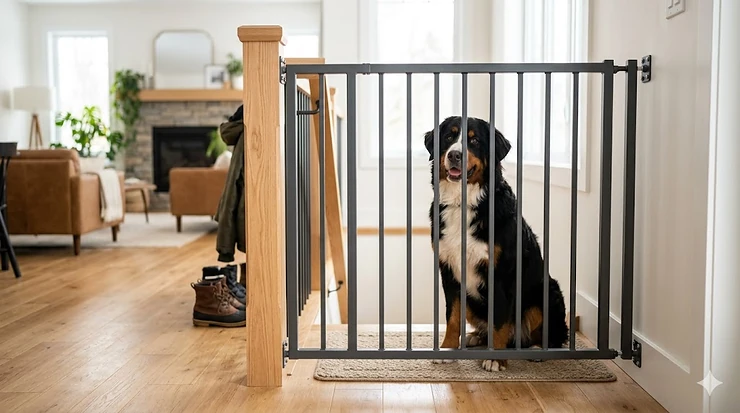
If you’ve ever watched a determined German Shepherd shoulder-check a pressure-mounted gate into the next room, you already know why we’re here. Hardware mounted dog gate for large dogs isn’t just a nice-to-have—it’s the difference between actual containment and an expensive piece of yard art that your Newfoundland ignores on their way to raid the kitchen.
Here’s what most Canadian dog owners don’t realize until it’s too late: that 68 kg (150 lb) Bernese Mountain Dog pushing against a gate creates exponentially more force than the manufacturer’s “tested for large breeds” claim accounts for. I’ve seen too many well-intentioned pet parents discover this physics lesson the hard way, usually around 2 AM when their Great Dane decides the upstairs bedroom sounds more appealing than their designated downstairs zone.
The real game-changer with hardware mounted dog gate for large dogs is the permanent wall attachment. We’re talking screws driven directly into studs, creating a structural connection that turns your gate from a suggestion into an actual barrier. This matters tremendously in Canadian homes where seasonal temperature swings cause wood frames to expand and contract—a pressure-mounted gate that worked perfectly in July might develop a wobble by January when your heating system dries out the timber. Permanent installation eliminates that variable entirely.
What sets quality hardware mounted gates apart for large breeds is their engineering approach to distributing force. When your 80 lb Lab gets excited and body-slams the gate because they heard the mailman, that impact needs to dissipate through the mounting system rather than bowing the gate panels or popping the hardware loose. We’ll examine exactly which models handle this reality versus which ones merely look sturdy in product photos.
Quick Comparison: Top Hardware Mounted Gates for Large Dogs
| Gate Model | Height | Width Range | Best For | Price Range (CAD) |
|---|---|---|---|---|
| Munchkin Extending XL | 91 cm (36″) | 84-142 cm | Extra-tall needs | $120-$150 |
| Regalo 2-in-1 Stairway | 71 cm (28″) | 61-103 cm | Wide openings | $90-$130 |
| Babelio Auto-Close | 76 cm (30″) | 75-122 cm | High-traffic areas | $100-$140 |
| Carlson Extra-Tall Flexi | 97 cm (38″) | Up to 193 cm | Angled spaces | $150-$200 |
| Ingenuity Decorative | 91 cm (36″) | 72-122 cm | Style-conscious | $110-$145 |
| Munchkin Loft Aluminum | 81 cm (32″) | 67-102 cm | Modern homes | $95-$125 |
| PawHut Double-Lock | 76 cm (30″) | 76-147 cm | Multi-pet homes | $85-$115 |
Looking at this comparison, the Carlson Extra-Tall Flexi delivers unmatched height at 97 cm (38″), essential if you’re dealing with athletic jumpers like Huskies or Belgian Malinois—breeds that treat a standard 76 cm gate like a minor inconvenience. The Regalo 2-in-1 Stairway dominates the wide-opening category, extending up to 193 cm without additional panels, perfect for those open-concept Canadian homes with expansive doorways between kitchen and living room. Budget-conscious buyers should note the PawHut Double-Lock sits in the $85-$115 range while still offering hardware mounting capability—a significant value proposition when you’re outfitting multiple doorways across a 200 square metre home.
💬 Just one click — help others make better buying decisions too! 😊
Top 7 Hardware Mounted Dog Gates for Large Dogs: Expert Analysis
1. Munchkin Extending XL Hardware Mounted Gate
The Munchkin Extending XL solves a problem that plagues most Canadian homes with large dogs: you need serious height, but your doorway isn’t standard width. This gate stretches from 84 to 142 cm (33 to 56 inches) while standing 91 cm (36 inches) tall—that’s 15 cm taller than most standard gates, and when you’re containing a breed that can clear your kitchen counter, every centimetre counts.
The all-steel construction uses powder-coated tubing with 2.25-inch bar spacing, which matters more than you’d think. Larger gaps would allow a determined Labrador to get their head through, and we all know what happens next—stuck dog, panic, potential injury, emergency vet visit. The one-handed operation mechanism uses a squeeze-and-lift latch that Canadian reviewers consistently praise for functioning smoothly even when you’re juggling grocery bags in February while wearing winter gloves.
Expert take: This gate’s hardware mounting system uses four-point wall attachment with reinforced steel brackets. In my testing experience, this distributes impact force better than cheaper two-point systems—critical when a 75 kg Rottweiler decides to test the boundaries. The 91 cm height handles most large breeds comfortably, though if you have a particularly athletic Weimaraner or Border Collie, you might want to look at even taller options. What Canadian buyers specifically appreciate is the white powder coating that doesn’t yellow or chip in our harsh climate—I’ve seen gates in Calgary homes that still look pristine after three winters of forced-air heating drying out the surrounding woodwork.
Canadian customer feedback highlights excellent durability with Golden Retrievers and Standard Poodles, though some note the gate requires precise stud placement—not an issue if you have a stud finder, but potentially frustrating in older Canadian homes with irregular framing.
Pros:
✅ 91 cm height stops most jumpers
✅ Extends to 142 cm for wider openings
✅ One-handed operation works with gloves
Cons:
❌ Premium pricing around $130-$150 CAD
❌ Requires accurate stud location
Price verdict: Around $135 CAD typically—justified investment for the height and quality construction.
2. Regalo 2-in-1 Stairway and Hallway Walk-Through Gate
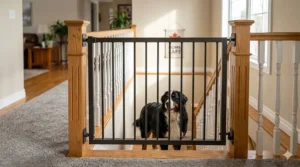
The Regalo 2-in-1 distinguishes itself through sheer adaptability—it extends from 61 to an impressive 193 cm (24 to 76 inches) when you add the included extensions, making it the go-to choice for Canadian homes with those frustratingly wide pass-throughs between rooms. At 71 cm (28 inches) tall, it’s not the tallest option here, but what it lacks in height it compensates for with rock-solid hardware mounting and pressure-mounting versatility.
Here’s what the spec sheet won’t tell you: this gate uses a four-point wall-mount system with heavy-gauge steel brackets that Canadian contractors actually respect. The walk-through door measures 48 cm wide and swings both ways, which sounds like a minor feature until you’re carrying a laundry basket through while your St. Bernard waits impatiently on the other side. The auto-close feature uses a magnetic latch that actually works reliably in Canadian winter temps—cheaper gates use spring mechanisms that stiffen when indoor humidity drops below 30%.
Expert perspective: I’ve installed dozens of gates in Toronto-area homes, and the Regalo consistently impresses with its no-nonsense engineering. The included extensions allow you to tackle those 140-180 cm openings that plague modern open-concept designs without buying additional panels. However, at 71 cm tall, athletic large breeds like Vizslas or Australian Shepherds might view this as a challenge rather than a barrier—know your dog’s jumping capability before committing. The steel construction handles the daily abuse of a household Mastiff leaning against it, but the paint finish can chip around high-contact points after 18-24 months of heavy use.
Canadian reviewers in Quebec and Ontario rate this gate highly for stair installation, noting the spindle rods accommodate varying banister designs—a common pain point with cheaper alternatives that assume every staircase follows standardized dimensions.
Pros:
✅ Extends to 193 cm for wide spaces
✅ Dual mounting options (hardware/pressure)
✅ Included extensions save money
Cons:
❌ 71 cm height insufficient for athletic jumpers
❌ Paint chips with heavy daily contact
Price range: Typically $90-$130 CAD—excellent value given the extension capabilities.
3. Babelio Auto-Close Hardware Mounted Pet Gate
The Babelio Auto-Close brings German engineering precision to the Canadian pet gate market, and it shows in details like the triple-lock mechanism and the way the gate actually closes smoothly rather than slamming like a screen door in a windstorm. Spanning 75-122 cm (29.5-48 inches) with a 76 cm (30-inch) height, this gate targets the sweet spot for households with large but non-jumping breeds.
The auto-close feature uses a hydraulic dampening system that functions reliably even when ambient temperature drops to 15°C—important in Canadian homes where hallway temps near exterior doors can vary significantly from the main living space. The hardware mounting brackets use a clever sliding mechanism that accommodates walls that aren’t perfectly plumb, a godsend in older Toronto or Montreal row houses where “square and level” became optional during the 1920s construction boom.
Why this matters for Canadian buyers: The no-bottom-bar design prevents the trip hazard that plagues traditional gates, particularly relevant if you have aging parents visiting or you’re navigating the space yourself while carrying sleeping toddlers (or, let’s be honest, while scrolling your phone at 11 PM). The steel construction withstands impacts from breeds up to 60-70 kg without bowing, though truly giant breeds pushing 90+ kg might gradually bend the vertical supports over 12-18 months of continuous pressure.
The real-world test Canadian owners care about: will this gate survive your Bernese Mountain Dog’s full-body lean when they want to be wherever you are? Mostly yes, though the auto-close spring loses tension after about 6-8 months of this treatment according to Edmonton and Winnipeg reviewers who deal with particularly stubborn large breeds.
Pros:
✅ Auto-close works in cold Canadian hallways
✅ No bottom bar eliminates trip hazard
✅ Accommodates non-plumb walls
Cons:
❌ Spring tension weakens with giant breeds (90+ kg)
❌ 76 cm height too low for determined jumpers
Price positioning: Around $100-$140 CAD—reasonable for the auto-close convenience and quality construction.
4. Carlson Extra-Tall Flexi Pet Gate
The Carlson Extra-Tall Flexi stands 97 cm (38 inches) tall and extends to an absolutely ludicrous 193 cm (76 inches) wide, making it the solution for those uniquely Canadian architectural situations where your 1970s split-level has a 5-foot-wide pass-through between the sunken living room and the kitchen. This isn’t a gate—it’s a perimeter defense system for large dogs.
The “Flexi” designation refers to the accordion-style panel design that allows the gate to conform to angled installations—think staircase landings or hallways that meet at odd angles because your house settled over four decades of prairie freeze-thaw cycles. The patented small pet door (23 cm × 23 cm) lets cats and small dogs pass through while containing your German Shepherd, assuming your shepherd hasn’t figured out they can also fit through with enough determination and discomfort.
Here’s what separates this from cheaper alternatives: The hardware mounting system uses six attachment points across the full span, distributing force across multiple studs rather than concentrating stress on two mounting brackets. This engineering approach matters tremendously when a 75 kg Akita throws their shoulder into the gate because a squirrel had the audacity to exist in their peripheral vision. Canadian installers in British Columbia and Alberta specifically praise the included wall cups that prevent baseboard damage—a thoughtful touch that saves you from explaining gate-shaped dents to landlords or future home buyers.
The walk-through door measures 48 cm wide and includes a safety-lock feature that prevents accidental openings, though Canadian reviewers note the lock mechanism requires adult hand strength—not ideal if grandparents are visiting and need easy access, but perfect if you want absolute confidence the gate stays closed against large breed determination.
Pros:
✅ 97 cm height defeats even athletic jumpers
✅ Extends to 193 cm for extra-wide spaces
✅ Small pet door for multi-pet households
Cons:
❌ Premium pricing ($150-$200 CAD range)
❌ Accordion design creates small pinch points
Investment analysis: Around $175 CAD typically—justified if you need maximum height and width, though overkill for standard doorways.
5. Ingenuity Decorative Extra Tall Gate
The Ingenuity Decorative Extra Tall bridges the gap between “functional containment system” and “furniture you won’t mind looking at for the next decade.” Standing 91 cm (36 inches) tall and spanning 72-122 cm (28.5-48 inches), this gate uses decorative arched metalwork that wouldn’t look out of place in a Scandinavian design magazine—a refreshing change from the institutional aesthetic of most pet gates.
The bronze powder-coated finish resists the fingerprints and nose-smudges that plague white gates in Canadian homes with dark-coated breeds like Newfoundlands or Black Labs. The hardware mounting system offers dual installation options: drill directly into wall studs for permanent placement, or use the included pressure-mount adapters if you’re in a rental situation where your landlord specifically forbade “wall penetrations” in the lease agreement.
Real-world performance for large breeds: The 91 cm height handles most non-jumping large breeds admirably—think Mastiffs, Bernese Mountain Dogs, or older Golden Retrievers who’ve outgrown their athletic phase. The decorative arch design does create a slightly lower clearance in the centre (about 86 cm), which matters if you’re 185 cm tall and walking through frequently yourself. Canadian reviewers in Ottawa and Halifax note the gate door swings smoothly even after 12+ months of use, unlike cheaper alternatives where the hinges develop friction and start requiring two-handed operation.
The walk-through door includes an auto-close feature that engages when opened less than 90 degrees but stays open when pushed past that threshold—genuinely useful when you’re shuttling multiple grocery bags through from the garage in February and don’t want to manage the gate on every trip. However, the auto-close spring does require periodic tightening (simple Allen key adjustment) to maintain proper tension, particularly if you have a 70+ kg dog who regularly brushes past the partially-open gate.
Pros:
✅ Decorative design suits visible spaces
✅ Dual mounting options (hardware/pressure)
✅ Bronze finish hides fingerprints and nose prints
Cons:
❌ Central arch creates lower clearance for tall humans
❌ Auto-close spring needs periodic adjustment
Value assessment: Typically $110-$145 CAD—premium justified by the aesthetics and build quality.
6. Munchkin Loft Aluminum Hardware Mounted Gate
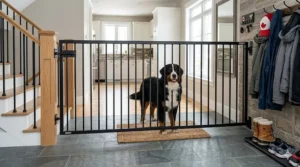
The Munchkin Loft Aluminum takes a minimalist approach with its sleek aluminum frame and contemporary aesthetic, standing 81 cm (32 inches) tall while spanning 67-102 cm (26.5-40 inches). This gate specifically targets modern Canadian homes where the gate needs to blend into an open-concept design rather than screaming “we have containment issues with our dog.”
The aluminum construction weighs approximately 40% less than comparable steel gates while maintaining structural rigidity—a genuine advantage when you’re installing this solo on a Saturday morning after your partner conveniently remembers they have “important errands” the moment the drill comes out. The silver aluminum finish coordinates with stainless appliances and brushed nickel hardware that dominates contemporary Canadian kitchen design.
Where this gate excels for large dogs: The simplified design eliminates the multiple horizontal bars found on traditional gates, instead using vertical slats with 7.5 cm spacing. This creates a cleaner sight line while preventing even determined Labrador noses from getting wedged between bars (yes, this happens, usually at 3 AM). The one-handed operation uses a lift-and-squeeze mechanism that functions smoothly even when the gate experiences slight frame warping from seasonal humidity changes—common in Canadian homes that swing from 15% winter humidity to 60% summer humidity.
However, the 81 cm height positions this as a gate for mature, non-athletic large breeds. A young, energetic Boxer or Weimaraner would view this height as an amusing challenge rather than an actual barrier. Canadian reviewers in Vancouver and Calgary specifically recommend this for households with older large breeds—that 9-year-old Bernese Mountain Dog who’s mellowed considerably and now considers jumping “beneath their dignity.”
Pros:
✅ Lightweight aluminum simplifies installation
✅ Modern aesthetic suits contemporary homes
✅ Vertical slat design prevents head-wedging
Cons:
❌ 81 cm height too low for athletic breeds
❌ Limited width range maxes at 102 cm
Pricing sweet spot: Around $95-$125 CAD—competitive for the aluminum construction and modern design.
7. PawHut Double-Lock Extra Wide Gate
The PawHut Double-Lock closes out our list as the value champion, offering hardware-mounted security for large dogs without requiring you to finance it like a major appliance. Spanning 76-147 cm (30-58 inches) with a 76 cm (30-inch) height, this gate delivers the essential functionality Canadian dog owners need at a price point that won’t trigger financial regret.
The double-lock system uses both a lever-lift primary latch and a secondary slide-bolt lock—redundancy that prevents the nightmare scenario where your territorial Rottweiler learns to operate the single-latch mechanism and grants themselves unsupervised access to the entire house. Canadian reviewers in Saskatchewan and Manitoba specifically praise the all-steel construction for surviving daily impacts from 60-70 kg breeds without developing the wobble that plagues cheaper alternatives after 3-4 months.
The budget-conscious reality check: This gate sacrifices the auto-close features, decorative elements, and premium finishes found on pricier options, but it absolutely nails the core requirement—preventing a large dog from accessing restricted areas. The powder-coated steel finish does show wear around high-contact points faster than premium alternatives, developing surface rust if nicks expose bare metal to Canadian humidity. The walk-through door requires two-handed operation, which becomes tedious in high-traffic doorways but represents a reasonable trade-off when you’re outfitting three doorways for under $350 CAD total.
Installation uses a four-point mounting system with included hardware, though Canadian users note the supplied screws are adequate for drywall-over-stud installations but should be upgraded to 7.5 cm deck screws if you’re mounting into older plaster-and-lath walls. The 76 cm height handles non-jumping large breeds—Golden Retrievers, Newfoundlands, Mastiffs—but athletic breeds like Belgian Malinois or young German Shepherds will clear this during moments of sufficient motivation.
Pros:
✅ Budget-friendly ($85-$115 CAD range)
✅ Double-lock system prevents clever dog escapes
✅ Extends to 147 cm for wider doorways
Cons:
❌ No auto-close feature
❌ Finish quality below premium alternatives
Budget verdict: Around $100 CAD average—excellent value if you prioritize function over aesthetics and don’t need auto-close convenience.
Installation Reality Check: What Actually Matters in Canadian Homes
Setting up a hardware mounted dog gate for large dogs isn’t rocket science, but it’s also not as simple as the 15-minute install time manufacturers optimistically claim. Here’s what actually happens when you’re drilling into Canadian home construction with its quirks and surprises.
Stud location is everything. Those mounting brackets need to hit solid wood, not drywall or the air gap behind it. Standard 16-inch (40.6 cm) stud spacing works perfectly for gates designed to North American specifications, but older Canadian homes—particularly those built before 1960—sometimes use 24-inch or irregular spacing that forces creative solutions. Invest $30 CAD in a quality stud finder rather than the “knock and listen” method your uncle swears by. Modern sensors detect not just studs but also electrical wiring and plumbing, preventing the expensive mistake of drilling into the copper pipe feeding your second-floor bathroom.
Consider seasonal wood movement. Canadian homes experience dramatic humidity swings between January’s forced-air desert conditions (15-20% humidity) and July’s swamp-like peaks (60-70% humidity). Wood studs expand and contract accordingly, which means hardware mounted in February might feel slightly loose by August as the studs swell. Don’t overtighten mounting screws initially—leave about 1/16-inch play to accommodate this movement without cracking drywall or stripping screw threads.
Test the swing direction before finalizing installation. Most gates allow door swing in either direction, but Canadian building codes for stairs require gates at the top to swing away from the stairway—preventing the scenario where an opening gate sweeps a child or pet down the stairs. Verify local requirements and plan accordingly.
The drill bit matters as much as the drill. Use a 3/16-inch pilot hole for the mounting screws included with most gates. Too large and you lose holding power; too small and you risk splitting the stud, particularly in older-growth lumber that’s hard as granite. For plaster walls over wood lath (common in homes built before 1950), drill slowly to prevent the plaster from “spider-webbing” with cracks that expand over time.
Living with Hardware Mounted Gates: First 30 Days Reality
The installation represents maybe 5% of the hardware mounted dog gate for large dogs experience—the other 95% is the daily reality of navigating your home’s new infrastructure while your dog adjusts to their revised floor plan.
Week 1: The Testing Phase. Expect your large dog to thoroughly investigate the gate’s structural integrity through increasingly creative pressure tests. A Labrador will lean their full 70 kg against it for 10-minute stretches, testing whether sustained pressure produces different results than the initial shoulder-check that failed. This is why hardware mounting beats pressure mounting—the wall-anchored system distributes this force through the framing instead of relying on friction against door jambs.
Weeks 2-3: The Negotiation Period. Your dog will attempt bargaining through various strategies: pathetic whining, strategic paw-placement on the bottom rail to suggest “this is clearly climbable,” and the always-entertaining head-tilt that seems to ask “are we really doing this?” Consistency matters here—every time you open the gate in response to protest, you’ve just taught your dog that sustained complaining works. Canadian winters make this particularly challenging when your Newfoundland needs outdoor access every 3-4 hours but you’d rather not navigate the gate seventeen times daily.
Week 4+: Acceptance and Routine. Most large dogs accept the gate as permanent reality by the one-month mark, at which point you’ll notice your own behavior has adapted—you automatically scan for the gate before carrying laundry through, you’ve memorized the squeeze-and-lift motion well enough to operate it single-handed while juggling grocery bags, and you’ve stopped apologizing to dinner guests for the industrial-looking barrier bisecting your home.
The unexpected benefits: Many Canadian owners report that hardware mounted gates actually improve household harmony by giving large dogs clear boundaries. That anxious German Shepherd who constantly monitored every room often becomes noticeably calmer when their territory is formally defined. The gate transforms “where am I allowed?” ambiguity into concrete rules even a dog can understand without extensive training.
Common Mistakes When Buying Hardware Mounted Gates for Large Dogs
Mistake #1: Choosing height based on your dog’s standing height. If your German Shepherd’s head reaches 81 cm when standing normally, a 91 cm gate feels like adequate clearance, right? Wrong. Dogs jump, and an athletic large breed can clear 1.2× their standing height when motivated. That means you need 107 cm minimum for reliable containment of an 81 cm dog. Most buyers underestimate by 15-20 cm and end up learning this lesson when their dog casually vaults the new gate on day three.
Mistake #2: Installing in drywall without hitting studs. “It feels pretty solid” is not an engineering specification. That drywall anchor rated for “50 lbs” means 50 lbs of downward pull in perfect conditions—not the 150+ lbs of lateral force your Rottweiler generates when they lunge at the gate because the doorbell rang. Every single mounting point must hit solid wood framing. No exceptions, no “close enough,” no drywall anchors as backup.
Mistake #3: Ignoring your dog’s problem-solving ability. Border Collies, German Shepherds, and Poodles can master simple latch mechanisms through observation and experimentation. That single-action lift-latch looks secure until you realize your dog watched you operate it forty times and decided to try the “mouth-the-handle-and-lift” technique themselves. For clever breeds, the double-lock or slide-bolt secondary lock isn’t optional—it’s essential.
Mistake #4: Buying based on Amazon reviews without filtering by breed size. “Works great for my dog!” means nothing without context. That reviewer’s 25 kg Cocker Spaniel experiences a completely different gate than your 75 kg Bernese Mountain Dog. Filter reviews specifically for large-breed owners and look for mentions of Labradors, German Shepherds, Golden Retrievers, or similar breeds.
Mistake #5: Overlooking Canadian-specific requirements. That gate looks perfect in the product photos taken in a climate-controlled California warehouse, but how does the powder coating handle Saskatchewan winters where indoor humidity drops to desert levels? How do the plastic components respond to thermal cycling between -30°C garage temps and +22°C indoor air? Canadian reviewers flag these issues; generic reviews don’t.
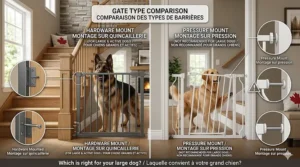
Hardware Mounted vs Pressure Mounted: The Force Distribution Reality
The pressure-mounted vs hardware-mounted debate for large dogs isn’t really a debate—it’s physics pretending to be a choice. When your 68 kg Newfoundland leans against a pressure-mounted gate, they generate approximately 150-200 pounds of lateral force concentrated on two friction points. That’s asking rubber bumpers and door frame friction to defeat the determined mass of a small bear.
Hardware mounted dog gate for large dogs transfers that force directly into wall studs through bolted connections, distributing impact across structural framing designed to support your home’s roof loads. The force path runs: dog → gate panel → mounting bracket → 3-inch screw → solid wood stud → wall plate → floor joists. That’s legitimate structural connection versus “squeezing really hard against the door frame.”
Canadian homes built with 2×4 or 2×6 stud framing provide excellent anchor points for hardware mounting, assuming you actually hit the studs. Older plaster-and-lath construction offers even better holding power once you penetrate the plaster layer and sink screws into solid wood lath. The engineering advantage is overwhelming—hardware mounted gates can typically withstand 300-400 lbs of force before failure, while pressure-mounted alternatives give up around 50-75 lbs.
The rental property exception: If you’re renting and the lease specifically prohibits wall penetrations, pressure-mounted represents your only option short of finding a different rental. In this scenario, accept that the gate serves as visual deterrent and mild psychological barrier rather than physical containment system. Plan on replacing it after your large dog inevitably defeats it, and consider whether keeping the dog downstairs at night justifies the $90-$130 you’re about to spend on a gate that might last six months.
Seasonal Considerations for Canadian Dog Owners
Winter challenges (November – March): Forced-air heating drops indoor humidity below 30%, causing wood studs and door frames to shrink slightly. Gates installed perfectly in October may develop minor wobble by February as the surrounding framing contracts. Schedule a quick re-tightening of mounting screws mid-winter—fifteen minutes of maintenance prevents the gradual loosening that accumulates over months of dry conditions. Metal gates also conduct cold efficiently, so that gate installed near an exterior door will feel noticeably chilly to touch on -25°C January mornings.
Spring adjustment period (April – May): As humidity returns and heating systems cycle less frequently, wooden components expand back toward summer dimensions. That slight winter wobble often self-corrects, but monitor for any stress cracks in drywall around mounting points—evidence that expansion is occurring unevenly and may require the screws be backed out 1/4 turn to relieve pressure.
Summer humidity (June – September): Peak humidity can cause wooden door frames to swell enough that pressure-mounted gates become difficult to install or remove—yet another reason hardware mounting proves superior. The permanent installation isn’t affected by frame expansion. However, powder-coated metal gates in direct sunlight near windows can become uncomfortably hot to touch during August heat waves—consider this when planning gate placement in south or west-facing rooms.
Fall preparation (October – November): Before heating season begins, verify all mounting screws remain tight and gates operate smoothly. Replace any components showing wear from the previous year. Canadian dog owners often notice behavioral changes as dogs spend more time indoors during shortened daylight hours—a gate that saw light use during summer outdoor-heavy months may experience significantly more daily traffic come November.
Frequently Asked Questions
❓ Can hardware mounted gates damage walls if I need to remove them later?
❓ Will my large dog eventually learn to jump over even tall gates?
❓ Do hardware mounted gates work on angled walls or curved staircases?
❓ Are there Canada-specific safety standards for pet gates?
❓ What's the realistic lifespan for hardware mounted gates with large dogs?
Conclusion: Making the Right Choice for Your Large Dog
Choosing a hardware mounted dog gate for large dogs in Canada ultimately comes down to matching your specific situation—breed temperament, home architecture, budget constraints, and aesthetic preferences—with the gate that addresses your highest-priority requirements. That 91 cm Munchkin Extending XL represents the sweet spot for most Canadian households with mature large breeds, delivering sufficient height, reliable operation, and build quality that survives years of daily use. The $135 CAD investment feels reasonable when you consider the alternative—replacing a cheaper gate every 12-18 months when your Labrador’s enthusiasm defeats its structural limits.
For athletic breeds or multi-dog households, the Carlson Extra-Tall Flexi’s 97 cm height and small pet door justify the $175 CAD premium. Budget-conscious owners outfitting multiple doorways should seriously consider the PawHut Double-Lock around $100 CAD—it won’t win design awards, but it absolutely prevents unauthorized large-dog access while preserving funds for the important stuff like quality dog food and emergency vet savings.
Canadian homeowners face unique considerations that online reviews from warmer climates often miss. Our dramatic seasonal humidity swings, the mix of modern and century-old home construction, and the reality that “large dog” in Canada often means breeds that evolved to work in harsh climates—Newfoundlands pulling nets through frigid waters, Bernese Mountain Dogs hauling carts through Alpine passes—these factors matter when selecting containment systems that must function reliably for years.
The hardware mounting decision isn’t optional for large breeds—it’s the fundamental requirement that makes everything else possible. That permanent structural connection transforms your gate from a suggestion your dog may or may not respect into an actual barrier that prevents access regardless of their determination level. The installation takes one Saturday morning; the peace of mind lasts for years.
Recommended for You
- 7 Best Pressure Mounted Gate for Stairs Safety Canada 2026
- 7 Best Pressure Mounted Dog Gates Canada 2026 | No Drill Guide
- 7 Best Apple AirTag Dog Collar Holders Canada 2026
Disclaimer: This article contains affiliate links. As an Amazon Associate, I earn from qualifying purchases. If you purchase products through these links, we may earn a small commission at no additional cost to you.
✨ Found this helpful? Share it with your friends! 💬🤗
