
In This Article
So you’re standing in the pet aisle — or more likely, scrolling Amazon.ca at 11 p.m. — trying to answer one deceptively simple question: dog playpen vs crate, which is better for the chaos currently living in your home? Here’s the annoying truth: there isn’t a single right answer, because a wiggly eight-week-old Goldendoodle and a nine-year-old rescue Beagle need completely different setups. What we can do is break down exactly what each option does well, where it falls apart, and which real products on amazon.ca are worth your money in 2026.
This isn’t a rehash of a product listing. We researched actual specs, pulled aggregated review sentiment from real buyers, and cross-checked guidance from the Canadian Veterinary Medical Association and humane societies across the country so you’re getting genuine analysis, not just a spec sheet with a price tag. If you’ve been going back and forth on dog playpen vs crate which is better for your specific dog, breed, and living situation, you’re in the right place. We’ll walk through seven real products spanning budget to premium, compare them head-to-head, and give you a decision framework you can actually use tonight.
By the end, you’ll know not just which product to buy, but why — and what nobody tells you about combining both tools instead of picking a side.
Quick Comparison Table: Dog Playpen vs Crate at a Glance
| Factor | Dog Playpen | Dog Crate |
|---|---|---|
| Space for the dog | Larger, room to stand, turn, stretch, play | Compact, den-like, sized to just fit the dog |
| Best for | Supervised confinement, multi-hour daytime containment | House-training, travel, unsupervised short absences |
| Portability | Moderate (folds, but takes floor space) | High (many fold flat or collapse, like the Diggs Revol) |
| Price range (CAD) | Roughly C$60-C$550 depending on size and material | Roughly C$50-C$1,600 depending on size and build |
| Escape risk | Low for tall panels; higher for jumpers | Very low with double-locking doors |
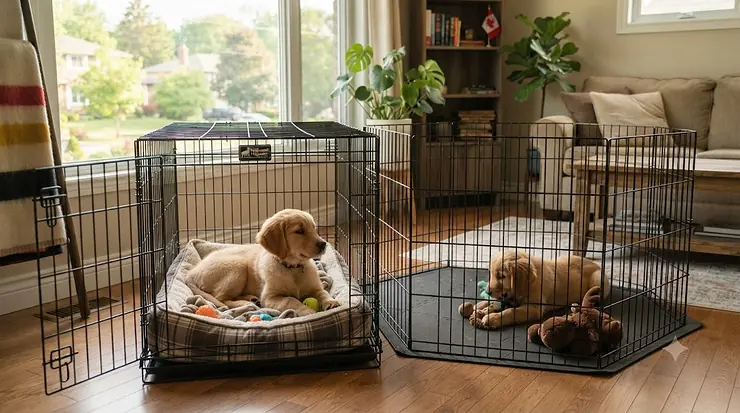
A playpen gives a dog room to move, which matters more than most first-time owners expect — a 24-inch-tall exercise pen isn’t a place to nap for six hours, it’s a supervised play zone. A crate, by contrast, leans into the dog’s instinct to avoid soiling a tight space, which is precisely why the CVMA’s puppy crate training guidance treats it as a house-training tool rather than a general containment pen. Neither one “wins” outright; the honest answer to dog playpen vs crate which is better depends on whether you need square footage for play or a snug, secure den for sleep and travel.
💬 Just one click — help others make better buying decisions too!😊
Top 7 Dog Playpens and Crates: Expert Analysis
We picked products across budget, mid-range, and premium tiers, covering both classic wire playpens and crates plus a couple of hybrid designs that blur the line entirely.
1. Amazon Basics Foldable Octagonal Metal Exercise Dog Playpen — best budget starter playpen
The Amazon Basics Foldable Octagonal Metal Exercise Dog Playpen is the playpen equivalent of a reliable used car: nothing flashy, but it does the job. It’s an 8-panel steel pen available in small (24″), medium (30″), and large (36″) heights, with a single swinging door on one panel.
The e-coated steel frame resists rust in humid basements or covered porches, and because it folds flat, it stores under a bed between uses — a detail that matters more than people expect once the puppy phase ends and the pen goes into storage for months at a time. Reviewers consistently report that assembly takes under ten minutes without tools, though a meaningful number also mention that determined jumpers or larger adolescent dogs can tip the shorter 24-inch model if it isn’t anchored down.
This is the pick for owners who want a no-frills, budget-first way to test whether their dog even tolerates a playpen before spending more. It’s ideal for small breeds, cats, or puppies under about 25 lbs; it’s not the pick for a 60-lb adolescent Lab with springs for legs.
Aggregated buyer sentiment skews positive on value and ease of setup, with the most common complaint being that the connecting pins can loosen over time on hard flooring, requiring occasional retightening.
Pros:
- ✅ Folds flat in seconds for easy storage between uses
- ✅ E-coated steel resists rust in damp areas
- ✅ Budget-friendly entry point for first-time playpen buyers
Cons:
- ❌ Shorter heights can be jumped by athletic adolescent dogs
- ❌ Connector pins loosen on hard floors over time
At around C$60-C$100 depending on size, this is one of the cheapest legitimate ways to trial the playpen approach — solid value if your dog is small or you’re not yet sure a playpen is the right long-term tool.
2. MidWest Homes for Pets Foldable Metal Exercise Pen — best no-door design for maximum security
The MidWest Homes for Pets Foldable Metal Exercise Pen takes a deliberately different approach: no door at all. Instead, you lift your dog in and out, which sounds inconvenient until you realize it eliminates the single biggest playpen failure point — a door a clever dog learns to nose open.
This 16-square-foot, 30-inch-tall pen is built from the same e-coated steel MidWest uses across its wire crate lineup, and the panels connect with secure clip hinges rather than simple pins. In practice, that means less wobble when a dog leans against a panel, which matters for anyone housing a strong or anxious dog that paces the perimeter. Based on the spec comparison with door-equipped pens, the no-door design trades convenience for a real security upgrade, particularly for puppies still mastering the concept of “the door is closed, not just closed-ish.”
This pen is best suited to smaller dogs and puppies you’re comfortable lifting, and to households where a determined escape artist has already defeated a door-style pen. It’s a poor fit if you have back problems or a dog too large to lift comfortably in and out multiple times a day.
Real user reviews frequently mention the sturdier panel connections as a standout versus cheaper competitors, while a recurring complaint is that the lack of a door becomes genuinely impractical once a puppy hits 30-plus pounds.
Pros:
- ✅ No door means zero risk of nose-opened escapes
- ✅ Reinforced clip hinges reduce wobble versus pin designs
- ✅ 16 sq ft of usable play space at 30 inches tall
Cons:
- ❌ Lifting the dog in and out isn’t practical for larger breeds
- ❌ Not ideal for owners with mobility or back limitations
In the C$65-C$110 range, this is a smart upgrade pick over basic pin-style pens if security is your top priority and your dog is small enough to lift comfortably.
3. FurHaven Soft-Sided Dog & Cat Playpen — best portable pick for travel and RVs
If the two metal pens above are the workhorses, the FurHaven Soft-Sided Dog & Cat Playpen is the one you throw in the trunk. It’s a fabric-and-mesh pop-up enclosure with a zippered door and mesh windows, designed to fold into a compact carrying case rather than a stack of steel panels.
The mesh walls mean full ventilation and visibility in both directions, which is genuinely reassuring for anxious dogs who calm down when they can see their owner rather than staring at solid panels. Set-up is closer to a pop-up tent than furniture assembly — most owners report it takes under a minute once you get the hang of the fold. What most buyers overlook about this style is that it’s built for supervised use only; the fabric walls won’t stop a determined chewer or a serious jumper the way steel will.
This is the right call for camping trips, hotel stays, or backyard use where portability beats permanence, and a poor fit as an unsupervised daily containment solution for a strong or destructive dog.
Reviewers frequently praise the packability and the mesh visibility, while a common complaint is that the fabric floor and walls show wear faster than metal alternatives when used daily outdoors.
Pros:
- ✅ Packs down small enough for car trunks and RVs
- ✅ Mesh windows give full visibility and airflow
- ✅ Fast pop-up setup, no tools required
Cons:
- ❌ Fabric walls won’t contain a serious chewer
- ❌ Not designed for unsupervised long-term use
Priced around C$70-C$120, it’s a smart secondary purchase alongside a metal pen — travel convenience first, everyday containment second.
4. MidWest iCrate Double Door Folding Wire Crate — best budget crate for first-time owners
The MidWest iCrate Double Door Folding Wire Crate is the crate most Canadian vet clinics and rescues default to, and there’s a reason: it’s inexpensive, widely available, and functional enough for most average dogs.
It ships with a divider panel so one crate grows with a puppy from eight weeks to full adult size, plus a removable leak-proof plastic pan for easy cleanup during house-training accidents. The double slide-bolt door latches are simple but effective for the average dog, though based on independent strength testing, the thinner wire gauge used here flexes more under pressure than pricier wire crates — something to weigh if your dog is a known escape artist rather than a typical, well-adjusted pup.
This is the pick for budget-conscious first-time owners, foster homes, or anyone crating a calm, non-destructive dog. It’s not the pick if your dog has already defeated a similar crate before, or if you specifically need a crate rated for serious strength testing.
Aggregated reviews highlight the value and the divider panel as major wins, while a recurring theme in feedback is that the thin wire can pinch fingers slightly during assembly and disassembly.
Pros:
- ✅ Growth divider means one crate lasts puppy to adult
- ✅ Removable leak-proof pan simplifies house-training cleanup
- ✅ Widely available and genuinely budget-friendly
Cons:
- ❌ Thinner wire flexes more under pressure than pricier crates
- ❌ Assembly can pinch fingers due to lighter-gauge wire
Expect to pay in the C$50-C$95 range depending on size — arguably the best value entry point into crate training available on amazon.ca right now.
5. MidWest LifeStages Double Door Crate — best sturdier wire crate for the money
Step up from the iCrate and you land on the MidWest LifeStages Double Door Crate, which independent strength testing has ranked as a noticeably tougher wire option without tipping into premium pricing.
The frame uses a heavier-gauge wire than the iCrate, and in side-by-side door-pressure testing it showed meaningfully less warping and gapping — a real-world signal that a persistent pusher is less likely to create an escape route. Front and side double doors, both with double slide-bolt latches, mean you can position the crate to fit an awkward room layout without sacrificing security. Here’s what to weigh: it’s heavier and slightly bulkier than the iCrate, so daily folding and moving is more of a chore.
This crate suits owners who want real wire-crate durability without jumping to premium collapsible designs, especially households with a moderately strong or mouthy dog. It’s overkill for a calm senior dog and underkill for a genuine escape artist who needs an impact-rated crate.
Reviewers consistently note the improved rigidity over cheaper wire crates as the standout feature, with occasional complaints that the added weight makes it less convenient to relocate between rooms.
Pros:
- ✅ Heavier-gauge wire holds up better under pressure
- ✅ Front and side double-door design fits more room layouts
- ✅ Meaningfully sturdier than base-tier wire crates at a modest premium
Cons:
- ❌ Noticeably heavier and bulkier to move than the iCrate
- ❌ Still a wire crate, not rated for true escape-artist dogs
In the C$90-C$150 range, this is the mid-tier sweet spot for buyers who want durability upgrades without paying premium-crate prices.
6. Diggs Revol Collapsible Dog Crate — best premium crate for design and portability
The Diggs Revol Collapsible Dog Crate was independently named a top dog crate pick for 2026 by a major consumer review outlet, and the reason shows up the moment you fold it: it collapses in under a minute using a twist-and-lock mechanism, no wire-hook wrestling required.
Built with a reinforced steel frame and diamond-shaped aluminum mesh rather than traditional wire bars, it includes a garage-style side door in addition to the standard front door, plus a removable tray for cleanup and a wheeled base for rolling it between rooms or out to the car. Based on the spec comparison with wire crates, the diamond mesh is genuinely gentler on paws and less prone to the gapping-under-pressure issue that plagues cheaper wire designs, though testers have noted some dogs hesitate at the overhead garage-style entry until they’re used to it. What the spec sheet won’t tell you is that Diggs raised prices substantially in 2025, so the value calculation is tighter than it once was against premium rivals.
This crate is the pick for design-conscious owners who travel frequently with their dog and want something that looks at home in a living room rather than a garage. It’s a tough sell for anyone crate-shopping on a tight budget, since two wire crates could be bought for the price of one Revol.
Aggregated reviews are strongly positive on the fold-flat convenience and aesthetics, with a recurring critique that the included wheels are too small to be genuinely useful on carpet.
Pros:
- ✅ Collapses and reassembles in under 60 seconds
- ✅ Diamond mesh is gentler and sturdier than standard wire
- ✅ Removable tray and wheeled base simplify cleaning and moving
Cons:
- ❌ Premium pricing puts it well above wire-crate alternatives
- ❌ Small wheels offer limited help on carpeted floors
Pricing runs roughly C$800-C$1,600 depending on size, positioning the Diggs Revol firmly as a premium, design-forward investment rather than a budget crate.
7. Diggs Evolv Dog Crate — best modular crate-to-playpen hybrid
The Diggs Evolv Dog Crate is the product that actually answers dog playpen vs crate which is better by refusing to pick a side — it’s a modular system where doors, panels, and a puppy divider can be rearranged, and with add-on parts it converts into an open-top playpen configuration.
It’s noticeably lighter than the Revol and doesn’t require tools to assemble, using a diamond-shaped mesh design similar to its sibling product for improved paw and jaw safety over classic wire. Based on the spec comparison, the trade-off for that modularity is that achieving the full playpen conversion requires purchasing separate add-on parts, which pushes the effective cost higher than the base price suggests. Reviewers who’ve used both note the Evolv’s flexibility is genuinely useful during the awkward transition period when a puppy has graduated from crate-only confinement but isn’t fully house-trained enough for open-room freedom.
This is the pick for owners who want one product that can flex between “secure den” and “supervised play space” as their dog’s training progresses, without buying two separate pieces of equipment. It’s not the pick for owners who know exactly which single format they need and don’t want to pay for flexibility they won’t use.
Aggregated review sentiment praises the modular design and lighter weight versus the Revol, while a common complaint is that the extra parts needed for full playpen mode aren’t included in the base purchase.
Pros:
- ✅ Converts between crate and open playpen configurations
- ✅ Lighter and easier to reconfigure than the Revol
- ✅ Diamond mesh design is gentler than standard wire bars
Cons:
- ❌ Full playpen conversion requires separate add-on purchases
- ❌ Total cost climbs quickly once accessories are added
Base pricing sits around C$250-C$550, with the fully converted playpen configuration pushing toward the higher end once add-ons are factored in.
Top 7 Products Compared
| Product | Type | Price Range (CAD) | Best For |
|---|---|---|---|
| Amazon Basics Foldable Octagonal Metal Exercise Dog Playpen | Playpen | C$60-C$100 | Budget-first small dogs and puppies |
| MidWest Homes for Pets Foldable Metal Exercise Pen | Playpen (no door) | C$65-C$110 | Max security for lightweight dogs |
| FurHaven Soft-Sided Dog & Cat Playpen | Soft playpen | C$70-C$120 | Travel, RVs, camping |
| MidWest iCrate Double Door Folding Wire Crate | Crate | C$50-C$95 | First-time owners on a budget |
| MidWest LifeStages Double Door Crate | Crate | C$90-C$150 | Durability upgrade at mid-range price |
| Diggs Revol Collapsible Dog Crate | Premium crate | C$800-C$1,600 | Design-conscious, frequent travellers |
| Diggs Evolv Dog Crate | Modular hybrid | C$250-C$550 | Owners who want crate-to-playpen flexibility |
Looking at the lineup as a whole, the budget tier (Amazon Basics and the MidWest iCrate) covers the vast majority of average dogs perfectly well, and most people overspend by jumping straight to premium options they don’t yet need. The Diggs Evolv earns its spot as the most interesting middle ground precisely because it sidesteps the dog playpen vs crate debate rather than forcing a choice, while the Diggs Revol only makes financial sense if design and near-silent collapsibility genuinely matter to your daily routine.
Practical Usage Guide: Setting Up Your Containment System Right
Buying the right equipment is half the job; setting it up correctly is the other half, and it’s the part most listings skip entirely. Start by placing whichever unit you choose — crate or pen — in a high-traffic area of the house rather than an isolated room. Dogs are social animals, and confinement in a room where the family never goes teaches them to associate the space with isolation rather than safety, a distinction the Canadian Veterinary Medical Association’s crate training guidance emphasizes repeatedly.
For the first 30 days, resist the urge to close the door immediately. Leave it propped open, toss treats inside, and let curiosity do the work before you ever latch anything shut. Feed regular meals inside the crate or pen for the first week; this single habit does more to build a positive association than any amount of verbal coaxing. Once your dog is comfortably eating inside, start closing the door for short stretches — a few minutes at first — and extend gradually rather than jumping straight to a full workday.
A common first-30-days mistake is over-crating: leaving a puppy confined for stretches longer than their bladder can handle. The commonly cited rule of thumb is one hour of confinement per month of age, plus one — so a three-month-old puppy tops out around four hours, not eight. Maintenance-wise, wipe down plastic pans weekly and do a deeper scrub with a mild, pet-safe cleaner monthly; wire and mesh surfaces should be checked periodically for rust spots or loosening connectors, especially on budget playpens with pin-style hinges.
One optimization trick that rarely makes it into product manuals: rotate the location of a playpen every few weeks if your dog seems bored or restless in it. A change of scenery, plus a rotating rotation of chew toys, prevents the pen from becoming a source of frustration rather than comfort.
Real-World Scenarios: Which Containment Fits Your Life
Consider a downtown Toronto condo owner with a new eight-week-old puppy and a one-bedroom layout. Floor space is precious, and the puppy needs frequent, closely supervised bathroom breaks. The MidWest iCrate, paired with occasional supervised time in the Amazon Basics playpen while working from a laptop, covers both bases without eating up the living room — crate overnight and during errands, pen during the day when eyes are on the puppy anyway.
Now picture a family in suburban Calgary with a large backyard, two kids, and a six-month-old Labrador mix who’s outgrown the “chew everything” phase but not quite mastered house manners. Here, the MidWest LifeStages Double Door Crate handles overnight and unsupervised confinement thanks to its sturdier build, while a larger outdoor-rated playpen gives the dog supervised backyard freedom during family time without a fence-jumping risk.
Finally, think about a retired couple who RV across the country every summer with a small senior dog. Portability trumps everything else here. The FurHaven Soft-Sided Dog & Cat Playpen sets up at each campsite in under a minute, while the collapsible Diggs Revol rides along in the RV for secure overnight containment that still looks presentable inside a shared living space — a genuinely different set of priorities than either of the first two households.
What Is a Dog Playpen vs Crate?
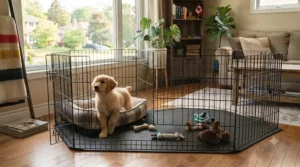
A dog playpen is an open or semi-open enclosure of connected panels that gives a dog room to stand, turn, stretch, and move around under supervision, while a dog crate is a smaller, den-like enclosure — wire, plastic, or collapsible fabric — sized to just fit the dog for house-training, travel, or short unsupervised periods.
The distinction matters because the two tools solve different problems. A playpen answers “how do I give my dog supervised space without full run of the house,” while a crate answers “how do I safely contain my dog when I’m not watching, or when we’re travelling.” Some households genuinely only need one; many benefit from both, using the crate overnight and the pen during active daytime hours.
Exercise Pen vs Kennel Comparison: What’s Actually Different
The terms get used loosely, so let’s separate them properly for this exercise pen vs kennel comparison. An exercise pen — the technical name for what most people call a playpen — is built from connected panels forming an open-top enclosure, with panel height (commonly 24 to 40 inches) determining how well it contains jumpers. A kennel, in the strict North American pet-industry sense, typically refers to a fully enclosed crate-style structure, though the term is also used loosely for boarding facilities, which is a completely different context.
The practical difference comes down to enclosure and scale. Exercise pens have no top and no floor in most designs, meaning a determined jumper or digger can defeat them; kennels/crates are enclosed on all sides including a floor pan, which makes them dramatically more escape-resistant but also more confining. According to general reference material on crate training, the enclosed design is precisely what leverages a dog’s instinct not to soil its immediate sleeping area, an instinct an open-top exercise pen doesn’t trigger nearly as effectively since the dog has room to separate a “toilet corner” from a “resting corner.”
For most puppies in the earliest house-training weeks, this makes a true crate more effective than an exercise pen at speeding up bathroom training, even though the pen wins hands-down on comfort and space during long daytime stretches.
How to Choose Between a Playpen and a Crate: 7-Step Framework
- Assess your daily absence windows. If you’re away four-plus hours regularly, a crate paired with a mid-day break is usually more appropriate than leaving a puppy alone in an open pen.
- Measure your available floor space. Playpens need considerably more square footage than crates of an equivalent dog size — measure before you buy either.
- Consider your dog’s jump height. A pen shorter than roughly three times your dog’s shoulder height is a jumping risk waiting to happen.
- Factor in travel frequency. Frequent travellers benefit more from collapsible crates like the Diggs Revol than from bulkier playpens.
- Think about house-training stage. Early-stage house-training leans crate; later-stage supervised freedom leans playpen.
- Set a realistic budget. Decide whether you need premium durability (Diggs Revol) or whether a budget option (MidWest iCrate, Amazon Basics playpen) genuinely covers your needs.
- Plan for growth. A divider-equipped crate like the iCrate or a modular hybrid like the Diggs Evolv avoids re-buying equipment as a puppy grows.
Puppy Containment Options: What Changes at Every Life Stage
Puppy containment options aren’t static — what works at eight weeks looks nothing like what works at eight months. In the first few weeks home, a crate with a divider panel, like the MidWest iCrate, keeps the usable space small enough to reinforce house-training instincts, since too much room lets a puppy soil one corner and sleep comfortably in another.
Around three to five months, many owners introduce supervised playpen time to give a increasingly mobile, curious puppy room to explore toys and practice recall commands in a contained space — this is where a pen like the MidWest Homes for Pets Foldable Metal Exercise Pen earns its keep, particularly its no-door design for puppies who haven’t yet learned respect for a latch. By six months and beyond, most healthy, house-trained dogs need less containment overall, shifting crates toward “safe travel den” duty and pens toward occasional supervised outdoor or camping use rather than daily necessity.
The mistake we see most often is buying adult-sized equipment too early, assuming it’ll “grow with them.” A too-large crate undermines house-training because the dog can separate sleeping and toileting zones inside it — the divider panel exists specifically to prevent that problem during the early months.
Playpen Benefits Most Buyers Overlook
The obvious playpen benefits — more room to move, easier multi-dog household management, better for supervised play — get plenty of attention. What most buyers overlook is how much playpens help with recovery and rehabilitation. A dog recovering from minor surgery or an injury often needs restricted activity but not the same rigid stillness a crate implies; a pen lets them shift position, stretch gently, and avoid the muscle stiffness that comes from being folded into a tight crate space for extended periods, subject to a vet’s specific activity restrictions.
Playpens also shine in multi-pet households introducing a new animal. A pen creates a supervised meet-and-greet buffer zone — cat and dog can see and smell each other through the panels without direct contact, something a solid-walled crate can’t offer as naturally. Finally, pens are genuinely useful outdoors: a portable pen set up in a fenced yard gives a dog fresh air and grass time without the escape risk of an unfenced yard, particularly valuable for renters without a fully enclosed outdoor space.
The feature that actually doesn’t matter as much as marketing suggests: panel count. More panels (12, 16) simply mean a larger perimeter for the same height, not inherently better security — the height and hinge quality matter far more than raw panel count.
Crate Alternative Options Worth Considering
If a traditional wire crate isn’t clicking for your dog or your space, there are legitimate crate alternative paths worth weighing before assuming crating is the only answer. A tether system — a short line secured to a fixed point in a room you’re actively occupying — lets a puppy stay close and supervised without full enclosure, and is frequently recommended by trainers as a middle-ground option for dogs who panic in enclosed crates.
Baby gates sectioning off a small room (a kitchen or laundry room, for example) function as an oversized, wall-mounted playpen, giving more room than a crate while still limiting access to the rest of the house — a solid option for dogs who do fine with space limits but genuinely dislike full enclosure. For dogs with diagnosed separation anxiety, a crate can occasionally worsen distress rather than help it, and a certified trainer or veterinary behaviourist consultation is a more appropriate first step than any piece of equipment.
The Diggs Evolv deserves another mention here specifically because it’s designed as a hybrid crate alternative — when the enclosed crate mode isn’t working, its playpen conversion offers a way to pivot without buying an entirely separate product.
Containment Comparison: Benefits vs Traditional Confinement Methods
| Method | Space Given | Escape Resistance | Good For |
|---|---|---|---|
| Playpen | High | Moderate | Supervised daytime containment |
| Crate | Low | High | House-training, travel, overnight |
| Baby gate + room | Very high | Low-moderate | Space-limited but not enclosure-averse dogs |
| Tether | Moderate (supervised only) | N/A (requires supervision) | Anxious dogs needing closeness, not enclosure |
This containment comparison makes the trade-off explicit: every method that gives more space sacrifices some escape resistance, and every method that maximizes security sacrifices room to move. A playpen and crate used together — crate for unsupervised hours, pen for supervised active time — routinely outperforms either single method used alone, which is likely why so many experienced owners eventually own both rather than picking one permanently.
💬 Ready to build your own combo setup? Check the current price and availability on the products above before they sell out.
Common Mistakes When Buying Containment Gear
The single most common mistake is buying based on current puppy size rather than projected adult size, which leads to a re-purchase within months for fast-growing breeds. A close second is skipping measurements entirely — a pen or crate that looks spacious in a product photo can feel cramped once it’s wedged into an actual hallway or bedroom corner.
Buyers also frequently underestimate panel or wire gauge quality, assuming all metal designs perform similarly; independent strength testing has repeatedly shown meaningful differences in how much a door bows under 50 lbs of pressure between budget and mid-tier crates. Another frequent misstep, echoed in guidance from the Regina Humane Society’s crate training resources, is using confinement as punishment after the fact rather than a neutral, positive space — doing so actively teaches a dog to fear the very equipment meant to comfort them.
Finally, plenty of buyers skip the divider panel option on crates entirely, not realizing it exists, and end up buying two crates over a dog’s first year instead of one adjustable one.
Long-Term Cost & Maintenance: The Real Total Cost of Ownership
| Product | Upfront Cost (CAD) | Expected Lifespan | Notable Ongoing Costs |
|---|---|---|---|
| Amazon Basics playpen | C$60-C$100 | 2-4 years | Occasional pin/connector replacement |
| MidWest iCrate | C$50-C$95 | 3-6 years | Divider panel included; minimal upkeep |
| Diggs Revol | C$800-C$1,600 | 5+ years | Optional crate pad, training aid add-ons |
| Diggs Evolv | C$250-C$550 | 4-6 years | Add-on parts needed for full conversion |
Judged purely on cost-per-year, the budget wire options win decisively — a MidWest iCrate amortized over five years costs a fraction of a single Diggs unit annually. But that math changes if you factor in re-purchases: a family that buys three different crates as their puppy grows through sizes may ultimately spend close to premium-crate money anyway, just spread across multiple lower-quality purchases instead of one durable one.
The Diggs Revol‘s higher upfront cost only makes long-term sense if the collapsible portability and design genuinely get used regularly — for a crate that stays permanently set up in one spot and never travels, that premium buys aesthetics more than function. Maintenance costs across the board stay low regardless of tier: mild soap, occasional pan replacement, and periodic hardware checks cover nearly all upkeep needs for either format.
Safety, Regulations & Compliance in Canada
Canada doesn’t have a single federal law dictating crate or playpen use in private homes, but several relevant guidelines shape best practice. The Canadian Veterinary Medical Association’s crate training resource outlines the widely cited rule that a puppy can typically be expected to hold their bladder for roughly one hour per month of age, plus one — a useful ceiling for planning confinement windows regardless of which product you choose. If you plan on air travel with your dog, Transport Canada and individual airlines defer largely to International Air Transport Association container standards, so a crate purchased for home use isn’t automatically airline-approved; check sizing requirements before booking.
For provincial and municipal considerations, some municipalities set minimum enclosure sizes for outdoor confinement structures, so it’s worth a quick check of your local bylaws if you’re using an outdoor playpen setup long-term rather than for occasional supervised sessions. The Edmonton Humane Society’s crate training guide reinforces a point worth repeating: a crate or pen should always be sized so the dog can stand, turn around, and lie down comfortably — undersizing either product for cost savings is a welfare issue, not just a comfort one.
CSA certification doesn’t currently apply directly to pet containment products the way it does to items like car seats, so buyers are largely relying on manufacturer testing and independent review data rather than a formal Canadian safety mark — one more reason genuine, sourced review analysis (rather than marketing copy) matters when comparing options.
Frequently Asked Questions
❓ Is a playpen or crate better for a new puppy?
❓ Can I use a dog playpen instead of a crate overnight?
❓ How big should a dog crate be compared to a playpen?
❓ Do vets recommend crate training in Canada?
❓ What is the difference between an exercise pen and a dog crate?
Conclusion
If you came in searching dog playpen vs crate which is better, the honest, research-backed answer is that most households eventually land on both — a crate for overnight and unsupervised hours, a playpen for supervised daytime space. Budget-conscious owners can start with the MidWest iCrate and Amazon Basics playpen combination for well under C$200 total, while owners who travel often or want a single flexible product should seriously consider the Diggs Evolv‘s crate-to-playpen conversion.
What matters most isn’t which single product wins some abstract contest — it’s matching the tool to your dog’s current life stage, your home’s floor plan, and your actual daily schedule. A three-month-old puppy in a downtown apartment has entirely different needs than a six-year-old Lab in a suburban backyard, and the seven products above cover that entire spectrum honestly, without pretending one size fits all.
Whichever direction you land on, remember the fundamentals that every Canadian veterinary and humane resource agrees on: introduce it positively, size it correctly, and never use it as punishment. Get those three things right, and either a playpen, a crate, or both will genuinely make life easier for you and your dog.
✨ Ready to set up the right containment system for your dog? Check current prices on the picks above and see which combination fits your home best! 🐾
Recommended for You
- Tall Dog Playpen for Jumpers: 7 Escape-Proof Picks (2026)
- Escape Proof Playpen for Husky: 7 Picks That Actually Hold in 2026
- Heavy Duty Dog Playpen for Large Breeds: 7 Tough Picks (2026)
Disclaimer: This article contains affiliate links. As an Amazon Associate, I earn from qualifying purchases. If you purchase products through these links, we may earn a small commission at no additional cost to you.
✨ Found this helpful? Share it with your friends! 💬🤗
