
In This Article
Few household chores make a dog and its owner sweat quite like nail day. The paw gets yanked back, the treat bag gets raided, and somewhere in the middle of it all you wonder whether the tool in your hand is helping or hurting. The debate over guillotine vs scissor dog nail clippers has been going strong among groomers and trainers for decades, and in 2026 it still splits the room.

Here’s the short version: one design lets you slip a loop over the nail and squeeze, while the other works like a pair of curved pliers that you aim by eye. Both can do the job well. Both can also go wrong in ways that make your dog remember the experience for months.
This guide skips the sales-page gloss. We compared seven real products, weighed the genuine review themes, and translated the specs into what they mean on your kitchen floor in February, when the whole house is dry and your dog’s nails are growing faster than you’d like.
What Is the Difference Between Guillotine vs Scissor Dog Nail Clippers?
Guillotine vs scissor dog nail clippers differ in how the blade meets the nail. A guillotine clipper has a small ring that the nail passes through, and a sliding blade slices it off when you squeeze. Scissor (plier-style) clippers use two curved blades that close around the nail from both sides. One is a loop-and-blade; the other is a cradle-and-shear. Whole Dog Journal’s clipper roundup describes the same split and notes that the best choice is the one that fits your hand and that your dog will tolerate.
Throughout this article we also cover the pros and cons of guillotine dog clippers, which dog nail clipper style is safest, guillotine clipper technique for dogs, nail quick avoidance, the clipper safety guard question, and the best nail trimming technique for nervous dogs.
Quick Comparison Table: Guillotine vs Scissor Dog Nail Clippers at a Glance
Before we dig into the individual products, here is the whole field on one screen. Prices are approximate ranges in Canadian dollars at the time of research and will vary by retailer and size, so please check current pricing before you buy.
| Product | Style | Built-In Protection | Best For | Approx. Price Range (CAD) |
|---|---|---|---|---|
| Resco Original Guillotine Nail Trimmer | Guillotine | Ring limits how far the nail slides in | Small to medium dogs, owners who struggle to line up a cut | C$25–C$40 |
| Resco Deluxe Guillotine Nail Clipper | Guillotine | Ring limits how far the nail slides in | Larger dogs, people who want cushioned grips | C$30–C$45 |
| Safari Professional Nail Trimmer | Scissor | Adjustable safety stop | Medium to large dogs, left- or right-handed users | C$15–C$25 |
| Millers Forge Pet Nail Clipper | Scissor | Safety stop bar and storage lock | All-round value, groomer-style control | C$15–C$26 |
| Boshel Dog Nail Clippers with Safety Guard | Scissor | Adjustable guard, bonus file | First-timers, thick nails | C$15–C$25 |
| gonicc Professional Dog Nail Clippers | Scissor | Safety guard | Home grooming, medium dogs | C$15–C$25 |
| Resco Professional Dog Nail Trimmer | Scissor | None (skill-based) | Giant breeds, confident trimmers | C$25–C$40 |
Notice how the price gap tracks the build rather than the style. The guillotine models cost a bit more because they use heavier linkage and, on some versions, replaceable blades, while the scissor field clusters at the lower end. If your priority is the cheapest route to a clean cut, a scissor model with a guard is hard to beat. If your priority is a forgiving cutting angle, the guillotine pair earns its premium.
💬 Just one click — help others make better buying decisions too!😊
Top 7 Guillotine vs Scissor Dog Nail Clippers: Expert Analysis
Each pick below comes from real product specifications and the genuine themes that show up across owner and retailer reviews. Where review coverage is thin, we say so instead of padding the gap.
1. Resco Original Guillotine Nail Trimmer — the classic that forgives clumsy aim
Resco has been making guillotine trimmers in the USA since 1937, and the Resco Original is the model that built that reputation. The standout feature is the fixed ring: you pass it over the nail and the geometry does a lot of the aiming for you.
The small/medium size suits dogs of roughly 4.5 to 22.5 kg (10 to 50 lb), with nails thinner than a standard pencil. The hardened steel blade slides through, and the blade is replaceable on this style through the manufacturer’s replacement kits, which turns a one-off purchase into a long-term tool.
Based on the spec comparison, this is the clipper for the person whose dog keeps shifting its paw. Instead of tracking a moving target with two blades, you just move the ring over it. Reviewers consistently praise the speed and the lighter squeeze pressure. Common complaints include splintering when the blade has dulled and a bit of a learning curve on the first few nails.
Pros:
- ✅ Ring guides nail into a consistent cutting position
- ✅ Replaceable blade extends the clipper’s working life
- ✅ Light squeeze needed once the blade is fresh
Cons:
- ❌ Dull blades crush or splinter nails
- ❌ Awkward angle takes practice for beginners
Expect a price in the C$25–C$40 range depending on size and colour. Value verdict: strong if you maintain the blade, mediocre if you plan to ignore it.

2. Resco Deluxe Guillotine Nail Clipper — cushioned grips for bigger dogs
The Resco Deluxe keeps the same guillotine concept as the Original but adds form-fitted rubber grips and a powder-coated body. The large size is engineered for thick, tough nails on bigger breeds.
Those grips matter more than they sound. Squeezing a heavy-duty tool across a dozen nails, plus dewclaws, is a surprisingly good hand workout, and slippery chrome handles do not help when your dog flinches. The heavier linkage cuts with less force, which tends to be the deciding factor for people with arthritic or smaller hands.
What most buyers overlook is replacement-blade availability. Some retailer listings say replacement blades aren’t carried at that store for this deluxe version, while the manufacturer’s descriptions claim blade replacement is part of the design. Confirm that before you commit. Reviewers describe the grips as comfortable and the cut as quick, though a few report a rough edge left on the nail and the nail wedging between the blade and the ring.
Pros:
- ✅ Rubber grips stay secure during squirmy trims
- ✅ Heavy-duty build cuts thick nails with less pressure
- ✅ Powder-coated finish resists chipping
Cons:
- ❌ Blade replacement availability varies by seller
- ❌ Can leave a rough edge needing a file
Expect roughly C$30–C$45. Value verdict: worthwhile for large dogs, overkill for a Chihuahua.
3. Safari Professional Nail Trimmer — adjustable stop with real groomer cred
The Safari Professional Nail Trimmer is a scissor-style clipper with a double-bladed cutter, a tension spring, and a metal safety stop that you slide to limit cutting depth. It’s built for either hand, which makes it friendlier than it sounds for left-handers.
The practical meaning of that stop is this: on a clear nail you set it just before the quick and clip. On a dark nail you can shine a flashlight behind the nail to estimate where the quick sits, then position the stop accordingly. It takes a minute to understand, and several owners say they weren’t sure how to use the safety stop at first.
The sharp stainless steel is the real draw. Reviewers describe quick, clean snips and fewer cracked nails than they got from older clippers. The main warning is sizing: the standard size fits smaller dogs, while the large size is the one for big breeds, and buying the wrong size is a recurring complaint.
Pros:
- ✅ Adjustable stop adds a cutting-depth margin
- ✅ Sharp stainless blades give clean cuts
- ✅ Works comfortably for left or right hands
Cons:
- ❌ Wrong size choice ruins the experience
- ❌ Stop takes a few tries to master
Expect around C$15–C$25. Value verdict: excellent for the money.
4. Millers Forge Pet Nail Clipper — the plain, sharp workhorse
If you ask experienced trainers and groomers which scissor clipper they reach for, Millers Forge comes up again and again. It’s plier-style, with heat-treated stainless steel blades, a spring-loaded action, a safety stop bar, and a lock so the blades stay closed in your drawer.
The spring-loaded design means the clipper opens itself between cuts, which saves your hand a lot of work across ten or twenty nails. The large-dog version is aimed at dogs over about 18 kg (40 lb) and made in Italy of German stainless steel, according to Canadian retailer listings.
One genuine quirk: reviewers note that the blades are designed not to open all the way, so you have to place the nail at the very tip rather than clipping halfway down. That can feel limiting, but it also forces the small, safe trims you want anyway. Several owners report that a nervous dog finally tolerated nail trims once they switched to this clipper, which aligns with the clean-cut reputation.
Pros:
- ✅ Sharp blades cut cleanly in one snip
- ✅ Safety lock makes storage safe
- ✅ Sizes available for small to large dogs
Cons:
- ❌ Limited opening for very overgrown nails
- ❌ Safety bar can feel fiddly to some
Expect roughly C$15–C$26 depending on size. Value verdict: arguably the best all-round buy in this list.
5. Boshel Dog Nail Clippers with Safety Guard — beginner insurance in blue
The Boshel is a scissor-style clipper with 3.5 mm stainless steel blades, a curved cutting edge, an adjustable guard, and a bonus nail file. The curved geometry wraps slightly around the nail, which helps stop round or conical nails from squirting out of the jaws mid-squeeze.
Thick blades matter because thin ones flex under pressure and crush rather than slice. At 3.5 mm, the Boshel is built for thicker nails, and it is promoted as suitable for large dogs. The included file is a smart finishing step, since a quick pass over a fresh cut removes the sharp corner that scratches hardwood and sofas.
Reviewers consistently highlight the guard as the feature that rescues beginners. The recurring complaints are practical: the guard can shift or loosen with use, the jaws may not open wide enough for an overgrown nail, and a few owners felt the build wasn’t as sturdy as pricier alternatives.
Pros:
- ✅ Adjustable guard reduces over-cutting risk
- ✅ Curved blade holds the nail steadily
- ✅ Free file smooths freshly cut edges
Cons:
- ❌ Guard can loosen or slide during use
- ❌ Jaws struggle with very long nails
Expect roughly C$15–C$25. Value verdict: great starter kit if you check the guard before each session.
6. gonicc Professional Dog Nail Clippers — thick blades, rubber grips, medium dogs
The gonicc Professional Dog Nail Clippers share the 3.5 mm stainless steel blade and safety guard approach seen on the Boshel, wrapped in contoured, non-slip rubber grips. Think of it as the quiet middle child of this category.
What the spec sheet won’t tell you, but comparison reviews suggest, is that the grip contour reduces the effort you spend holding the clipper steady. That’s a real advantage for medium dogs that squirm just enough to make you flinch. The guard physically blocks the blade from closing past a set point, which gives you a margin of error if your dog jerks mid-cut.
Candidly, gonicc has less independent review coverage than the Resco and Millers Forge names, so we can’t point to a deep pool of long-term durability reports. Treat it as a sensible mid-range scissor option rather than a proven heirloom. If you buy it, test the guard’s tightness and the blade’s sharpness on the first nail.
Pros:
- ✅ Thick stainless blades resist crushing nails
- ✅ Non-slip grips improve control
- ✅ Guard adds a cutting-depth margin
Cons:
- ❌ Less long-term durability data available
- ❌ Guard may not suit every nail shape
Expect roughly C$15–C$25. Value verdict: fair for home grooming, especially for medium dogs.
7. Resco Professional Dog Nail Trimmer — surgical steel for giant breeds
The Resco Professional is the scissor-style entry from the same company known for guillotines. It uses surgical stainless steel blades and a double-lock pivot screw that holds blade tension steady over years of use. It has no safety guard.
That lack of a guard is deliberate. Skilled trimmers argue that a guard blocks your view and caps how much nail you can remove in one pass. On thick, brittle nails, such as those of large and giant breeds, a firm and decisive scissor action can slice where softer clippers shatter. Owners of very large dogs specifically praise how it handles tough nails.
The trade-off is real: you need confidence about where the quick sits, and the stiff spring can fatigue your hand if you’re trimming several dogs. Think of it as a professional tool for a professional job.
Pros:
- ✅ Surgical steel handles tough, thick nails
- ✅ Double-lock pivot keeps tension consistent
- ✅ No guard means a clear view of the nail
Cons:
- ❌ No guard demands good quick awareness
- ❌ Stiff spring tires hands over time
Expect roughly C$25–C$40. Value verdict: best for experienced users with big dogs.
How the Seven Compare on Specs
| Product | Blade Style | Typical Dog Size | Safety Feature | Replaceable Blade | Best For |
|---|---|---|---|---|---|
| Resco Original | Sliding guillotine blade | Small/medium (about 4.5–22.5 kg) | Ring limit | Yes, via manufacturer kit | Owners who can’t line up a scissor cut |
| Resco Deluxe | Sliding guillotine blade | Larger dogs | Ring limit | Varies by seller | Big dogs, comfort-seekers |
| Safari | Double-bladed scissor | Standard to large sizes | Adjustable stop | No | Value-minded owners of all hand types |
| Millers Forge | Spring-loaded scissor | Small to large | Stop bar and lock | No | Dependable, clean cuts |
| Boshel | Curved 3.5 mm scissor | Medium to large | Adjustable guard | No | Beginners with thick nails |
| gonicc | 3.5 mm scissor | Medium | Guard | No | Home grooming on a budget |
| Resco Professional | Surgical steel scissor | Large to giant | None | No | Experienced trimmers |
This table reveals a useful pattern. Only the guillotine models (and only some versions) promise replaceable blades, while every scissor model stands or falls on the sharpness it ships with. If you hate throwing tools away, Resco Original is the one to watch. If you’d rather buy a new pair every couple of years at a lower price, Safari and Millers Forge are the sensible picks.
Why Nail Length Matters More Than You Think
Nails aren’t a cosmetic detail. A 2026 paper in Frontiers in Veterinary Science reports that overgrown nails appear among the more common issues in UK primary-care dog records, roughly in the 5 to 7 per cent range, while also admitting that formal research on how trimming changes gait is still thin. In other words, the problem is common and the science is catching up.
Veterinary sources commonly describe a simple test: when your dog stands on a firm, flat surface, the nails should not touch the ground. If you hear a steady click across your hardwood or your dog’s nails snag on blankets and carpet, you’re overdue. Long nails can tip the toes backward, shift weight, and add stress to the joints over time.
For Canadian owners there’s a seasonal twist. Winter walks on snow and packed ice don’t file nails down the way a summer of asphalt does, and many dogs spend more time indoors. That is exactly when nails creep out, so a regular trim every two to four weeks beats waiting until the clicking starts.
Guillotine Clipper Technique for Dogs: A Step-by-Step Guide
Guillotine clipper technique for dogs is where this style either shines or sinks, because the tool is forgiving only when you hold it right. Here’s how to set up for success.
- Check the blade first. Run your thumb across the outside of the ring (never the blade edge). If the blade is dull or nicked, replace it before you start. A dull blade crushes the nail and is the most common cause of splintering.
- Position the ring correctly. The cutting blade should face you, with the flat side of the ring toward the dog’s paw. If you hold it backward, the blade crushes against the nail rather than shearing it.
- Slide the nail in only as far as you need. Aim to remove the curved tip. Pushing the nail all the way through the ring is how people end up cutting too deep.
- Squeeze in one smooth, decisive motion. Hesitating mid-squeeze is what makes a dog flinch.
- Check the cut surface. On light nails you’ll see a clean oval. If you spot a pale, then darker centre as you trim, stop early.
- File the edge. A pass with a nail file or grinder removes any burr.
One more practical tip: wipe the blade with a dry cloth after use and add a drop of oil to the pivot every few weeks. A smooth pivot makes a smoother cut, and the blade lasts longer.
Nail Quick Avoidance: A Problem-to-Solution Guide
Nail quick avoidance is the heart of safe trimming. The quick is the living part of the nail, containing blood vessels and nerves, and cutting it is painful and bloody. It’s also the main reason dogs learn to hate nail day. Here are the common problems and what to do about each.
Problem: Dark nails hide the quick. Take off just a sliver at a time, roughly 1 to 2 mm, and look at the cut surface after every snip. The Ontario SPCA’s guide to trimming dark nails recommends small clips and checking for a small shiny dot in the centre, which signals you’re close to the quick. Stop there.
Problem: Long nails mean a long quick. The longer nails grow, the longer the quick extends. Instead of trying to fix the whole thing in one session, trim a little every week. The quick will gradually recede, and you’ll get nails back to a healthy length.
Problem: Your dog won’t hold still. This is where a Resco Original or Resco Deluxe ring can help, since the tool tracks the nail rather than you tracking the dog. Alternatively, a Millers Forge with its spring-loaded action lets you work quickly between treats.
Problem: You nicked the quick. Stay calm. Press styptic powder (available at most Canadian pet stores and pharmacies) onto the nail, or use cornstarch as a stopgap, and apply gentle pressure. If bleeding doesn’t stop in a reasonable time, call your veterinarian.
Problem: You’re nervous. Your dog senses it. Start with one paw, then one nail, then take a break. Confidence follows repetition.
Best Nail Trimming Technique: Three Real-World Scenarios
The best nail trimming technique depends on who’s holding the clipper and who’s wearing the nails. Here are three profiles to help you match your situation to the right tool.
Scenario 1: The nervous first-time owner with a 12 kg terrier mix. Budget is limited, nerves are high. A Boshel or gonicc scissor with a guard offers a built-in margin of error, and the included file lets you finish off sharp edges. Work after a walk, when your dog is calmer, and clip one nail per sitting if needed.
Scenario 2: The apartment dweller with a squirmy 8 kg dog. Quick, short sessions suit this household. The Resco Original guillotine’s ring tracks a moving paw, so the clip happens before the dog finishes protesting. Keep treats on the counter and finish in under five minutes.
Scenario 3: The giant-breed family with a 45 kg Newfoundland. Thick, hard nails call for a clipper with serious leverage. The Resco Professional scissor’s surgical steel or the Resco Deluxe large guillotine both cope, and a second person feeding treats makes everything easier. Trim weekly in small amounts rather than wrestling with overgrown nails monthly.
Across all three, the best nail trimming technique looks the same: sharp tool, small clips, calm handling, rewards after every nail. The clipper style changes the mechanics, not the principle.
Pros and Cons of Guillotine Dog Clippers
The pros and cons of guillotine dog clippers are easy to oversimplify, so here’s the balanced view.
What guillotines do well. The ring gives you a built-in reference. Because the nail passes through a fixed opening, you can see exactly how much is sticking out before you squeeze. The cutting action can be quick and smooth, and well-made models need less hand pressure. Some, like the Resco Original, offer replaceable blades.
Where they struggle. Technique matters more than you’d think. Hold the clipper backward and you crush the nail. Let the blade go dull and you get splinters. Because the ring is fixed, very thick or very oval nails may not fit. Some experienced trainers dislike the style on principle, arguing that scissor clippers give a cleaner, more controllable cut. Julie Buzby’s detailed comparison on Toe Grips takes exactly that position, favouring scissor-style clippers and sharing a strong dislike of guillotines, so read it for the opposing view.
The balanced verdict. Guillotines suit people who struggle to aim a scissor and who will maintain the blade. Scissors suit people who want a visible cutting line and a simpler tool. Neither is inherently cruel or inherently safe. Condition and handling decide the outcome.
Which Dog Nail Clipper Style Is Safest?
If you’re asking which dog nail clipper style is safest, the honest answer is that safety depends less on the style and more on four factors: sharpness, size fit, your confidence, and your dog’s temperament.
Sharpness. A dull clipper of either style crushes the nail, pressing on the quick and hurting before the cut finishes. Sharp blades cut quickly and cleanly.
Size fit. A clipper that’s too small for the nail forces an awkward angle. A clipper that’s too big can feel unwieldy on a small dog’s nails. Always match the model to your dog’s size.
Your confidence. A guard or a ring can help if you’re nervous, while an experienced trimmer may prefer an open view of the nail.
Temperament. A calm dog allows careful scissor work. A wriggler may do better with a ring that follows the paw.
If we had to rank them for a total beginner, a scissor with a well-fitted guard, such as the Boshel or Safari, offers the clearest margin of error. For someone who can’t hold a squirmy paw steady, the guillotine ring may be the safer bet. Either way, keep styptic powder within reach.
Clipper Safety Guard: Helpful Feature or False Comfort?
A clipper safety guard is a small metal stop that sits opposite the blade and limits how much nail the clipper can take in a single bite. It sounds like pure protection, but reviews and experts split on it.
The case for guards. For most home users, a guard means fewer yelps and less blood. It physically stops the blade from closing past a set point, giving you a margin of error if your dog jerks mid-cut. The Boshel, gonicc, Safari, and Millers Forge all offer some version.
The case against. Guards can block your view of the nail, cap how much you can trim, and give a false sense of security. They don’t know where the quick is. They simply stop at a fixed spot, which may be too short on one nail and too long on another. Some owners also report that guards loosen or shift during use, particularly on budget models.
How to use one wisely. Treat the clipper safety guard as a backup, not a replacement for looking. Set it conservatively, check the cut surface after every snip, and verify it’s snug before each session. On dark nails, trim in tiny slivers regardless of the guard setting.
How to Choose Between Guillotine vs Scissor Dog Nail Clippers
Use these seven steps to settle the debate for your own household.
- Weigh your dog. Match clipper size to your dog’s weight and nail thickness. A small/medium ring suits dogs up to about 22.5 kg, and large scissors suit heavier dogs with thicker nails.
- Check nail colour. Clear nails reveal the quick, while black nails demand smaller cuts and more caution.
- Be honest about your confidence. Nervous? A guard or ring adds margin. Experienced? An open view may suit you.
- Test your hand strength. Heavy tools with stiff springs fatigue weak hands. Grips matter.
- Consider your dog’s temperament. A fidgety dog might favour a ring that follows its paw, while a calm one suits careful scissor work.
- Plan for maintenance. Replaceable blades extend a guillotine’s life, while scissors are replaced when dull.
- Pair it with a finisher. A file or grinder smooths edges and reduces snags.
| Option | Best Use | Strength | Weakness | Best For |
|---|---|---|---|---|
| Manual clipper (guillotine or scissor) | Quick regular trims | Fast and portable | Needs quick awareness | Millers Forge, Safari, Resco Original |
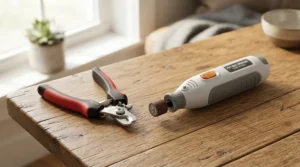
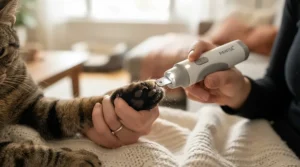
| Electric grinder | Dark nails, gradual wear | Smooth finish, fine control | Noise and time | Noise-tolerant dogs |
| Groomer or vet visit | Fearful dogs, overgrown nails | Professional handling | Recurring cost | Severe cases |
The table shows why many owners keep both a clipper and a file or grinder: clip to length, then smooth the edges. For nail-shy dogs that can’t tolerate a grinder’s noise, a sharp clipper such as Millers Forge often gets the job done faster. For heavily overgrown nails, there’s no shame in booking a groomer.
Common Mistakes When Buying and Using Dog Nail Clippers
Even good tools fail when used badly. Watch for these pitfalls.
Buying the wrong size. The most frequent complaint on Safari listings is size mismatch, and the same applies across the category. Check the weight guidance, not just the colour.
Ignoring blade condition. A dull blade, guillotine or scissor, crushes nails. Replace or sharpen as needed. The Resco Original makes this easy with replaceable blades, but only if you actually swap them.
Cutting too much at once. Big bites invite the quick. Small snips with checks in between beat speed every time.
Trimming only when nails click. By then nails are overdue. Aim for a regular schedule, roughly every two to four weeks.
Skipping the styptic powder. Accidents happen to everyone. Keep it in the drawer with your clippers.
Forcing a scared dog. Pushing a panicked dog teaches nail trims equal terror. Stop, reset, and try again with treats and shorter sessions.
Forgetting the dewclaws. These nails don’t touch the ground and can overgrow into curls. Trim them like the others.
Long-Term Cost and Maintenance: What Your Clipper Really Costs
Buying a clipper is a small purchase, but cost per year tells a clearer story.
Consider a Millers Forge or Safari at roughly C$15–C$25. If it lasts a few years with regular use, the annual cost is a few dollars. Compare that with a groomer or vet nail trim at recurring visits, and a home clipper pays for itself in a handful of sessions.
A Resco Original costs more upfront, around C$25–C$40, but the manufacturer’s replacement blade kits mean you can refresh the cutting edge instead of replacing the whole tool. Whether that pencils out depends on how long you’d keep a scissor clipper before it dulled.
Maintenance is simple. Wipe blades dry after use, apply a drop of oil to the pivot occasionally, store clippers with the safety lock engaged where available, and keep them away from children. A damp bathroom drawer is a rust trap even for stainless steel, so a dry spot is better.
The real hidden cost is a dog that learns to fear nail trims. A sharp, well-fitted clipper protects against that, and that makes a fair price easy to justify.

FAQ
❓ Are guillotine clippers bad for large dogs?
❓ How often should I clip my dog's nails in a Canadian winter?
❓ Can I use one clipper on both my dog and my cat?
❓ What do I do if my dog refuses to hold still for nail trims?
❓ Do I need a nail file after clipping?
Conclusion
The guillotine vs scissor dog nail clippers debate has no universal winner. Guillotines such as the Resco Original and Resco Deluxe give you a ring that tracks the nail and a replaceable blade, but they punish dull edges and sloppy angles. Scissors such as Millers Forge, Safari, Boshel, gonicc, and Resco Professional give you a visible cutting line and simpler handling, and the guard-equipped models add a safety margin that beginners often appreciate.
If you’re nervous and want the most forgiving start, a guard-equipped scissor like the Boshel or Safari is a smart first purchase. If your dog never sits still, the Resco Original ring may rescue your sanity. If you share your life with a giant breed and you’re confident about nail quick avoidance, the Resco Professional earns its place. And if you want one dependable all-rounder, Millers Forge is hard to argue with.
Whatever you choose, keep it sharp, keep the trims small, keep styptic powder nearby, and keep the treats flowing. Your dog’s joints, floors, and nerves will thank you.
✨ Ready to make nail day calmer?
🐾 Check current prices on the clippers that match your dog’s size and your comfort level, and start building a stress-free routine today!
Recommended for You
- Dog Nail Clippers For Thick Nails: 7 Tough Picks (2026)
- Dog Nail Grinder For Anxious Dogs: 7 Stress-Free Picks 2026
- Dog Nail Clippers For Small Dogs: 7 Safest Picks (2026)
Disclaimer: This article contains affiliate links. As an Amazon Associate, I earn from qualifying purchases. If you purchase products through these links, we may earn a small commission at no additional cost to you.
✨ Found this helpful? Share it with your friends! 💬🤗
