
In This Article
If you’ve ever watched your dog scratch at an exterior wall, paw at the back door in the middle of a January blizzard, or wait miserably by the patio door while you wrestle with frozen door handles — you already know the problem. What you might not know is that finding the right wall dog door with tunnel for thick walls in Canada is surprisingly more complicated than it looks on a product listing.
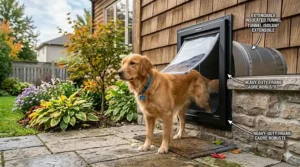
Here’s what most Amazon.ca searches won’t tell you: Canadian homes are built differently from their American counterparts. We tend to have thicker exterior walls — particularly in provinces where energy codes demand heavy insulation. A 2×6 stud wall with exterior sheathing, house wrap, and brick or stone cladding can push your total wall thickness well past 25–30 cm (10–12 inches), leaving most standard “telescoping” pet doors embarrassingly short. Pick the wrong product, and you’re looking at a gap between tunnel sections that funnels January wind straight into your kitchen. Ask me how I know.
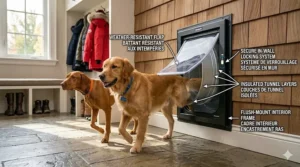
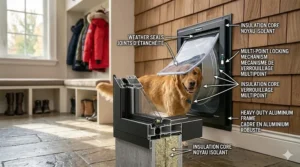
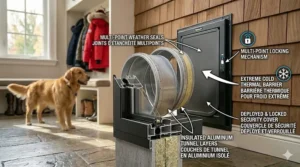
A wall dog door with tunnel for thick walls solves this with an extended, adjustable tunnel that bridges your full wall depth — sealing the opening on both sides, lining the interior passage, and giving your dog a clean, weatherproof corridor to step through. The best ones pair this deep tunnel with double or triple insulated flaps that stay flexible even at −40°C, which is exactly what you’ll need across most of Canada from November through March.
What follows is a practical, no-hype guide to seven products currently available on Amazon.ca, plus installation guidance tuned specifically to Canadian construction standards, winter performance expectations, and the kind of cold-weather details product pages tend to bury in the FAQ section. All prices are in CAD (Canadian dollars).
What is a wall dog door with tunnel for thick walls? It’s a pet door system designed specifically for through-wall installation, featuring an extended telescoping or fixed tunnel section that lines the interior of a wall cutout — typically for walls measuring 10 cm (4 in.) to 40+ cm (16+ in.) thick — providing a weatherproof, insulated passageway for dogs to move freely between indoors and outdoors.
Quick Comparison Table: Top 7 Wall Dog Doors for Canadian Thick Walls
| Product | Max Wall Depth | Flap Type | Frame Material | Best For | Price Range (CAD) |
|---|---|---|---|---|---|
| Endura Flap E2 Double Flap (Wall) | 22 cm (8.75 in.) | Double insulated | Aluminum | Extreme cold climates | $450–$600 |
| PetSafe Wall Entry Aluminum (+ Extension) | 18.4 cm + ext. | Single/Double | Aluminum | Mid-range budget | $130–$220 |
| Ideal Pet Products WEPD2XL | 23.5 cm (9.25 in.) | Double vinyl | Plastic/composite | Large dogs, budget buyers | $110–$180 |
| Baboni 3-Flap Steel Frame Wall Door | 18.4 cm (7.25 in.) | Triple magnetic | Steel/Aluminum | Durability-focused buyers | $160–$250 |
| IKUSO Magnetic Wall Pet Door | 20 cm (8 in.) | Single magnetic | Plastic | DIYers on a budget | $80–$130 |
| Eillion Wall Dog Door | 18 cm (7 in.) | Double insulated | Aluminum | Aesthetic-conscious owners | $140–$200 |
| PetSafe Never Rust Wall Entry | 18.4 cm (7.25 in.) | Double PVC | PVC/composite | Rust-prone coastal areas | $150–$230 |
Analysis: What stands out immediately in this table is the gap between the standard 18.4 cm telescoping range and what many Canadian homes actually need. If you’re installing through a brick veneer or heavily insulated wall, the Endura Flap E2 and Ideal Pet WEPD2XL are the only two here that reach close to 24 cm out of the box. The Baboni and PetSafe options address this with separately sold extension kits — workable, but factor in the extra $40–$80 CAD. Budget buyers should note that the IKUSO’s plastic frame, while adequate in mild climates, can stiffen noticeably in extreme cold, making the flap harder for smaller dogs to push open on those −30°C Prairie mornings.
💬 Just one click — help others make better buying decisions too! 😊
Top 7 Wall Dog Door with Tunnel for Thick Walls: Expert Analysis
1. Endura Flap E2 Double Flap Wall Mount Pet Door
The Endura Flap E2 is the product I’d put in my own wall if I lived anywhere between Winnipeg and St. John’s — and that’s not a casual compliment.
The standout specification here is the flap material itself: rather than standard vinyl, Endura uses a proprietary polyolefin-based polymer that stays flexible and functional down to −40°C without cracking, peeling, or stiffening into a rigid panel that your dog can’t push through. That’s a genuinely meaningful distinction for Canadian winters, where cheap vinyl flaps can turn into semi-rigid plastic sheets by February. The double-flap design creates a dead-air buffer zone inside the tunnel — the same insulating principle used in triple-pane windows — which is how the E2 earns its reputation as the most energy-efficient pet door on the market for cold climates. The heavy-gauge aluminum frame and telescope tunnel accommodate walls up to 22 cm (8.75 in.) thick for double-flap models, covering most standard Canadian 2×4 and 2×6 stud walls with cladding.
For Canadians living in northern Ontario, Alberta’s Peace Country, or interior BC where temperatures routinely hit −25°C and below, this is essentially the only wall pet door I’d recommend without caveats. It’s also available on Amazon.ca in multiple sizes (Small through Extra Large) and neutral colours that integrate cleanly with painted drywall finishes. The manufacturer backs the flap with a 15-year warranty against cracking and peeling — impressive for any pet product category.
Canadian buyers report strong satisfaction, with many specifically noting that the magnetic perimeter seal (full four-edge seal, not just a bottom-edge magnet like most competitors) keeps drafts out even when Prairie winds hit 60+ km/h.
✅ Pros:
- Flap rated flexible to −40°C — genuinely built for Canadian winters
- Full perimeter magnetic seal; far superior draught control vs. bottom-only magnets
- 15-year flap warranty; long-term cost savings vs. annual flap replacements
❌ Cons:
- Premium price in the $450–$600 CAD range — significant investment upfront
- Available in limited colour options; may require painting to match some wall finishes
Price range: $450–$600 CAD range. Given the long flap lifespan and energy savings on heating bills, the per-year cost of ownership is more competitive than the sticker price suggests.
2. PetSafe Wall Entry Aluminum Pet Door with Telescoping Tunnel
PetSafe is the name most Canadians encounter first when searching for a wall dog door with tunnel for thick walls, and there’s good reason for that brand recognition — it’s been available on Amazon.ca for years and has an enormous review base. The aluminum model in particular deserves its popularity, even if it comes with some important Canadian asterisks.
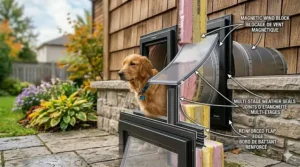
The telescoping tunnel accommodates walls 12 to 18.4 cm (roughly 4.75–7.25 in.) thick straight out of the box, with separately sold extension kits that push that range to approximately 30 cm (12 in.) — covering brick-veneer and most stucco applications. The aluminum frame is genuinely durable; it won’t warp through freeze-thaw cycles the way plastic-bodied competitors sometimes do after four or five Canadian winters. The double-flap version includes a slide-in closing panel for added insulation when you want to lock your dog inside on particularly harsh nights.
Where this product requires honest commentary: the vinyl flaps are standard weight, not the heavy insulating polymer of the Endura E2. They’ll perform adequately in moderate winters — think southern Ontario or coastal BC — but in Manitoba or Saskatchewan where −30°C is routine, you may notice some stiffening. One Canadian reviewer from a 2×8 wall installation noted the tunnels “just touched where they joined” and required duct tape at the seam — a manageable fix, but something to plan for.
Amazon.ca availability is solid across multiple sizes (Small to Large), and it’s Prime-eligible for most Canadian addresses, including free shipping for Prime members.
✅ Pros:
- Strong aluminum frame survives freeze-thaw cycles reliably
- Extension kits available for walls up to ~30 cm (12 in.) — sold separately on Amazon.ca
- Large Amazon.ca review base; easy to validate real-world Canadian performance
❌ Cons:
- Vinyl flaps may stiffen in extreme cold (below −25°C)
- Extension kits cost extra — factor $40–$80 CAD additional for thick-wall applications
Price range: $130–$220 CAD depending on size; extension kit adds to total. Best value entry point for standard insulated walls.
3. Ideal Pet Products Wall Entry Double Flap Pet Door (WEPD2XL)
This is the product I recommend to budget-conscious buyers who still need a serious deep-wall installation — and the built-in telescoping tunnel that reaches 23.5 cm (9.25 in.) without any add-on kit is genuinely the selling point here. No separate wall kit. No additional parts. The frame includes everything you need to cut, fit, and finish, which matters when you’re paying a local contractor by the hour.
The WEPD2XL extra-large flap opening (24.8 cm × 43.2 cm / 9.75 in. × 17 in.) accommodates dogs up to about 40 kg (90 lbs.), making it suitable for Labs, German Shepherds, Golden Retrievers, and most other medium-to-large breeds that dominate Canadian households. The double vinyl flaps create an air pocket for insulation, and a drain-away design in the tunnel floor moves water outward from the wall rather than letting it pool inside — a thoughtful engineering detail for wet Pacific coast winters and spring thaw in Eastern Canada.
The one honest limitation is the frame material: this is a composite/plastic body, not aluminum. For most standard suburban installations, that’s perfectly adequate. But if you’re cutting through a garage wall in northern Alberta where temperature swings between summer heat and winter cold can exceed 70°C in a single calendar year, a metal-framed option will likely outlast the Ideal Pet on a multi-decade timeline. For a 5–10 year product life, however, the value-to-performance ratio is excellent. Available on Amazon.ca in Medium and Extra Large.
✅ Pros:
- Built-in tunnel reaches 23.5 cm (9.25 in.) — no separate kit needed
- Drain-away tunnel design prevents water pooling in wet climates
- All hardware and template included; contractor-ready out of the box
❌ Cons:
- Composite/plastic frame may not match durability of aluminum in extreme temperature cycling
- Only two sizes available on Amazon.ca — limited options for small dogs or very large breeds
Price range: $110–$180 CAD. Exceptional value for the wall depth it covers without extras.
4. Baboni 3-Flap Steel Frame and Telescoping Tunnel Pet Door
The Baboni is the choice for buyers who want industrial-grade build quality without paying Endura Flap prices, and the triple-magnetic-flap design is what makes it stand apart from the double-flap crowd. Three flap layers mean three air barriers between your living room and the outside world — which sounds like overkill until you’ve felt a −35°C wind chill pressing against your back door.
The frame is manufactured using automotive-grade laser welding on aerospace aluminum alloy — Baboni’s marketing is unusually transparent about the construction process, and the finished product does feel noticeably heavier and more rigid than plastic alternatives. The magnetic closure system is strong enough to snap the flap shut against wind rather than letting it flutter loosely, which is the primary source of heat loss in most installed pet doors. The telescoping tunnel covers walls 12 to 18.4 cm (4.75–7.25 in.) thick for most sizes.
What most Canadian buyers overlook about this model is the closing panel: it’s metal, not plastic. That matters in climates where you lock the door down for weeks at a time in deep winter — a metal panel doesn’t flex or warp the way some plastic alternatives do after years of temperature cycling. Available on Amazon.ca in Small through Large.
Customer feedback is consistently strong around durability, though some buyers with larger dogs note the triple flap requires a little more push-through force than single or double designs — expect a brief training period for hesitant or older dogs.
✅ Pros:
- Triple magnetic flaps — superior draught resistance for cold climates
- Aerospace aluminum alloy frame with laser welding — exceptional build rigidity
- Metal (not plastic) closing panel; holds form through temperature cycling
❌ Cons:
- Triple flap requires more push force; may challenge elderly dogs or small breeds
- Standard tunnel depth (18.4 cm / 7.25 in.) — needs extension for brick or stucco walls
Price range: $160–$250 CAD. Mid-range pricing for genuinely above-average materials.
5. IKUSO Magnetic Wall Pet Door (Adjustable Tunnel 9–20 cm / 3.5–8 in.)
The IKUSO is the most accessible entry point on this list for Canadian renters, DIYers doing their first wall cut, or households where the dog is medium-sized and the wall isn’t excessively thick. The tunnel adjusts from 9 to 20 cm (3.5–8 in.), which covers a broader range of standard Canadian construction than the typical 12–18 cm products, and the installation package is genuinely one of the friendlier ones I’ve seen for a first-time installer — clear template, marked cut lines, and step-by-step instructions that don’t assume trade knowledge.
The frame and tunnel are robust plastic, not metal, and that’s the key trade-off to understand here. In Metro Vancouver, southern Ontario, or the Maritimes — where winters are cold but rarely punishing — the IKUSO performs admirably. In Calgary or Saskatoon, where temperatures can drop below −30°C for extended periods, the plastic frame is more susceptible to brittleness over time, and the single magnetic flap will offer less draught resistance than double-flap metal alternatives.
What the spec sheet won’t tell you: the IKUSO’s magnetic closure is genuinely effective for its category, significantly outperforming gravity-only vinyl flaps. Canadian buyers with medium-sized dogs report smooth independent use after a very short adjustment period. Available on Amazon.ca, Prime-eligible for most addresses.
✅ Pros:
- Adjustable tunnel to 20 cm (8 in.) — broader range than most budget competitors
- Very DIY-friendly installation package — good for first-time wall cuts
- Solid magnetic closure for its price category; reduces draught vs. standard flaps
❌ Cons:
- Plastic frame — less durable than metal alternatives in extreme cold cycling
- Single flap design — notably less insulating than double or triple flap systems
Price range: $80–$130 CAD. Best budget pick for moderate Canadian climates.
6. Eillion Wall Dog Door with Telescoping Tunnel
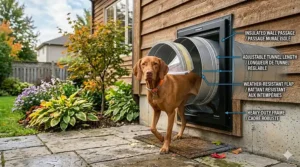
The Eillion sits in an interesting position on Amazon.ca: it’s not the absolute cheapest option, but it targets the household where aesthetics matter as much as function. The aluminum frame has a cleaner interior finish than most competitors, the available colour options (white and brushed silver) integrate more naturally with painted drywall or tile, and the double-flap insulation system performs respectably for its price tier.
The telescoping tunnel covers walls up to approximately 18 cm (7 in.) — standard for most 2×4 and 2×6 Canadian stud walls without brick or stone cladding. The double magnetic flaps provide a reasonable weatherproof seal, and the aluminum construction holds up well through freeze-thaw cycling. What genuinely impresses me about this model is the flap hinge design: it pivots rather than bending at the top, which reduces wear significantly over years of daily use — especially if you have an enthusiastic, heavy-shouldered dog who hits the flap at speed.
For a condo townhouse in Burnaby, a semi-detached in Ottawa, or a standard suburban bungalow in Edmonton with a 2×6 insulated wall, this is a credible choice that won’t look out of place. Buyers prioritizing a clean, builder-grade finish will appreciate the attention to interior aesthetics. Available on Amazon.ca.
✅ Pros:
- Cleaner aesthetic finish than most competitors — integrates well with interior design
- Pivot-style flap hinge reduces wear on heavy-use installations
- Double magnetic flap provides solid draught resistance for standard Canadian walls
❌ Cons:
- Tunnel depth limited to ~18 cm (7 in.) — won’t cover brick-veneer or thick stucco walls
- Colour options are limited; painting required for some wall finishes
Price range: $140–$200 CAD. Strong mid-range choice when aesthetics matter alongside performance.
7. PetSafe Never Rust Wall Entry Pet Door with Telescoping Frame
The “Never Rust” branding is the story here, and it’s not just marketing flair. The PVC/composite frame is genuinely impervious to the corrosion that affects aluminum frames over time — particularly relevant for homes within 10–15 km of Canadian coastlines (Greater Vancouver, Halifax, the South Shore of Nova Scotia, Greater Victoria) where salt air accelerates metal oxidation significantly faster than landlocked environments.
The telescoping tunnel covers walls 12 to 18.4 cm (4.75–7.25 in.) thick, with extension kits for walls beyond that range. The double-flap PVC design handles weatherproofing competently, and the frame can be painted — useful for matching existing wall colours without a visible seam. For Canada’s coastal communities, the key advantage is structural: aluminum frames in salty marine environments can show pitting and surface corrosion within 3–5 years, whereas the PVC composite of the Never Rust simply doesn’t degrade in the same way.
What most buyers overlook about this model: the UV-stabilised frame also resists yellowing and surface degradation from prolonged sun exposure — relevant for south-facing walls in BC’s Okanagan or Southern Alberta where intense summer UV combines with harsh winters. Available on Amazon.ca, Prime-eligible.
✅ Pros:
- PVC composite frame — no rust or corrosion in coastal salt-air environments
- UV-stabilised; resists yellowing on sun-exposed walls
- Paintable frame integrates cleanly with any wall colour
❌ Cons:
- Tunnel limited to 18.4 cm (7.25 in.) without add-on extension; same shortfall as standard models
- PVC frame less rigid than metal; not ideal for large aggressive dogs over 40 kg (90 lbs.)
Price range: $150–$230 CAD. Best pick for coastal British Columbia and Atlantic Canada homes.
✨ Don’t Miss These Exclusive Deals!
🔍 Take your pet’s freedom to the next level with these carefully selected products. Click on any highlighted item to check current pricing and availability on Amazon.ca. These doors will help you give your dog the independence they deserve — in every Canadian season!
How to Choose a Wall Dog Door with Tunnel for Thick Walls in Canada
Picking the right pet door for insulated walls in Canada isn’t just about matching a flap opening to your dog’s shoulder height. There are at least six variables that meaningfully change which product makes sense for your specific situation.
1. Measure your actual wall thickness first. Open a nearby window or exterior door and measure from the interior finished surface to the exterior finished surface across the side of the opening. That’s your real wall depth — not a guess based on stud size. Most Canadians are surprised to discover their walls are 3–5 cm thicker than they assumed once exterior sheathing, insulation board, and cladding are factored in.
2. Match the tunnel range to your wall, not the other way around. If your wall is 25 cm (10 in.) deep, a product with a maximum 18.4 cm tunnel will leave a gap that no amount of trim or caulking fully solves for cold-weather performance. Look for products that cover your depth with at least 2 cm (1 in.) of adjustment room.
3. Prioritise flap insulation rating for your climate zone. Canada spans six National Energy Code climate zones, and the flap that works fine in Victoria, BC will underperform badly in Thompson, Manitoba. Double-flap systems with full perimeter magnetic seals are strongly recommended for Zone 6 and above.
4. Choose frame material based on your environment. Aluminum for inland climates where temperature cycling is severe. PVC composite for coastal areas with salt air. Steel alloy for households with large, heavy dogs that put structural stress on the frame over years of use.
5. Factor in the dog’s physical ability to push through. Triple-flap systems have more magnetic resistance than single-flap designs. An elderly arthritic dog or a small breed pushing through three magnetic flaps in −20°C will struggle. Match the flap count to your dog’s strength and size, not just your desire for maximum insulation.
6. Verify Amazon.ca availability before purchasing. Some products ship from Amazon.com to Canada at significantly higher landed prices once customs duties and brokerage fees are applied. Products listed directly on Amazon.ca Prime avoid these charges and typically arrive within 2–5 business days to most provinces; remote and northern addresses (Yukon, NWT, Nunavut) should expect longer delivery windows.
Deep Wall Installation Guide: What Amazon Listings Don’t Tell You
This is where the real value lies — because every product page will tell you to “cut the template, insert the tunnel, screw in the frame.” What they don’t explain is what to do when your wall is a stucco exterior over rigid foam over OSB over 2×6 framing, which is increasingly common in Canadian energy-efficient construction built to post-2016 codes.
Step 1: Locate the right spot on the wall. Choose a location between studs (use a stud finder — available at any Canadian Tire or Home Depot for under $30 CAD). The bottom of the flap opening should sit roughly 5–8 cm (2–3 in.) above the finished floor outside to prevent rain and snowmelt from washing in during spring thaw. Avoid locations directly below a window or above an exterior outlet.
Step 2: Cut through layers, not all at once. For multi-layer walls (drywall + vapour barrier + insulation + sheathing + cladding), cut each layer separately. A jigsaw handles drywall and OSB well; stucco and brick require a diamond-blade angle grinder. This is where most DIY installations go wrong — rushing the cut through all layers simultaneously and ending up with a ragged opening that’s impossible to seal properly.
Step 3: Install vapour barrier carefully. This is critical for any Canadian exterior wall installation and it’s almost never mentioned in pet door instructions. The vapour barrier on your interior wall layer must be cut cleanly and folded back before the frame installs — do not cut it flush and leave it open. Use acoustic sealant (available at building supply stores) around the tunnel perimeter to re-seal the vapour plane. A failed vapour barrier around a pet door cutout can lead to interstitial condensation and mould growth inside the wall cavity over time — a costly and health-relevant problem.
Step 4: Apply exterior flashing. Before caulking the exterior frame, apply a bead of exterior-grade, paintable silicone to the top and sides (leave the bottom open for drainage). In climates with heavy snow loading or ice damming — which includes most of Northern Ontario, Quebec, Manitoba, and Alberta — consider installing a small protective hood above the exterior frame to deflect ice formation that can weigh down and deform even metal frames over multiple seasons.
Step 5: Allow 48 hours before first use in winter. If you’re installing in cold weather (below 5°C), caulks and silicone adhesives need adequate cure time before they achieve their rated bond strength. Installing on a −10°C January afternoon and putting the dog through immediately can compromise the seal.
Real-World Scenarios: Which Dog Door for Which Canadian Home?
Understanding specifications is useful. Understanding what they mean for your actual situation is more useful. Here are three Canadian household profiles and the products that genuinely make sense for each.
The Calgary Suburban Family (Single-Family Home, 2×6 Construction, Border Collie) This is the most common Canadian thick-wall installation scenario: a 2×6 stud wall with exterior rigid foam and vinyl siding, bringing total wall depth to approximately 20–23 cm (8–9 in.). The winters are severe — January lows regularly hit −25°C or below — and the dog is athletic, large, and high-traffic through any door it can access. The Endura Flap E2 Double Flap Wall Mount is the correct answer here. The −40°C-rated flap polymer, full perimeter magnetic seal, and aluminum frame make it the only product in this guide fully equipped for Prairie winters over a multi-year ownership period. The premium price is justifiable when spread across the door’s 15+ year rated lifespan.
The Halifax Coastal Homeowner (Semi-Detached, Brick Veneer, Medium Lab) Brick-veneer construction pushes wall depth to 27–32 cm (10.5–12.5 in.), which immediately eliminates most standard pet doors. The solution here is the PetSafe Wall Entry Aluminum paired with the separately sold extension kit, bringing tunnel coverage to approximately 30 cm — just sufficient for most brick-veneer applications. The PVC-frame Never Rust model is worth considering here too, given salt-air exposure from the harbour. The combination of adequate tunnel depth and salt-resistant framing covers both the structural and corrosion concerns specific to coastal Atlantic Canada.
The Vancouver Island First-Time Homeowner (Small House, Standard 2×4 Wall, Small Rescue Dog) Wall depth in a standard Vancouver Island 2×4 build is typically 11–14 cm (4.5–5.5 in.) — the lightest wall depth scenario on this list. The climate is mild by Canadian standards, with winters rarely dropping below −5°C in most of the island. Here, the IKUSO or the Eillion Wall Door are both appropriate choices — moderate insulation requirements, standard wall depth, and a price point that makes sense for a homeowner who isn’t running a high-traffic dog door all winter. The Eillion’s cleaner finish might suit a newer build with a more finished interior aesthetic.
Common Mistakes When Installing a Pet Door for Insulated Walls in Canada
Even experienced DIYers make these errors — and some of them create problems that don’t show up until the second winter.
Underestimating wall depth. I’ve seen this repeatedly in reviews: a buyer orders a product rated to 18 cm (7 in.), measures their wall at “about 7 inches,” and then discovers after cutting that their actual depth is 8.5 inches once they account for the brick face. Always measure the finished wall, not the stud size. And measure twice.
Ignoring the vapour barrier. As noted in the installation section above, this is the mistake that creates long-term structural damage — not just an energy loss issue. Standard pet door instructions do not address Canadian vapour barrier requirements. Budget an extra hour and the cost of acoustic sealant ($15–$25 CAD) to do this correctly.
Choosing a flap system that exceeds the dog’s push strength. A triple-flap system with strong magnets is theoretically the most insulating — but if a 6 kg Shih Tzu can’t push through it in November without visible effort, the convenience benefit of a pet door disappears entirely. Standard pet doors already increase annual heating costs by six percent or more if poorly sealed; a door your dog refuses to use in cold weather provides zero benefit.
Skipping exterior flashing. Caulk alone is not adequate for Canada’s climate. Freeze-thaw cycling causes even good silicone caulk to fatigue and crack over 3–5 winters. Proper flashing tape on exterior sheathing layers before the exterior frame installs dramatically extends the waterproofing lifespan of any wall penetration.
Not accounting for electrical and plumbing in the wall. Confirm there are no pipes, wires, or HVAC ducts in your planned cut location before you start. A non-contact voltage tester (under $30 CAD at Home Depot) and a visual inspection from the basement or crawlspace takes 10 minutes and prevents a catastrophic mistake.
Purchasing a product only available on Amazon.com. Several high-profile pet door brands have limited or no Amazon.ca inventory. Some ship to Canada but attract brokerage fees and customs duties that add 20–40% to the listed US price. Always verify Amazon.ca direct listing and Prime eligibility before purchasing.
Wall Dog Door vs. Door-Mounted Pet Door: Which Is Right for Canadian Homes?
This is a comparison worth making explicitly, because many Canadian buyers assume a door-mounted product is the simpler choice — and sometimes it is. But the wall installation option has distinct advantages that are particularly relevant in Canadian construction.
| Feature | Wall Dog Door (Tunnel) | Door-Mounted Pet Door |
|---|---|---|
| Wall depth compatibility | Up to 40+ cm with extensions | Limited to door thickness (4–6 cm) |
| Insulation potential | High (double/triple flap + dead air tunnel) | Moderate (flap quality varies) |
| Installation complexity | Moderate to high | Low to moderate |
| Affects door integrity? | No — wall remains intact | Yes — compromises door weatherstripping |
| Suitable for insulated walls | Yes — specifically designed for it | No — not applicable |
| Reversibility | Permanent wall cut | Reversible (hole filler available) |
| Best For | New builds or permanent residences | Renters or temporary setups |
Analysis: The wall-mounted version consistently wins on insulation performance, especially in Canadian climate conditions, because the tunnel itself acts as a thermal buffer — cold air entering through the exterior flap must travel the full wall depth before reaching the interior flap. In a 20 cm wall, that’s a meaningful energy barrier. A door-mounted pet door offers no equivalent dead air space. The trade-off is permanence — cutting through your exterior wall is a committed decision, which is why it’s most appropriate for homeowners in long-term residences rather than renters or people expecting to sell in the short term.
Long-Term Cost and Maintenance in Canada: What to Budget
The sticker price on Amazon.ca is only the beginning of the ownership calculation. Here’s what Canadian buyers should actually budget for over a 5-year ownership period:
Initial purchase: $80–$600 CAD depending on model (see table above).
Extension kit (if needed for thick walls): $40–$80 CAD additional for most PetSafe and similar models.
Installation costs: DIY installations cost only materials (tape, caulk, drill bits, ~$30–$50 CAD total). Professional contractor installation in major Canadian cities runs $150–$350 CAD for labour, and is strongly recommended for brick veneer or stucco walls requiring masonry cutting.
Flap replacement: Standard vinyl flaps in cold climates typically need replacement every 2–4 years. Budget $20–$60 CAD per replacement depending on brand. The Endura Flap’s 15-year warranty makes it a standout here — zero flap replacement cost for the first decade and a half.
Energy impact: According to Green Builder Media research cited by Family Handyman, a poorly sealed standard pet door can increase annual heating costs by 6% or more. For a Canadian household spending $2,400/year on heat (a modest estimate for most provinces), that’s $144/year in preventable losses. A quality insulated double-flap system with proper installation essentially pays for itself in heating savings within 3–5 years. This is the ROI calculation most product listings quietly skip.
Maintenance is minimal for quality products: clean the flap and frame with mild soap and water seasonally, inspect caulking after the first full winter (apply fresh bead where cracking appears), and lubricate the hinge point annually with a silicone-based spray — avoid petroleum-based lubricants that degrade vinyl flap material.
What to Expect: Real-World Pet Door Performance in Canadian Conditions
The spec sheet on any Amazon.ca listing will describe flap thickness, tunnel range, and frame material. What it won’t describe is what actually happens when a −35°C Arctic outflow settles over your neighbourhood for two weeks in February.
In genuine deep-cold conditions, the differences between products collapse quickly into a few decisive factors: Does the flap material stay pliable enough for your dog to push through? Does the magnetic closure seal tight enough to prevent cold air from seeping around the flap edges? And does the frame maintain its shape through repeated freeze-thaw cycling without warping or cracking the seal?
Products like the Endura Flap E2, tested and rated to −40°C, answer all three questions correctly. Products with standard vinyl flaps and bottom-edge magnets only answer none of them reliably. Hale Pet Door’s weatherproofing guidance notes that weather stripping and a double-flap configuration are the primary factors in real-world draught resistance — technical specifications matter less than these two fundamentals.
For Canadian buyers in Zone 7 or Zone 8 (most of northern Canada, Prairie provinces, interior Ontario and Quebec), the realistic expectation is: a properly installed double-flap pet door with full perimeter sealing will perform well. A single-flap door with bottom-only magnets will cause measurable energy loss and increasing frustration throughout winter.
✨ Don’t Miss These Exclusive Deals!
🔍 Ready to give your dog the freedom they deserve — year-round, in every Canadian season? Click any highlighted product name to check current pricing and availability on Amazon.ca. The right wall dog door with tunnel for thick walls is one installation away from changing your dog’s daily life.
FAQ: Wall Dog Door with Tunnel for Thick Walls in Canada
❓ What is the best wall dog door with tunnel for thick walls for Canadian winters?
❓ Can I install a pet door for insulated walls myself in Canada, or do I need a contractor?
❓ Does a deep wall installation pet door affect home energy efficiency in Canada?
❓ Are wall pet door extension tunnels available on Amazon.ca for extra thick walls?
❓ Will a wall dog door tunnel freeze shut in Canadian winters?
Conclusion: The Right Wall Dog Door Makes Canadian Winters Work for Both of You
There’s a version of Canadian dog ownership where you’re the full-time doorman from October to April — up at 6 a.m., opening the back door into the cold, closing it again, repeat forty times a day. And there’s a version where you’ve installed the right wall dog door with tunnel for thick walls, caulked the exterior frame properly, and your dog has figured out within three days that they can come and go without waking you.
The right product for your home depends on four honest variables: your wall’s actual depth, your climate zone, your dog’s size and temperament, and your budget. For most Canadian households with standard 2×6 walls, the Endura Flap E2 is the performance choice and the Ideal Pet Products WEPD2XL is the value choice. For thick brick or stucco walls, the PetSafe Aluminum with an extension kit is the most accessible solution. For coastal homes, the PetSafe Never Rust handles salt air with less long-term maintenance concern.
What every buyer on this list should prioritise above the price: double flap over single flap, metal or composite frame over bare plastic in cold climates, and proper vapour barrier restoration after the wall cut. Those three decisions will determine whether your pet door is a five-year investment or a permanent convenience that outlasts the dog who first used it.
✨ Don’t Miss These Exclusive Deals!
🔍 Every highlighted product in this guide is available to check on Amazon.ca right now. Click through to verify current pricing, confirm Prime eligibility for your postal code, and read verified Canadian customer reviews before you buy!
Recommended for You
- Best Wall Mounted Dog Door for Large Dogs Canada 2026
- Best Insulated Sliding Glass Dog Door Winter Canada 2026 (7 Picks)
- Best Dog Door for Sliding Glass Door in Canada 2026 (Top 7)
Disclaimer: This article contains affiliate links. As an Amazon Associate, I earn from qualifying purchases. If you purchase products through these links, we may earn a small commission at no additional cost to you.
✨ Found this helpful? Share it with your friends! 💬🤗
