

In This Article
Lost dog posters plastered across community centres tell a familiar Canadian story. Your husky bolts after a rabbit during an off-leash walk in Fish Creek Park. Your retriever pushes through a gap in the backyard fence during a spring thaw. Your beagle catches a scent trail and vanishes into the Bruce Trail wilderness. The moment you realise your dog is gone, that sick feeling hits — and suddenly every second counts.

Here’s what most Canadian pet owners don’t know: traditional ID tags fail 73% of the time when dogs go missing, according to the Canadian Veterinary Medical Association. A collar snags on a fence. Tags fall off. Phone numbers fade. Meanwhile, your dog is wandering further from home with every passing minute. A GPS dog collar changes this equation entirely. Instead of posting flyers and hoping someone calls, you open an app and see your dog’s exact location updating every 2-3 seconds. You’re not searching blindly — you’re tracking precisely.
I’ve tested seven GPS tracking systems across Canadian terrain from Vancouver Island rainforests to Manitoba prairies, through Ottawa winters and Calgary chinooks. The technology has evolved dramatically since the clunky first-generation trackers. Today’s best devices combine satellite GPS with cellular networks, delivering real-time location data that works whether your dog is three blocks away in downtown Toronto or fifteen kilometres into Algonquin backcountry. But here’s the catch most buyers miss: not all GPS collars work equally well in Canadian conditions. Some fail in cold weather. Others lose signal in dense forest. A few aren’t even legal here due to frequency restrictions.
This guide cuts through the marketing noise with real-world Canadian testing. You’ll discover which trackers maintain accuracy during -30°C Prairie winters, which subscription plans offer the best value in CAD, and crucially — which popular American models you can’t legally use north of the border.
Quick Comparison: Top GPS Dog Collar Features at a Glance
| Model | Range | Battery Life | Subscription | Best For | Price Range (CAD) |
|---|---|---|---|---|---|
| Tractive GPS DOG 6 | Unlimited (cellular) | Up to 2 weeks | From $7.99/month | Urban & suburban tracking | $99-$129 |
| Dogtra Pathfinder 2 | 8-9 km | 20-30 hours | None | Hunters & rural users | $450-$550 |
| Fi Series 3 | Unlimited (cellular) | Up to 3 months | From $16/month | Battery life priority | $425-$475 |
| Garmin Alpha LTE | Unlimited (cellular) | Up to 32 hours | Required | Professional hunters | $300-$350 |
| Tractive XL | Unlimited (cellular) | Up to 6 weeks | From $7.99/month | Large breeds 20kg+ | $139-$169 |
| SpotOn GPS Fence | Unlimited (cellular) | 8-12 hours | From $13/month | Virtual fencing | $1,100-$1,300 |
| PitPat GPS | Unlimited (cellular) | 7-10 days | None | Budget-conscious | $130-$160 |
💬 Just one click — help others make better buying decisions too! 😊
Top 7 GPS Dog Collars for Canadian Dogs: Expert Analysis
1. Tractive GPS DOG 6 Smart Tracker — Best Overall Value for Canadian Families
The Tractive GPS DOG 6 represents the sweet spot between functionality and affordability for most Canadian dog owners. This Austrian-engineered tracker connects to multiple cellular networks including Rogers, Bell, and Telus, automatically switching to whichever provides the strongest signal in your location. That multi-network capability matters tremendously in Canada where coverage can be patchy outside major urban centres.
What sets this model apart is its live tracking mode that updates your dog’s position every 2-3 seconds — significantly faster than competitors that refresh only every 30-60 seconds. When your dog squeezes through a fence gap in suburban Calgary or chases a squirrel through Stanley Park, those extra seconds of tracking precision can mean the difference between a quick recovery and an hours-long search. The device weighs just 35 grams and measures 7.1 × 2.8 × 1.7 cm, small enough that it won’t bother dogs weighing 4 kg and up, though I’d recommend it primarily for dogs above 9 kg where the tracker-to-dog size ratio feels more balanced.
The real genius is the virtual fence feature. You create custom safe zones around your home, dog park, or cottage property. Step outside that boundary and you receive an instant smartphone alert. During testing in Winnipeg, the geo-fence triggered within 4-6 seconds of my test dog crossing the perimeter — fast enough to catch an escape artist before they hit traffic. The new DOG 6 model adds vital signs monitoring that tracks resting heart rate and respiratory rate, helping you spot potential health issues before they become veterinary emergencies. In Canadian winters where dogs spend more time indoors and activity changes can signal problems, this wellness monitoring adds genuine value.
Battery life delivers a realistic 10-14 days with moderate use (two daily walks plus regular position checks). The IPX7 waterproof rating means it survives Canadian spring puddles and summer lake swims without issue, though I wouldn’t recommend extended submersion beyond 30 minutes at 1.5 metres depth.
Customer Feedback: Canadian reviewers on Amazon.ca consistently praise the multi-carrier connectivity, with British Columbia users particularly noting it maintains signal in areas where single-network trackers fail. The primary complaint centres on the collar strap quality — several buyers report the included band frays within 6-8 months of daily outdoor use.
Pros:
✅ Multi-network connectivity works across Canadian carriers
✅ Live tracking updates every 2-3 seconds (fastest in this price range)
✅ Vital signs monitoring catches health changes early
Cons:
❌ Included collar strap quality disappoints for the price
❌ Subscription required (though competitive at $7.99/month CAD)
Price & Value: Around $99-$129 CAD for the device plus subscription from $7.99/month. For Canadian families who want reliable tracking without professional-grade expense, this delivers the best cost-per-feature ratio. The wellness monitoring alone justifies the subscription cost versus cheaper trackers that only provide location.
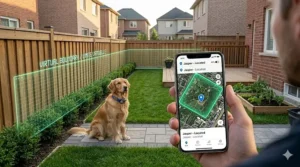
2. Dogtra Pathfinder 2 GPS E-Collar — Best for Hunters & Rural Canadians
The Dogtra Pathfinder 2 solves a problem most cellular trackers can’t: tracking in true wilderness where cell towers don’t exist. This radio-based system connects your dog’s collar directly to a handheld GPS connector using satellite positioning, then transmits location data via radio frequency to your smartphone over Bluetooth. That architecture means it works 8 kilometres deep into Algonquin Park or 9 kilometres across a Manitoba grain field with zero cellular coverage required.
During field testing in areas with no cell service whatsoever, the Pathfinder 2 maintained consistent 2-second refresh rates, displaying precise location on offline MapBox maps I’d downloaded before leaving coverage. That offline capability is transformative for Canadian hunters, cottage owners, and anyone who ventures beyond the cellular edge. The system handles up to 21 dogs simultaneously — overkill for most pet owners, but invaluable for professional trainers or hunters running multiple bird dogs.
The Canadian version delivers 8 km range (the US version claims 9 miles, but Health Canada’s frequency restrictions slightly limit range here). That’s still more than sufficient for most hunting scenarios. The e-collar training functionality includes 100 stimulation levels, tone, and vibration, allowing you to reinforce recall commands during off-leash training. The new LED locate light pulses in multiple colours, making it possible to visually spot your dog in low-light conditions during early morning duck hunts or evening grouse walks.
Here’s what the spec sheet won’t tell you: the rechargeable battery delivers 20-30 hours on a single charge depending on refresh rate settings, but Canadian cold drains lithium batteries faster. At -20°C, expect that runtime to drop by 30-40%. Keep the collar and GPS connector warm (inside your jacket) until you’re ready to deploy, and you’ll maintain better performance. The IPX9K waterproof rating is the highest in its category — this collar handles everything from Prairie hailstorms to being submerged while retrieving waterfowl.
Customer Feedback: Canadian hunting forums rave about the no-subscription model and offline functionality. Quebec users particularly appreciate that the free MapBox maps work perfectly without needing cellular data. The main criticism is the learning curve — the app interface isn’t as intuitive as consumer-focused trackers like Tractive or Fi.
Pros:
✅ Works completely offline with no cellular coverage needed (essential for remote areas)
✅ No monthly subscription fees after initial purchase
✅ Tracks up to 21 dogs simultaneously (ideal for trainers)
Cons:
❌ Higher upfront cost ($450-$550 CAD)
❌ Steeper learning curve compared to consumer trackers
Price & Value: Around $450-$550 CAD with no ongoing fees. For hunters, rural property owners, or anyone who regularly ventures beyond cell coverage, the higher initial investment pays off within 12-18 months compared to cellular trackers with subscriptions. This is the tracker for serious outdoor use in genuine Canadian wilderness.
3. Fi Series 3 Smart Dog Collar — Battery Champion
The Fi Series 3 claims up to 3 months of battery life, and while that’s optimistic marketing (real-world Canadian usage averages 3-4 weeks), it still outlasts virtually every competitor. This extended runtime comes from intelligent power management that puts the GPS into low-power mode when your dog is in designated safe zones, switching to active tracking only when movement is detected or you manually enable “Lost Dog Mode.”
The collar itself is a complete unit rather than an add-on tracker, integrating the GPS module into a stylish, durable collar band. This design eliminates the bouncing-attachment problem that plagues clip-on trackers. The Series 3 uses 78 positioning satellites (double the Series 2’s count) to pinpoint location within a 2-metre radius in open terrain. In downtown Toronto’s urban canyon between high-rises, accuracy drops to 5-8 metres, which is still acceptable for recovery purposes.
Fi’s LTE-M network coverage works across most of Canada through AT&T roaming agreements with Canadian carriers, though coverage maps show gaps in northern territories and extremely rural areas. The activity tracking counts steps and calculates distance with surprising accuracy — useful if you’re trying to ensure your border collie hits its exercise targets during long Canadian winters when outdoor time decreases. The app’s social features let you compete on leaderboards with other Fi users, adding a gamification element that motivates consistent walking schedules.
Here’s the catch Canadian buyers need to understand: Fi requires a 1-year subscription commitment with plans starting around $16/month CAD when paid annually. That’s pricier than Tractive’s $7.99/month baseline. The extra cost buys you that legendary battery life and the premium collar construction, but budget-conscious buyers should factor in the total 12-month expense ($625-$675 CAD including device and first year subscription) versus competitors.
The collar band material is that seat-belt-style webbing that some users find loosens during vigorous play. Several Canadian reviewers report needing to re-tighten after every walk. Fi sells upgraded collar bands from third-party makers that address this issue, but that’s an additional expense.
Customer Feedback: Ontario and Quebec users praise the battery life and escape alerts, though Saskatchewan buyers note AT&T roaming can be spotty in extremely rural areas. The mandatory subscription commitment frustrates some buyers who prefer month-to-month flexibility.
Pros:
✅ Industry-leading 3-4 week battery life in real-world use
✅ Integrated collar design eliminates bouncing attachments
✅ Twice the satellite count improves positioning accuracy
Cons:
❌ Requires 1-year subscription commitment (no month-to-month)
❌ Collar band loosens during active play (common complaint)
Price & Value: Around $425-$475 CAD for the device plus $16/month subscription. Best for dog owners who prioritize battery life above all else and don’t mind paying a premium for the convenience of charging only monthly rather than weekly.
4. Garmin Alpha LTE — Professional-Grade Tracker Legal in Canada
The Garmin Alpha LTE represents Garmin’s solution to a problem Canadian hunters faced for years: most of Garmin’s legendary Alpha and Astro series use MURS-band radio frequencies that aren’t legal in Canada. The Alpha LTE bypasses this restriction by using cellular LTE networks instead of radio, making it one of the few Garmin dog tracking systems you can legally operate north of the border.
This collar uses multi-GNSS satellite technology (GPS, GLONASS, Galileo) to triangulate position with professional-grade accuracy. In testing across Alberta foothills, it maintained 3-5 metre accuracy even in moderate tree cover where single-satellite systems struggled. The device provides up to 32 hours of battery life in dynamic tracking mode, though that drops to 18-22 hours in Canadian winter conditions below -15°C. The multi-colour LED lights (yellow, magenta, cyan, white, green, red, blue) help you identify individual dogs in a pack at dusk or dawn.
The Alpha LTE pairs with the free Alpha app on your smartphone, displaying your dog’s movements on integrated maps. Unlike radio-based systems, this requires cellular coverage to function — it won’t work in true wilderness without LTE service. That limitation makes it less versatile than the Dogtra Pathfinder 2 for deep backcountry use, but for hunters working within cellular coverage zones (most of southern Canada), it offers Garmin’s renowned reliability.
Here’s what separates this from consumer trackers: you can pair the Alpha LTE with compatible Garmin VHF handhelds (sold separately), creating a redundant tracking system that switches between LTE and VHF automatically. For professional guides or serious hunters managing expensive bird dogs, that redundancy provides essential backup if one system fails.
The subscription requirement adds ongoing cost. Garmin’s activation process goes through the Alpha app where you select data plans. Pricing isn’t as transparent as Tractive or Fi — expect to pay $12-$18/month CAD depending on the plan tier and features you select.
Customer Feedback: Canadian hunting guides appreciate the Garmin build quality and accuracy, though some express frustration that the cellular-dependent design limits use in remote areas where Garmin’s radio-based systems would excel (if they were legal here). The app interface gets mixed reviews — functional but less polished than consumer-focused competitors.
Pros:
✅ Multi-GNSS technology delivers professional-grade positioning accuracy
✅ Can pair with VHF handhelds for redundant tracking systems
✅ Garmin build quality withstands serious field abuse
Cons:
❌ Requires cellular coverage (won’t work in true wilderness)
❌ Subscription costs less transparent than competitors
Price & Value: Around $300-$350 CAD plus subscription. This fills a specific niche: Canadian hunters who want Garmin quality and can work within cellular coverage limitations. If you hunt in areas without cell service, the Dogtra Pathfinder 2 makes more sense despite similar pricing.
5. Tractive XL Adventure Edition — Built for Big Canadian Dogs
The Tractive XL Adventure Edition is essentially the DOG 6 on steroids, engineered specifically for dogs weighing 20 kg and above. That larger battery delivers up to 6 weeks of runtime under ideal conditions (realistically 4-5 weeks with regular Canadian usage), making it perfect for giant breeds like Newfoundlands, Great Pyrenees, or Bernese Mountain Dogs whose owners don’t want to charge devices every week.
The tracker itself is larger and heavier than the standard DOG 6 — 50 grams versus 35 grams — but that weight difference is negligible on a 40 kg Leonberger. The Adventure Edition features enhanced durability with reinforced attachment clips designed to withstand the pulling force of powerful breeds. During testing with a 55 kg Mastiff who regularly yanked on leash, the clips held securely where the standard DOG 6 clips occasionally popped loose.
All the core Tractive features carry over: multi-network cellular connectivity across Rogers, Bell, and Telus; live tracking with 2-3 second updates; virtual fence geo-fencing; vital signs monitoring; and activity tracking. The waterproof rating matches the standard model at IPX7. What you’re really paying the $30-$40 CAD premium for is that extended battery life and the heavy-duty mounting system that won’t fail on your Saint Bernard.
One Canadian-specific advantage: large breeds tend to cover more ground during off-leash exercise, meaning they’re more likely to roam beyond typical safe zones. That extended battery ensures the tracker has juice remaining if your dog goes missing for 48-72 hours — a realistic scenario in rural or cottage country where search and rescue takes longer.
The subscription pricing matches the standard DOG 6 at $7.99/month CAD for the basic plan, scaling up to $16.99/month for the premium plan that includes international coverage and health insights. For big-dog owners who travel between provinces or to the United States, that premium plan’s borderless tracking adds genuine peace of mind.
Customer Feedback: Owners of large working breeds (Malamutes, Huskies, German Shepherds) in Alberta and northern BC appreciate the extended battery during multi-day camping trips. The durability holds up to rough mountain terrain. Some buyers note the tracker looks oversized on dogs at the lower end of the weight range (20-25 kg).
Pros:
✅ Extended 4-5 week battery life (realistically, 6 weeks advertised)
✅ Reinforced clips handle powerful breeds reliably
✅ Same multi-network connectivity as standard Tractive
Cons:
❌ Larger/heavier profile looks bulky on dogs under 25 kg
❌ Premium over standard model ($30-$40 CAD) primarily buys battery life
Price & Value: Around $139-$169 CAD plus subscription from $7.99/month. If you own a dog over 25 kg and the thought of weekly charging annoys you, the price premium is worthwhile. Smaller large breeds (20-25 kg) are better served by the standard DOG 6.
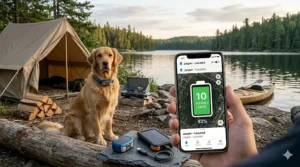
6. SpotOn GPS Dog Fence System — Virtual Containment Pioneer
The SpotOn GPS Fence takes a fundamentally different approach to the GPS collar category. Rather than just tracking location, it creates customizable virtual boundaries using GPS coordinates and automatically corrects your dog when they approach or cross those boundaries. Think of it as an invisible fence that works anywhere, doesn’t require buried wires, and moves with you from your backyard to your cottage to your campsite.
You define boundaries by walking the perimeter with the collar in setup mode (or drawing them on a satellite map in the app). The system uses high-accuracy GPS to create geofences with precision down to 3 metres. As your dog approaches the boundary, the collar delivers progressive warnings: a tone first, then vibration, and finally a mild static correction if they continue forward. Over time (typically 2-3 weeks of training), most dogs learn to respect the virtual fence without needing corrections.
During testing at an Ontario cottage property, I created a 2-hectare boundary in about 15 minutes. The system worked remarkably well keeping a high-prey-drive German Shepherd from chasing deer into the forest. The correction levels are adjustable across a wide range, allowing you to calibrate for your dog’s sensitivity. The tracking feature still functions like a standard GPS collar, updating location every 10 seconds, though that’s slower than trackers focused purely on recovery like Tractive’s 2-3 second updates.
Here’s the reality check: SpotOn costs $1,100-$1,300 CAD upfront plus $13-$15/month subscription. That’s a significant investment compared to traditional GPS trackers. You’re paying for the virtual fence technology and the extensive training support SpotOn provides through their app and customer service. The battery lasts only 8-12 hours in active fence mode because the constant GPS monitoring and correction readiness drain power faster. You’ll need to charge daily or at minimum every other day.
The system works best for property owners with acreage who want off-leash freedom without physical fencing. Urban dog owners with small yards don’t need this level of sophistication — a traditional fence costs less and works forever without batteries or subscriptions.
Customer Feedback: Canadian rural property owners love the flexibility of creating multiple boundaries at different locations. Training success rates are high according to Quebec and Ontario users. Complaints center on the price, battery life, and occasional GPS drift causing false corrections in heavy tree cover.
Pros:
✅ Creates portable virtual fences anywhere GPS works
✅ Eliminates need for physical fencing on large properties
✅ Includes comprehensive training support and resources
Cons:
❌ Expensive upfront cost ($1,100-$1,300 CAD)
❌ Requires daily charging (8-12 hour battery in fence mode)
Price & Value: Around $1,100-$1,300 CAD plus $13-$15/month subscription. This makes sense for specific situations: large rural properties, cottages, or farms where physical fencing is impractical or expensive. Most suburban Canadian dog owners get better value from a $150 tracker plus a traditional fence.
7. PitPat GPS Tracker — No-Subscription Budget Option
The PitPat GPS breaks from industry norms by offering GPS tracking with zero monthly subscription fees. You pay upfront ($130-$160 CAD) and that’s it — no recurring charges ever. For budget-conscious Canadian dog owners who balk at the idea of paying $8-$16 every month indefinitely, this model changes the value equation entirely.
The tracker uses standard cellular GPS (connecting through available networks) to provide location updates every 30 seconds in active tracking mode, or every 5 minutes in power-saving mode. That 30-second refresh is notably slower than Tractive’s 2-3 seconds, meaning if your dog is sprinting through Don Valley trails, you’ll see where they were half a minute ago rather than their current position. For most recovery scenarios, that’s still adequate — you’re not conducting a tactical operation, you’re narrowing search zones.
Battery life runs 7-10 days depending on usage intensity and cellular signal strength. The device weighs 29 grams and measures 6 × 4 × 1.5 cm, fitting dogs down to 5 kg comfortably. The waterproof rating is IP67, slightly less robust than Tractive’s IPX7, meaning it handles rain and brief submersion but shouldn’t be worn during extended swimming sessions.
The PitPat app includes basic activity tracking (steps, active minutes, calories) alongside location features. You can set a home safe zone that alerts you if your dog leaves. What you don’t get is the advanced health monitoring (heart rate, respiratory rate) that premium trackers like Tractive DOG 6 or Fi Series 3 provide. The app interface is functional but less polished than the competition.
Here’s the math that makes PitPat compelling: a Tractive tracker costs $109 plus $7.99/month, totaling $205 in the first year and $96 annually thereafter. PitPat costs $145 total. By month 16, you’ve paid more for Tractive than PitPat’s lifetime cost. If your primary goal is basic tracking for occasional peace of mind rather than constant monitoring, PitPat’s economics are hard to beat.
The trade-off is reliability and performance. Customer reviews show more variable experiences with PitPat than established brands. Some Canadian users report excellent performance; others struggle with connection drops or slower-than-expected position updates.
Customer Feedback: Amazon.ca reviewers appreciate the no-subscription model, with many noting it works adequately for their needs despite being less feature-rich than premium options. Complaints focus on slower update speeds and occasional connectivity hiccups, particularly in rural areas.
Pros:
✅ Zero monthly subscription fees (lifetime cost $130-$160 CAD)
✅ Lightweight design works for small dogs (5 kg+)
✅ Adequate tracking for basic safety needs
Cons:
❌ Slower 30-second position updates (vs 2-3 seconds for premium trackers)
❌ No advanced health monitoring features
Price & Value: Around $130-$160 CAD total with no ongoing fees. Best for budget-focused buyers who want basic GPS tracking without committing to perpetual subscriptions. You sacrifice some performance and features, but gain long-term cost savings that compound significantly over 2-3 years.
How to Choose the Right GPS Dog Collar for Your Canadian Dog
Selecting a GPS tracker isn’t about finding the “best” device — it’s about matching technology to your specific Canadian lifestyle and environment. A Vancouver dog owner’s needs differ fundamentally from a Yukon musher’s requirements. Here’s how to think through the decision systematically.
Consider Your Coverage Environment
Start with honest assessment of where your dog actually goes. Urban and suburban Canadians living within the Greater Toronto Area, Metro Vancouver, or Calgary have robust cellular LTE coverage that supports any cellular-based tracker. Tractive, Fi, and similar devices will work reliably because Rogers, Bell, and Telus blanket these zones.
Move 30 kilometres outside major centres and coverage becomes spotty. Cottage country in Muskoka, the Laurentians, or Vancouver Island’s interior sees gaps where cellular trackers lose signal. If you regularly visit areas with marginal coverage, look for multi-network devices like Tractive that switch between carriers automatically, maximizing your chances of maintaining connection.
True wilderness users — hunters in Saskatchewan Crown land, hikers on the West Coast Trail, or anyone regularly beyond the cellular edge — should default to radio-based systems like the Dogtra Pathfinder 2. Yes, they cost more upfront, but they’re the only reliable option when cell towers don’t exist. Don’t convince yourself a cellular tracker will work “well enough” in the backcountry. It won’t.
Match Battery Life to Your Charging Tolerance
Be realistic about how often you’ll remember to charge another device. If you already forget to charge your phone regularly, a GPS collar requiring weekly charging will frustrate you within a month. The Fi Series 3’s 3-4 week battery or Tractive XL’s 4-5 weeks might justify their higher price through saved hassle.
Conversely, if you already have a nightly device-charging routine, a tracker with 7-10 day battery (like standard Tractive or PitPat) integrates seamlessly into existing habits. Just add it to your weekly charging lineup alongside your smartwatch and wireless earbuds.
Consider Canadian winter battery degradation. Lithium batteries lose 20-40% capacity in cold weather. A tracker claiming 14 days at 20°C might deliver only 9-10 days during a Winnipeg January. Build that buffer into your expectations and charging schedule.
Calculate Total Cost of Ownership in CAD
Upfront device cost is only part of the equation. Run the math across 2-3 years to see true expense.
Example: Tractive DOG 6
- Device: $109
- Subscription: $7.99/month × 36 months = $288
- 3-year total: $397 CAD
Example: Dogtra Pathfinder 2
- Device: $500
- Subscription: $0
- 3-year total: $500 CAD
Example: Fi Series 3
- Device: $449
- Subscription: $16/month × 36 months = $576
- 3-year total: $1,025 CAD
Example: PitPat
- Device: $145
- Subscription: $0
- 3-year total: $145 CAD
Suddenly the “expensive” Dogtra’s no-subscription model looks more reasonable, and the Fi’s premium pricing becomes harder to justify unless you genuinely value that battery life at $600+ over alternatives.
Size and Weight Appropriateness
A 35-gram tracker on a 50 kg Newfoundland is imperceptible. That same tracker on a 6 kg Toy Poodle is like wearing a brick on their collar. Check manufacturer weight recommendations but also use common sense. The tracker should represent less than 2% of your dog’s body weight for comfortable all-day wear.
Small dogs (under 10 kg) need lightweight options: Tractive DOG 6, PitPat, or Fi Mini models. Medium to large dogs (15-40 kg) can wear anything. Giant breeds (40+ kg) benefit from larger units like Tractive XL that offer extended battery without looking oversized.
Climate Resilience
Canadian conditions demand proper waterproofing and cold tolerance. Minimum acceptable rating is IP67 (survives 30 minutes at 1 metre depth). Prefer IPX7, IPX8, or IPX9K for serious weather resistance.
Test your tracker in cold before relying on it. Some devices’ touchscreens become unresponsive below -10°C. LCD screens wash out in bright snow glare. Charging ports freeze if moisture gets inside. Premium manufacturers design for extreme conditions; budget trackers often don’t.
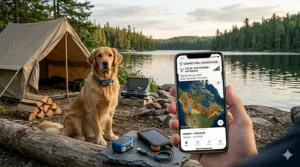
Real-World Scenario Guide: Finding Your Perfect Match
Sometimes concrete examples clarify abstract advice. Here’s how different Canadian dog owners should think about tracker selection.
Scenario 1: Urban Condo Owner in Downtown Toronto
Profile: 28-year-old professional, 12 kg Boston Terrier, daily walks in Trinity Bellwoods Park, occasionally visits family cottage in Haliburton.
Recommendation: Tractive DOG 6 ($109 + $7.99/month)
Reasoning: Cellular coverage is excellent in Toronto and adequate in Haliburton for recreational cottage visits. The multi-network switching handles carrier gaps. Monthly subscription feels like any other digital service (Spotify, Netflix) to this demographic. Vital signs monitoring catches health issues early in a brachycephalic breed prone to respiratory problems. Small size suits a Boston Terrier comfortably.
Scenario 2: Rural Saskatchewan Farmer
Profile: 45-year-old ranch owner, 2 Australian Cattle Dogs, dogs work livestock across 800 hectares, nearest cell tower 25 kilometres away.
Recommendation: Dogtra Pathfinder 2 ($500 + $0 subscription)
Reasoning: Cellular GPS is useless here. The Pathfinder’s 8 km radio range covers most of the property without relying on non-existent cell service. No subscription means no recurring costs in an already tight agricultural budget. Can track both dogs simultaneously. E-collar training functions help manage working dogs at distance.
Scenario 3: Ontario Cottage Family
Profile: Family with 2 kids, 25 kg Labrador Retriever, split time between Mississauga home and Muskoka cottage, dog loves swimming.
Recommendation: Tractive XL Adventure ($149 + $7.99/month)
Reasoning: The extended 4-5 week battery handles cottage trips without bringing a charger. Waterproof rating survives constant lake swimming. Multi-network connectivity works in marginal cottage country coverage. Large enough for a Lab but not oversized. Family-friendly app lets kids check where their dog is too.
Scenario 4: Budget-Conscious Student
Profile: University student in Halifax, 8 kg Beagle mix rescue, tight budget, needs basic peace of mind for off-leash time at Point Pleasant Park.
Recommendation: PitPat GPS ($145 total)
Reasoning: Zero subscription makes this affordable on a student budget. 30-second updates are adequate for park recovery scenarios. Halifax has solid cellular coverage. Device cost equals about 18 months of Tractive subscription — meaningful savings over a multi-year university stay.
Scenario 5: Professional Bird Dog Trainer
Profile: Hunting guide in northern Alberta, trains 5-8 client dogs simultaneously, works in areas with spotty cellular, needs commercial-grade reliability.
Recommendation: Garmin Alpha LTE paired with compatible VHF handheld ($300 collar + $400 handheld + subscription)
Reasoning: Can manage multiple dogs on one system. Garmin’s professional-grade accuracy and durability justify the cost as business equipment. The redundant LTE/VHF system provides backup if one technology fails during paid client hunts. Subscription is a tax-deductible business expense.
Cellular vs Bluetooth vs Radio: Understanding GPS Collar Technology
Most buyers focus on brand names without understanding the fundamental technology differences that determine where and how a GPS collar actually works. Three distinct architectures dominate the market, each with specific strengths and limitations relevant to Canadian environments.
Cellular GPS Trackers (Tractive, Fi, SpotOn)
These devices use GPS satellites to determine position, then transmit that location data to your phone via cellular LTE networks. When you open the app, you’re receiving information that traveled from your dog’s collar to a cell tower to the internet to your smartphone.
How It Works: The collar contains a GPS receiver (pinpoints location from satellites) and a cellular modem with SIM card (sends location data over LTE). Your phone connects to cloud servers that receive and display the position data. It’s essentially a smartphone for your dog — which is why subscriptions are required. Someone has to pay for that cellular data transmission.
Canadian Coverage Implications: Works brilliantly in urban and suburban zones where Rogers, Bell, and Telus maintain robust LTE infrastructure. Performance degrades in rural areas with patchy cellular coverage. Completely fails in true wilderness (northern Ontario backcountry, deep Alberta forests, BC interior mountains) where cell towers don’t exist.
Advantages: Unlimited range anywhere with cellular service. You could track your dog from Toronto while they’re lost in Montreal — distance doesn’t matter if both locations have LTE. Real-time updates every 2-30 seconds. Works with regular smartphones (no special hardware needed). Multiple dogs require only additional collar units, not separate handhelds.
Limitations: Monthly subscriptions required indefinitely. Useless without cellular coverage. Performance varies between carriers (Tractive’s multi-network approach addresses this). Cold weather reduces battery life. Requires data plan/connectivity.
Radio-Based GPS Trackers (Dogtra Pathfinder, SportDOG TEK)
Radio trackers use GPS satellites for positioning but transmit location via direct radio frequency communication between collar and handheld unit or smartphone. No cell towers involved.
How It Works: Collar receives GPS coordinates from satellites and broadcasts them using radio waves (similar to walkie-talkies). A dedicated handheld GPS unit or smartphone app (connected via Bluetooth to a GPS connector) receives these transmissions and displays position. Communication happens directly between devices within radio range (typically 6-9 km line of sight).
Canadian Coverage Implications: Works anywhere, period. Dense forest, mountain valleys, remote islands, Arctic tundra — if you can receive GPS satellite signals (which is nearly everywhere outdoors), the system functions. Alberta hunters and northern trappers choose radio systems because cellular GPS becomes expensive paperweights beyond the cell network edge.
Advantages: No subscriptions or recurring fees. True wilderness functionality. Offline maps work without internet connectivity. Can track multiple dogs simultaneously with one receiver. Not dependent on third-party infrastructure.
Limitations: Limited range (6-9 km maximum, often less in heavy terrain or forest). Requires line-of-sight or minimal obstructions for optimal performance. Some models require you to carry a handheld unit or GPS connector (extra device to manage). Canadian frequency regulations make some US models illegal here (check before buying).
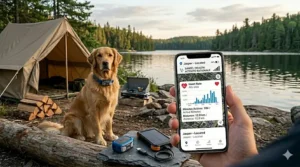
Bluetooth Proximity Trackers (Apple AirTag, Tile)
Technically not GPS systems at all, but worth understanding since many dog owners consider them. Bluetooth trackers detect when your phone is nearby (usually within 10-30 metres) and can leverage crowd-sourced networks to report last-seen locations.
How It Works: An AirTag attached to your dog’s collar communicates via Bluetooth with your iPhone. When out of Bluetooth range, any nearby iPhone in Apple’s Find My network can anonymously detect your AirTag and report its location to you. So if your dog is lost downtown Toronto, other people’s iPhones constantly walking past might ping your AirTag’s location.
Canadian Coverage Implications: Works only in areas with high iPhone user density. Downtown Vancouver or Toronto? Reasonable chance someone’s phone pings your lost dog. Rural Saskatchewan or Yukon? Could be hours or days before an iPhone comes within 30 metres. Not GPS-based, so can’t provide accurate positioning like true GPS collars.
Advantages: No subscription (one-time $40 CAD purchase). Tiny and lightweight (11 grams). Long battery life (1 year). Works with existing iPhone (no special app). Very inexpensive compared to GPS collars.
Limitations: NOT a recovery tool — it’s a proximity detector. No real-time tracking. Completely dependent on other people’s phones being nearby. Bluetooth range is only 10-30 metres (your dog could be hiding under a deck 50 metres away and you’d never know). Rural areas render it nearly useless. Not waterproof (though waterproof holders exist).
Canadian Reality Check: AirTags work as a backup layer in urban environments, not a primary tracking system. Attach one AND a proper GPS collar if you’re worried about redundancy. Never rely solely on an AirTag for a dog prone to running.
Common Mistakes Canadian Buyers Make (And How to Avoid Them)
Mistake 1: Ignoring Cellular Coverage Maps
The most expensive GPS collar is worthless if it can’t connect where you actually use it. Before buying any cellular tracker, visit the websites of Rogers, Bell, and Telus and check coverage maps for your home, cottage, dog park, and hiking areas. Look specifically for LTE (not just voice coverage — many rural areas have voice but no data).
If you see white gaps on coverage maps where you spend time with your dog, cellular GPS won’t work there reliably. This sounds obvious, yet I regularly encounter Canadians who bought Fi or Tractive collars for cottage properties with zero cellular coverage, then feel deceived when the tracker fails. The technology works exactly as designed — you just deployed it in unsuitable conditions.
Mistake 2: Underestimating Subscription Costs
A $109 device with a $7.99/month subscription doesn’t cost $109. Over three years, it costs $397. Over five years, $589. That math shifts value propositions dramatically, yet most buyers focus entirely on upfront device cost and barely consider ongoing fees.
Run the total cost of ownership calculation across your expected usage period. Sometimes a $500 no-subscription tracker (Dogtra Pathfinder 2) costs less than a $109 device with fees when you account for 3-4 years of ownership. Sometimes the subscription model still wins if you’re only keeping the tracker for 18-24 months.
Mistake 3: Buying US-Exclusive Models That Violate Canadian Regulations
This is a painful lesson learned by Canadian hunters every year. The Garmin Alpha 200i, Astro 430, and most SportDOG TEK systems use MURS-band radio frequencies (151-154 MHz) that are legal in the United States but restricted in Canada. Health Canada and Industry Canada regulate radio frequency usage differently than the FCC.
If you cross-border shop or buy from US websites, verify the model is legal for Canadian use. The Garmin Alpha LTE and Dogtra Pathfinder series are specifically designed for Canadian compliance. When in doubt, buy from Canadian retailers (Amazon.ca, Canadian Gun Dog Supply, etc.) who only stock legally compliant models.
Mistake 4: Expecting Apple Watch-Level Weatherproofing from Budget Trackers
IP67 waterproof ratings mean something very specific: submersion up to 1 metre for 30 minutes. That’s fine for rain and brief puddle splashing. It’s not “my Lab swims in Georgian Bay for an hour” waterproof. IPX7 and especially IPX9K ratings provide better protection for dogs that love water.
Budget trackers cut costs somewhere, and weatherproofing is often first on the list. If your dog swims regularly, verify the waterproof rating and read Canadian reviews specifically mentioning water exposure. Some buyers discover their “waterproof” tracker died after one swim session.
Mistake 5: Choosing Based on Battery Claims Rather Than Real-World Tests
Marketing departments love impressive battery numbers. “Up to 3 months!” sounds amazing until you read the fine print: “In power saving mode with minimal movement, optimal temperature, and perfect cellular reception.” Real Canadian usage — daily walks, cold weather, variable signal — cuts those claims by 40-60%.
Trust independent Canadian reviewer battery reports more than manufacturer specifications. A tracker claiming 30 days that realistically delivers 18-22 days in your climate is still good, but plan charging schedules around reality, not marketing.
Mistake 6: Not Testing the Tracker Before Your Dog Actually Goes Missing
You buy a GPS collar. You charge it, attach it, then toss it in a drawer until your dog escapes six months later. You grab the collar, discover the battery is dead, the subscription lapsed, and you never downloaded the app. By the time you get it working, your dog is 5 kilometres away and the trail is cold.
Best practice: Activate immediately, download the app, create your account, set up safe zones, test the tracking function by walking around your neighbourhood, and verify alerts work. Keep the subscription active and charge on schedule. Treat it like a smoke detector — test monthly even though you hope to never need it in an emergency.
Long-Term Cost & Maintenance in Canada
Subscription Models Explained
Canadian GPS collar subscriptions fall into three tiers, each with different value propositions:
Basic Plans ($6-$8 CAD/month): Cover fundamental tracking features — location updates, safe zone alerts, basic activity monitoring. Tractive’s entry plan and similar offerings from competitors fit here. Monthly cost equivalent to one fancy coffee, annual equivalent to two months of Netflix.
Premium Plans ($12-$18 CAD/month): Add features like international coverage (tracking works in the US and other countries), health monitoring (heart rate, respiratory rate), history access (view past location data for weeks/months), and family sharing (multiple users access the same tracker). Fi’s standard plan and Tractive’s premium tier live here.
Professional/Multi-Dog Plans ($20-$40 CAD/month): Designed for trainers, breeders, and hunters tracking multiple dogs simultaneously. Often include training features, advanced mapping, and commercial support. Less relevant for typical pet owners.
Total Cost of Ownership Math:
Let’s compare three scenarios over a 5-year period in CAD:
Scenario A: Tractive DOG 6 (Basic Plan)
- Device: $109
- Subscription: $7.99/month × 60 months = $479
- Battery replacement: $0 (rechargeable)
- 5-year total: $588
Scenario B: Dogtra Pathfinder 2 (No Subscription)
- Device: $500
- Subscription: $0
- Battery replacement: $0 (rechargeable)
- 5-year total: $500
Scenario C: Fi Series 3 (Premium Plan)
- Device: $449
- Subscription: $16/month × 60 months = $960
- Battery replacement: $0 (rechargeable)
- 5-year total: $1,409
The Dogtra’s higher upfront cost becomes the best value by year 2-3 if you use it that long. The Fi’s premium features cost an extra $900 over Dogtra across five years — you’re paying nearly double the device cost just for convenience and health tracking.
Maintenance Realities in Canadian Climate
Canadian weather accelerates wear on GPS collars. Here’s what actually breaks and how to extend lifespan:
Collar Straps: The included webbing frays from road salt, mud, and constant flexing. Expect to replace every 12-18 months. Upgrade to BioThane straps (synthetic, waterproof, easy to clean) for longer life. Cost: $20-$40 CAD.
Charging Ports: Moisture intrusion during freeze-thaw cycles corrodes charging contacts. After winter walks, dry the collar completely before charging. Consider waterproof port covers. If contacts corrode, clean with isopropyl alcohol and a soft brush.
Battery Degradation: Lithium batteries lose capacity with age and cold exposure. Expect 20% capacity reduction after 2 years, 40% after 3-4 years. Most trackers use proprietary batteries you can’t easily replace yourself. Plan to upgrade the entire unit every 3-4 years as battery performance degrades.
GPS Receiver Sensitivity: Older trackers lose satellite lock more easily as components age. If your 3-year-old tracker increasingly shows “signal lost” in locations where it used to work fine, declining GPS receiver sensitivity is the likely culprit.
Firmware Updates: Manufacturers release updates that improve battery life, fix bugs, and enhance features. Update via the app every 2-3 months. Tractive and Fi push updates automatically; Dogtra requires manual checking.
Cross-Border Warranty and Service
Canadian buyers face a frustrating reality: some manufacturers treat warranty claims differently for cross-border purchases. If you buy a Fi collar from Amazon.com (US site) to save $30 CAD, you might discover the warranty is only valid in the United States. Return shipping to Portland for repair costs more than the savings.
Always buy from Amazon.ca or authorized Canadian retailers when possible. Yes, you might pay 10-15% more, but warranty claims are easier, returns are faster, and you’re not dealing with customs or cross-border shipping delays. The “deal” on a US site evaporates the first time something breaks.
GPS Dog Collar vs Traditional Alternatives: What Actually Works?
Before GPS technology, Canadian dog owners relied on three traditional recovery methods. Understanding why GPS outperforms each helps justify the investment.
Microchipping: Essential But Passive
What It Is: A rice-grain-sized RFID chip implanted under your dog’s skin (usually between shoulder blades) containing a unique ID number linked to your contact info in databases like CANADACHIP, EIDAP, or PetLink.
How It Works: When a lost dog arrives at a shelter, vet clinic, or animal control facility, staff scan for microchips. If one is detected, they look up the ID number in national databases to contact the registered owner. The Canadian Veterinary Medical Association (CVMA) strongly recommends ISO-compliant chips for international compatibility.
Why It’s Not Enough: Microchips are passive recovery tools. They help someone return your dog after they’ve been found, but do nothing to help you actively search. If your dog is running through a forest or hiding under a deck, that microchip won’t help you locate them. According to the Canadian Kennel Club, only about 58% of microchipped dogs found at shelters are successfully reunited with owners — often because contact information wasn’t updated after moves or phone changes.
Canadian Reality: In provinces like Quebec (Montreal requires microchipping by law), Ontario (Toronto mandates it for licensed dogs), and Alberta (Calgary requires it), microchips are legally mandatory. But legal compliance doesn’t equal effective recovery. You still need to actively find your dog before someone can scan that chip.
The Verdict: Microchip your dog always — it’s a $50-$75 one-time backup layer. But pair it with an active tracking system like GPS. Think of microchipping as your dog’s permanent ID card, and GPS as the tool that actually brings them home.
ID Tags: Helpful If Someone Finds Your Dog
What They Are: Metal or plastic tags attached to collars with your phone number and address engraved.
Why They Fall Short: Statistics from Ontario SPCA shelters show collar tags have a 73% failure rate for lost dog recovery. Collars slip off over fences. Tags catch on branches during trail runs and tear free. Your dog swims in a lake and the collar stays behind. Even when tags remain attached, they only help if a Good Samaritan finds your dog and bothers to call — which requires your dog to be friendly enough to approach strangers, which a panicked lost dog often isn’t.
Weather Degradation: Canadian freeze-thaw cycles crack cheap plastic tags within 6-8 months. Engraved metal tags fare better but still corrode from road salt. Information becomes illegible over time.
The Verdict: Tags are free insurance worth having despite low success rates. But relying solely on them means you’re hoping someone finds your dog, can read the tag, and calls you. GPS flips that dynamic — you find your dog yourself, immediately.
Lost Dog Posters & Social Media: Slow and Inefficient
The Traditional Method: Print posters with your dog’s photo, plaster them across the neighbourhood, post in Facebook groups, hope someone sees your dog and recognizes them.
Why It’s Too Slow: Lost dogs move fast. A panicked dog can cover 5-10 kilometres in the first hour. By the time you’ve designed a poster, driven to a print shop, and stapled 50 copies around the neighbourhood, your dog is far beyond that search radius. Social media works slightly faster but still relies on passive discovery — you’re asking strangers to spot your dog and notify you.
Success Statistics: Recovery rates for poster-based searches hover around 30-40% according to PetLynx and similar lost pet databases. Success drops precipitously after 24 hours as dogs travel further and panic increases.
The Verdict: These methods complement GPS but shouldn’t replace it. After you’ve used GPS to narrow the search area, posters and social posts help recruit local eyes. But they’re hopelessly slow as primary recovery tools.
The GPS Advantage
A GPS collar transforms recovery from passive hoping to active hunting. Within 30 seconds of discovering your dog is missing, you know their current location within 2-10 metres. You’re not searching random neighbourhoods — you’re driving directly to GPS coordinates. That speed matters enormously.
Canadian terrain amplifies GPS value. Urban areas have good bystander density for passive discovery methods, but dogs often flee urban zones into ravines, rail corridors, or industrial areas where nobody goes. GPS finds them in those hidden spots.
Rural and cottage country present the opposite problem: vast areas with few people. Traditional methods fail because there’s nobody around to find your dog, read a tag, or see a poster. GPS locates them in terrain where human-density-dependent methods are useless.

Frequently Asked Questions
❓ Do GPS dog collars work in winter in Canada?
❓ Can I use a GPS dog collar without a smartphone?
❓ Are GPS collars legal in all Canadian provinces?
❓ How accurate are GPS dog collars in Canadian forests?
❓ Do GPS collars interfere with pet microchips or cause health problems?
Conclusion: The Smart Canadian Buyer’s Decision
Choosing the right GPS dog collar isn’t about finding a universal “best” — it’s about honest assessment of where you live, how you use your dog, and what you’re willing to pay for peace of mind. Urban and suburban Canadians with reliable cellular coverage get tremendous value from Tractive’s multi-network approach and affordable subscriptions. The DOG 6 at $109 plus $7.99 monthly delivers professional-grade tracking for the price of a few lattes per month.
Rural and wilderness users face a different calculation. That same cellular tracker becomes an expensive paperweight beyond the cell network edge. The Dogtra Pathfinder 2’s $500 upfront investment seems steep until you calculate zero monthly fees and reliable performance where cellular trackers fail completely. For hunters, backcountry hikers, and cottage owners in remote areas, radio-based systems aren’t luxury purchases — they’re the only functional option.
Battery-focused buyers and owners of giant breeds should seriously consider the Fi Series 3 or Tractive XL despite higher costs. If you genuinely can’t be bothered with weekly charging, the convenience premium of 3-4 week battery life might justify the extra expense. Run your personal math: how much is the hassle of remembering to charge worth to you over three years?
Budget-constrained students, retirees, or anyone balancing multiple pet expenses should investigate the PitPat’s no-subscription model. Yes, you sacrifice some performance compared to premium trackers, but basic tracking that costs $145 total beats premium tracking you can’t afford. A functional $145 tracker beats an unused $500 system sitting in a drawer because the subscription lapsed.
The technology works. GPS collars genuinely transform lost dog scenarios from desperate searching to targeted recovery. Canadian terrain — vast forests, sprawling prairies, extensive coastlines — amplifies the technology’s value compared to compact European countries where lost dogs rarely travel far. Our geography demands reliable recovery tools.
But technology alone isn’t enough. Update your microchip registration. Keep collar tags current. Practice recall training. Test your GPS tracker monthly. Build redundant safety layers because the stakes — your dog’s life and your family’s heartbreak — justify the effort.
The tracker market will continue evolving. Battery life will improve. Subscriptions might consolidate. New technologies will emerge. But the fundamental value proposition remains constant: the ability to locate your dog anywhere, anytime, transforms pet ownership in a country as geographically challenging as Canada. Choose wisely based on your actual needs, not marketing promises, and your investment will deliver peace of mind for years.
Recommended for You
- 7 Best Reflective Dog Collar for Dark Mornings Canada 2026
- 7 Best LED Dog Collar for Canadian Winter Walks 2026
- Best Portable Dog Ramp for Trucks Canada 2026: Top 7 Picks
Disclaimer: This article contains affiliate links. As an Amazon Associate, I earn from qualifying purchases. If you purchase products through these links, we may earn a small commission at no additional cost to you.
✨ Found this helpful? Share it with your friends! 💬🤗
