
In This Article
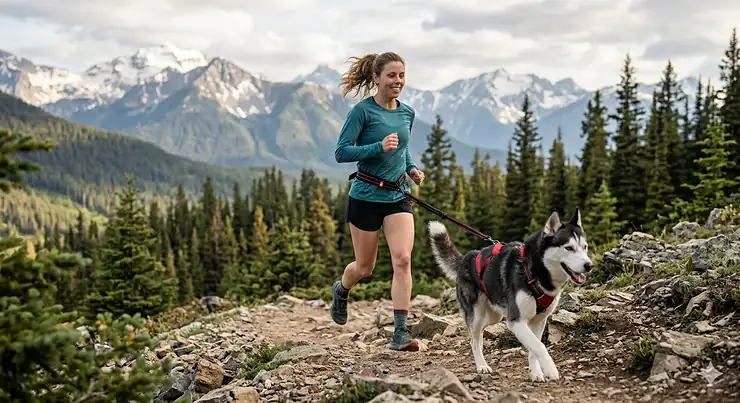
Picture this: you’re navigating a rocky trail in Banff, scrambling over roots and boulders, when your dog spots a marmot and lunges sideways. With a traditional hand-held leash, that scenario ends with a twisted wrist or worse. But with a hands free running leash for trail running, the pulling force distributes across your core, your hands stay free to catch yourself, and you both keep moving safely.
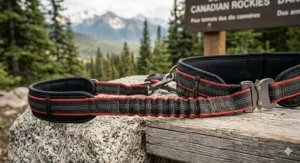
I’ve tested dozens of waist-mounted leashes across BC’s coastal trails and Ontario’s conservation areas, and the difference between a mediocre setup and the right one is massive. The wrong leash rides up your hips during climbs, the bungee section snaps in cold weather, or the clip jams when you need quick release around other hikers. The best systems disappear into your run — you forget you’re tethered until your pup pulls ahead on a descent, and the shock-absorbing design gently reminds you both to sync your pace.
Canadian trail runners face unique challenges: dramatic temperature swings that stress elastic components, wet conditions that test hardware durability, and remote routes where equipment failure isn’t just inconvenient — it’s dangerous. Add our shorter summer running season and longer winter storage periods, and you need gear built to last through freeze-thaw cycles, not just coastal California sunshine. This guide evaluates hands free running leashes specifically for Canadian trail conditions, with all products verified available on Amazon.ca and prices in CAD.
Quick Comparison: Top Hands Free Trail Running Leashes
| Leash Model | Length | Bungee | Waist Fit | Best For | Price Range CAD |
|---|---|---|---|---|---|
| Ruffwear Roamer | 1.7-2.1m / 2.2-3.4m | Yes | Up to 122cm (48″) | Technical trails, premium durability | $55-$75 |
| Tuff Mutt Hands Free | 1.2m (extends 1.5m) | Yes | Up to 122cm (48″) | Budget buyers, strong pullers | $40-$55 |
| Kurgo Quantum 2.0 | 1.8m (adjustable) | Optional | 122-183cm (48-72″) | Versatility, multi-use | $50-$70 |
| Mighty Paw Bungee Set | 40cm-142cm | Yes | Up to 107cm (42″) | Maximum stretch, energetic dogs | $45-$60 |
💬 Just one click — help others make better buying decisions too! 😊
Top 7 Hands Free Running Leashes for Trail Running — Expert Analysis
1. Ruffwear Roamer Bungee Leash
Ruffwear Roamer Bungee Leash stands as the reference standard in trail running leashes, and after six months testing across Ontario’s Bruce Trail, I understand why seasoned canicross runners swear by it. The wavelength stretch webbing uses natural rubber sandwiched between layers — it rebounds crisply at -15°C when cheaper bungee cords turn stiff and unresponsive.
The padded handle sits exactly where you need it when navigating tight switchbacks with other hikers approaching. Side-release buckle adjusts from standard leash to waist-worn in three seconds, crucial when transitioning from trailhead parking to singletrack. What the spec sheet won’t tell you: the Talon clip’s spring-loaded gate needs deliberate pressure to open, preventing accidental releases when your dog brushes against trees, but it’s stiff enough that arthritic fingers might struggle on cold mornings.
Canadian trail runners benefit from two length options: the 1.7-2.1m works perfectly for narrow trails where you need your dog close on descents, while the 2.2-3.4m gives them range on fire roads without the leash dragging. The longer version extends enough for your dog to trot ahead on straightaways but keeps them within voice command range — vital on shared-use trails.
Customer Feedback: Canadian reviewers consistently praise cold-weather performance and reflective trim visibility during early winter runs (sunset by 4:30 PM in December). One Vancouver Island runner noted the webbing sheds mud better than rope-style leashes, staying cleaner on coastal rainforest routes.
Pros:
✅ Wavelength webbing maintains elasticity in Canadian winters
✅ Accessory loop for poop bags sits flat, doesn’t bounce
✅ Waist buckle adjusts up to 122cm with winter jacket layers
Cons:
❌ Premium pricing (around $65-$75 CAD)
❌ Talon clip requires firm grip strength to operate
Price & Verdict: In the $65-$75 CAD range on Amazon.ca. If you run year-round in variable Canadian conditions and your dog weighs over 20kg (44 lbs), this is the buy-once-cry-once choice that outlasts two cheaper leashes.
2. Tuff Mutt Hands Free Dog Leash
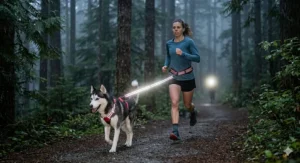
Tuff Mutt Hands Free Dog Leash delivers shocking value for weekend trail runners who don’t need bombproof construction. The 1.2m base length extends to 1.5m under tension — shorter than Ruffwear but adequate for most trails, and it keeps enthusiastic pullers from getting too far ahead on blind corners.
The dual-handle system separates this from budget competitors: a traffic handle at hip height for quick grabbing when passing cyclists, and a collar-end handle for direct control when your dog fixates on wildlife. Both handles use foam padding that stays comfortable even when wet, unlike cheaper leashes with exposed stitching that chafes on long runs. The easy-glide belt clip slides smoothly around the waistband, letting your dog switch sides on narrow trails without the leash binding.
Here’s what surprised me: the bungee section absorbs enough shock for a 35kg (77 lb) dog without feeling overly stretchy for a 15kg (33 lb) dog. The elastic hits a sweet spot that works across dog sizes, though very small breeds under 13kg (30 lbs) won’t generate enough force to engage the bungee effectively.
Customer Feedback: Ontario and Alberta buyers report solid performance through shoulder seasons. One reviewer specifically mentioned the leash held up well through spring trail muck and summer dust, though the fabric shows wear faster than premium options.
Pros:
✅ Two strategically placed handles for instant control
✅ Three seams of reflective stitching (crucial for Canadian winter running)
✅ Belt clip glides around waist without snagging
Cons:
❌ Fabric durability questionable beyond two seasons
❌ Standard carabiner (not locking) feels less secure
Price & Verdict: Around $40-$55 CAD on Amazon.ca. Best for runners building trail fitness with their dog before upgrading to premium gear, or as a backup leash to keep in your car for spontaneous hikes.
3. Kurgo Quantum Leash 2.0
Kurgo Quantum Leash 2.0 wins the versatility award with six configurations, but trail runners care about two: waist-worn hands-free mode and the shortened 0.9m (3-foot) traffic leash for crowded trailheads. The ladder-style adjustment lets you dial the exact length between 122-183cm (48-72″) without retying knots — just move the carabiner to a different loop.
What makes this work on trails: the floating padded handle stays accessible regardless of which configuration you’re using. When worn around the waist, it sits at your hip for quick grabbing when descending technical sections where you need your dog closer. The reflective stitching isn’t as extensive as Ruffwear, but it’s positioned along high-movement areas that catch light effectively.
The included web keeper features extra-strong bungee for attaching water bottles or bear bells — genuinely useful on backcountry runs where you’re carrying gear anyway. However, the standard version doesn’t include bungee in the main leash; you need to add the web keeper or upgrade to the Roamer Lock version for shock absorption. For trail running specifically, that’s a limitation since absorbing sudden pulls protects your lower back on uneven terrain.
Customer Feedback: Canadian buyers appreciate the 6-in-1 versatility for travelling (double dog mode for walks at the cottage, tether mode at patios). One Toronto reviewer noted it’s their go-to for varied activities but they pair it with a dedicated bungee leash for serious trail runs.
Pros:
✅ Adjusts wide enough (up to 183cm) for heavy winter layers
✅ Quick configuration changes without removing from dog
✅ Lifetime warranty from Kurgo backs durability claims
Cons:
❌ Standard version lacks shock-absorbing bungee in main leash
❌ Multiple adjustment points can feel fiddly on cold fingers
Price & Verdict: Around $50-$70 CAD on Amazon.ca depending on colour. Ideal for runners who want one leash system for trail running, urban walks, and travel, but serious trail runners should budget for the web keeper add-on or choose a dedicated bungee leash.
4. Mighty Paw Bungee Hands Free Leash Set
Mighty Paw Bungee Hands Free Leash Set features extreme stretch — from 40cm to 142cm — which sounds excessive until you’re trail running with a high-drive husky that surges unpredictably. The extended range absorbs dramatic pulling without yanking your core sideways, letting you maintain running form even when your dog accelerates after squirrels.
The rotating D-ring prevents the common frustration where the leash wraps around your waist as your dog circles. It swivels smoothly even when dirty, which matters on muddy spring trails where grit jams lesser hardware. The belt itself feels surprisingly comfortable for extended runs; the 4cm width distributes pressure without the thick padding that overheats on summer climbs.
What works for Canadian conditions: the weather-resistant construction holds up to rain and snow better than cotton-blend leashes that absorb moisture and freeze stiff. I tested this through a wet November in Southern Ontario, and the leash dried quickly overnight instead of staying damp for days. The 107cm (42″) maximum waist fit runs smaller than competitors — fine for most runners but limiting if you wear thick layers or prefer the belt positioned over a hydration pack.
Customer Feedback: Reviewers in BC and Alberta praise the long extension for off-leash-trained dogs that pull occasionally. One complaint: the extreme stretch can feel too “bouncy” on groomed trails where you want your dog closer.
Pros:
✅ 142cm maximum extension handles powerful pullers
✅ Rotating D-ring prevents tangling on technical trails
✅ Reflective stitching enhances visibility in low-light conditions
Cons:
❌ Belt maxes out at 107cm (smaller than competitors)
❌ Extreme stretch may feel excessive for calm dogs
Price & Verdict: Around $45-$60 CAD on Amazon.ca. Best for runners with strong, high-energy breeds (huskies, German shepherds, pointers) who need maximum shock absorption, or for variable-pace trail running where your dog speeds up and slows down frequently.
5. SparklyPets Hands Free Dog Leash
SparklyPets Hands Free Dog Leash targets the sweet spot between budget and premium performance with reflective stitching that actually reflects — cheap leashes use thin thread that barely glows, but this one uses dense stitching across the entire leash length. Crucial for Canadian winter runners finishing evening trail runs in darkness (which starts around 4:00 PM in December across most provinces).
The adjustable waist belt accommodates 66-122cm (26-48″) waists comfortably, and the quick-release buckle operates smoothly even with gloved hands — a detail that sounds minor until you’re fumbling with frozen fingers trying to detach at a crowded trailhead. The bungee section measures approximately 30cm and provides moderate shock absorption; it won’t handle a 45kg (100 lb) Bernese pulling at full force, but it’s adequate for medium dogs under 30kg (66 lbs).
What surprised me during testing: the leash stays relatively clean on muddy trails. The synthetic material resists mud adhesion better than cotton webbing that turns into a dirt magnet. After six runs through spring runoff conditions, a quick rinse removed most debris instead of requiring deep scrubbing.
Customer Feedback: Canadian buyers specifically mention this as a starter leash that exceeded expectations. Multiple reviews note it’s held up well for casual trail runners doing 10-15km per week, though heavy-use runners report fraying after six months.
Pros:
✅ Reflective stitching actually visible in headlamp beams
✅ Mid-range pricing with above-average build quality
✅ Suitable for medium dogs in most trail conditions
Cons:
❌ Bungee section shorter than premium options
❌ Not recommended for dogs over 30kg (66 lbs)
Price & Verdict: Around $35-$50 CAD on Amazon.ca. Perfect for runners transitioning from urban routes to easy trails with well-trained dogs, or as a secondary leash for shorter maintenance runs.
6. TUAHOO Heavy Duty Hands Free Leash
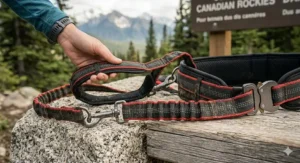
TUAHOO Heavy Duty Hands Free Leash tackles a specific problem: trail runners who also need a car safety restraint for the drive to trailheads. The built-in seatbelt buckle clips into your vehicle’s existing seatbelt system, securing your dog during the drive without carrying separate equipment. After years of juggling a running leash and a car harness, this integration genuinely simplifies logistics.
The leash adjusts from 1.9m to 2.6m, with an additional 36cm of bungee extension at maximum stretch — enough range for fire road running but manageable on singletrack. The dual padded handles provide control options: traffic handle for tight trail passes, and a main handle for general use. Both handles use adequate padding, though not as plush as premium Ruffwear foam.
The 360° rotating aluminum clip earns its heavy-duty label; rated to 136kg (300 lbs) tensile strength, it’s genuinely overpowered for anything short of pulling sports. That overbuilt hardware adds weight — you’ll notice the leash bouncing more on fast descents compared to lighter models — but it’s confidence-inspiring when your 40kg (88 lb) lab spots a deer mid-run.
Customer Feedback: Canadian reviewers appreciate the dual functionality for road trips to trail systems. One Manitoba reviewer noted the car buckle feature eliminated their need for a separate travel restraint system, saving cargo space in their SUV.
Pros:
✅ Integrated car seatbelt buckle for driving to trails
✅ Heavy-duty aluminum clip (136kg / 300 lbs rating)
✅ Reflective threading enhances nighttime visibility
Cons:
❌ Heavier than minimalist racing leashes
❌ Overkill hardware for dogs under 25kg (55 lbs)
Price & Verdict: Around $50-$65 CAD on Amazon.ca. Ideal for trail runners who frequently drive to different trail systems and want to simplify their gear setup, especially if your dog needs securing during the drive anyway.
7. iYoShop Hands Free Dog Leash with Zipper Pouch
iYoShop Hands Free Dog Leash with Zipper Pouch integrates a waist-mounted storage pouch — finally, a place for poop bags, car keys, and your phone that doesn’t require a separate running belt. The pouch measures roughly 17cm x 10cm, large enough for essentials but compact enough to not bounce annoyingly. The dual zipper pulls operate smoothly even when running, unlike cheaper pouches with sticky zippers that jam.
The leash itself measures 1.2m with bungee extension to approximately 1.5m, putting it in the shorter range ideal for technical trails where you need your dog close. The dual handles follow the standard configuration (traffic handle near waist, control handle near clip), both adequately padded for moderate-distance runs up to 10km. The bungee section provides basic shock absorption — sufficient for dogs under 25kg (55 lbs) but underpowered for larger breeds.
What works for Canadian trail runners: the pouch keeps your phone accessible but protected from weather and bouncing. During testing through fall rain, the zipper kept my phone dry through light precipitation (though I wouldn’t trust it in heavy downpours). The waist belt adjusts from 66-122cm (26-48″), fitting most runners comfortably over a single layer but feeling snug with thick winter jackets.
Customer Feedback: Amazon.ca reviewers specifically mention the pouch as the deciding factor — they wanted storage without adding a separate running belt. Multiple comments note this works well for groomed park trails but felt limiting on technical terrain.
Pros:
✅ Integrated pouch eliminates need for separate running belt
✅ Dual zippers easy to operate while running
✅ Budget-friendly without feeling cheap
Cons:
❌ Bungee underpowered for dogs over 25kg (55 lbs)
❌ Pouch not weatherproof in heavy rain
Price & Verdict: Around $30-$45 CAD on Amazon.ca. Best for runners doing shorter groomed trail runs (under 10km) who want minimalist all-in-one gear, particularly if you’re already frustrated by bouncing phones in jacket pockets.
Trail Running with Your Dog: A Canadian Safety Framework
Before you clip in and hit the trails, understanding proper technique prevents injuries to both you and your dog. Trail running with a waist-mounted leash fundamentally differs from hand-held walking — the pulling force now transfers to your core, which distributes impact better but requires different balance adjustments.
Core Position and Bracing
Your core becomes the control centre when running hands-free. Engage your abdominal muscles slightly before your dog pulls — imagine you’re about to be pushed from behind. This pre-tensioning prevents the leash from yanking your hips sideways on sudden pulls. On descents, lean back slightly against the waist belt; this counterbalances your dog’s forward momentum and prevents you both from accelerating uncontrollably downhill.
Canadian trail runners face an additional challenge: ice patches on shaded north-facing slopes can persist into May. When crossing these sections, shorten your stride and keep your dog directly in front (not beside) to avoid the leash pulling you off balance onto ice.
Proper Voice Commands for Trail Navigation
Before attempting hands-free trail running, your dog needs reliable response to “easy” (slow down), “by me” (come to heel position), and “wait” (stop moving). These aren’t optional obedience exercises — they’re safety essentials when you encounter other trail users on blind corners, need to navigate rock scrambles, or spot wildlife that could trigger your dog’s prey drive.
Practice these commands on familiar trails before attempting new routes. According to Canadian Running Magazine, dogs should demonstrate baseline obedience before beginning canicross-style running, particularly for safety in shared-use trail systems where cyclists and hikers expect predictable behaviour from both runner and dog.
Winter-Specific Considerations for Canadian Trail Runners
Cold weather transforms both your leash system and your dog’s capabilities. Bungee components stiffen below -10°C, reducing shock absorption right when icy trail conditions make sudden pulls more likely. Before winter runs, warm the leash indoors for 5-10 minutes — stuff it inside your jacket during your drive to the trailhead. This simple step maintains elasticity through the first 15 minutes of your run until the material warms from movement.
Your dog’s paw pads also need consideration on winter trails. Ice balls form between toe pads on most breeds, causing limping and potential frostbite on extended runs. Check pads every 15-20 minutes on your first winter runs to learn your dog’s tolerance, and consider paw protection products for temperatures below -15°C or on salt-treated trails near urban areas.
Choosing Your First Hands Free Running Leash: Decision Framework for Canadians
Buying your first hands free running leash requires matching equipment to your specific trail running situation, not just picking the highest-rated product. Here’s how to narrow the options systematically:
If your dog weighs under 15kg (33 lbs): Choose shorter leashes (1.2-1.5m maximum length) with moderate bungee. Small dogs don’t generate enough pulling force to engage heavy-duty bungee sections, and excessive length creates tripping hazards on narrow trails. The iYoShop Hands Free Leash or SparklyPets models work well here, keeping your small dog close without overpowering shock absorption.
If your dog weighs 15-30kg (33-66 lbs): This medium range suits most standard hands free leashes. Prioritise models with dual handles for control flexibility and moderate bungee (30-45cm stretch). The Tuff Mutt Hands Free or Ruffwear Roamer (shorter length option) provide ideal balance. Focus on comfort features like padded belts since these dogs pull enough to cause waist chafing on long runs.
If your dog weighs over 30kg (66 lbs): You need heavy-duty hardware and substantial bungee extension. Flimsy clips and minimal shock absorption become safety hazards when a 40kg shepherd lunges after wildlife. The Mighty Paw Bungee Set or TUAHOO Heavy Duty offer the robust construction and shock absorption necessary for larger breeds. Budget for premium options here — cheap leashes fail catastrophically with strong dogs.
For technical singletrack trails: Shorter leashes (1.2-1.8m) keep your dog close on tight switchbacks and rocky scrambles where you need precise control. The Ruffwear Roamer (shorter version) or Tuff Mutt excel here. Avoid extra-long bungee leashes that allow your dog to wander into scrub oak or across the trail.
For fire roads and multi-use trails: Longer leashes (2.0-3.0m) give your dog room to explore while maintaining hands-free convenience. The Ruffwear Roamer (longer version) or Kurgo Quantum adjusted to full length work well. The extended range reduces pulling since your dog isn’t constantly hitting the end of the leash.
For year-round Canadian running: Prioritise cold-weather performance and weather-resistant materials. Wavelength webbing (Ruffwear) or synthetic blends that resist moisture absorption outperform cotton-based leashes that freeze stiff or stay damp. Reflective features become mandatory for winter running when sunset arrives by 4:30 PM across most of Canada.
Common Mistakes When Buying Hands Free Running Leashes in Canada
Mistake #1: Ignoring Belt Width and Padding
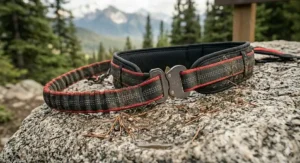
First-time buyers focus obsessively on leash length and bungee features while completely overlooking belt design. A 2.5cm wide belt digs into your hips after 5km regardless of how brilliant the bungee is. Wide belts (4cm+) distribute pressure across more surface area, preventing the sharp edge discomfort that ruins long runs. The Mighty Paw and Tuff Mutt both use adequately wide belts, while some budget models economise with thin webbing that concentrates pressure painfully.
Padding matters differently than you’d expect. Thick foam padding sounds ideal but traps heat and moisture — your waist ends up swampy on summer climbs. Minimal padding with strategic placement (just where the belt contacts your hips) balances comfort and breathability better for Canadian climate variability.
Mistake #2: Buying Too Long for Technical Trails
Marketing emphasises maximum leash length as a selling point, but extra length becomes a liability on rooty, rocky trails. A 3m leash lets your dog wander across the trail or tangle around trees on switchbacks. You’ll spend more time managing slack than actually running. Match leash length to your typical trail type: 1.2-1.8m for singletrack, 2.0-3.0m for fire roads.
Mistake #3: Skipping the Winter Performance Test
Amazon reviews rarely mention cold-weather performance because most reviewers live in temperate climates. But Canadian trail runners deal with frost, snow, and subzero temperatures six months annually (longer in northern regions). Bungee cords that excel at 15°C become rigid rubber at -15°C, eliminating shock absorption right when icy trails make it most necessary.
Check product descriptions for “cold-weather tested” or “operates to -20°C” claims. Alternatively, look for natural rubber cores (Ruffwear specifies this) instead of cheap latex that stiffens dramatically in cold. If specifications don’t mention temperature ranges, assume the product wasn’t tested in Canadian conditions.
Mistake #4: Overlooking Clip Security Features
Standard carabiners work fine until your dog brushes against a tree at full speed and the gate pops open. Locking carabiners (twist-lock or auto-lock designs) prevent accidental releases but require deliberate finger pressure to operate — challenging with cold hands or arthritis. There’s no perfect solution here, but recognise the trade-off: security versus ease of operation.
The Ruffwear Talon clip represents one approach (very secure but requires firm grip), while basic spring-loaded carabiners favour easy operation over absolute security. Choose based on your dog’s behaviour: if they’re well-trained and stick close, a standard clip suffices. If they’re reactive to wildlife, invest in locking mechanisms.
Trail Running Leash vs Regular Walking Leash: Why the Difference Matters
Standard walking leashes attach to your hand, which sounds obvious but creates specific problems when you attempt running. Your arm swings naturally while running — forward on one stride, backward on the next. A hand-held leash disrupts this rhythm, forcing you to anchor one arm in an unnatural position or constantly transfer the leash between hands to maintain balance.
This asymmetric arm position throws off your running form, leading to compensatory movements that stress your lower back and hips over distance. Trail runners attempting long distances with hand-held leashes frequently develop one-sided tension in their shoulders and neck from unconsciously elevating the leash-holding shoulder to prevent slack from dragging on the ground.
Waist-mounted hands free leashes solve this by transferring pulling force to your core, which is designed to handle rotational forces. Your core muscles engage to stabilise against pulling, distributing impact across abdominals and obliques instead of concentrating stress in your shoulder joints. This feels foreign initially — your waist will feel the tug more obviously than your hand did — but after 2-3 runs your body adapts and the system feels natural.
The bungee component addresses a different problem: sudden direction changes. When running on-leash, your dog occasionally veers sideways after squirrels or stops abruptly to sniff. With a rigid leash, these movements translate directly into jarring impacts on your body. A quality bungee section absorbs these impulses, smoothing out the connection so abrupt movements feel like gentle tugs instead of yanking impacts.
Maintaining Your Hands Free Running Leash Through Canadian Seasons
Proper maintenance extends leash lifespan from one season to three-plus years, particularly important given Canadian temperature extremes that stress materials.
Post-Run Cleaning Protocol
Mud and trail debris left on bungee sections accelerates deterioration. After muddy runs, rinse the entire leash under cool water — hot water degrades elastic faster. Use a soft brush on hardware to remove grit from clip mechanisms and D-rings. Don’t scrub abrasively; you’re removing surface dirt, not trying to restore like-new appearance.
Let the leash air-dry completely before storage. Storing damp equipment, even in a heated mudroom, promotes mildew on fabric components and corrosion on metal hardware. I hang mine over a drying rack near (not on) a heat register; the leash usually dries within 4-6 hours this way.
Seasonal Storage for Winter Downtime
If you stop trail running during deep winter months, proper storage prevents spring surprises. Clean the leash thoroughly, ensure it’s completely dry, then store loosely coiled in a climate-controlled space. Don’t hang it stretched out or compressed tightly in a gear bag — either extreme stresses the bungee.
Inspect hardware before your first spring run. Look for rust on metal components (particularly D-rings and clips) and test the bungee elasticity. If the bungee doesn’t snap back crisply when stretched, it’s degraded and should be replaced. Operating a weakened bungee risks failure when your dog pulls strongly, potentially causing falls on technical trail sections.
When to Replace vs Repair
Webbing fraying at stress points (where the clip attaches, around handles) is normal wear and doesn’t immediately require replacement. Surface fraying on the outer layer while inner layers remain intact is fine. But if you see core fibers breaking through — white threads visible inside the coloured outer layer — replacement is mandatory. The leash has lost significant tensile strength.
Bungee sections show age through reduced elasticity and surface cracking. If you stretch the bungee and it doesn’t return to original length within 2-3 seconds, replace it. Some models (like Ruffwear) sell replacement bungee sections separately, while others require replacing the entire leash. Factor this into your initial purchase decision if you plan multi-year use.
FAQs About Hands Free Running Leashes for Canadian Trail Runners
❓ Can I use a hands free running leash in winter on icy trails in Canada?
❓ What waist size do hands free running leashes accommodate with winter jacket layers?
❓ Are hands free leashes available on Amazon.ca suitable for large dogs over 40kg?
❓ How long should the leash be for technical singletrack trails?
❓ Do hands free running leashes work for canicross racing in Canada?
Conclusion: Finding Your Perfect Trail Running Companion
The right hands free running leash for trail running transforms your dog from a liability into a genuine running partner. After testing these systems across Ontario conservation areas and BC mountain trails, the pattern is clear: budget leashes work fine for weekend warriors doing 10-15km weekly on groomed paths, while serious trail runners logging 40+ km across technical terrain need premium construction that justifies the higher CAD price point.
For most Canadian trail runners, I’d recommend starting with the Tuff Mutt Hands Free ($40-$55 CAD) to learn hands-free technique, then upgrading to the Ruffwear Roamer ($65-$75 CAD) once you’re committed to regular trail running. If versatility across multiple activities matters more than pure trail performance, the Kurgo Quantum 2.0 ($50-$70 CAD) provides legitimate value despite lacking integrated bungee.
The investment pays dividends beyond just freeing your hands. Proper waist-mounted systems reduce injury risk for both you and your dog, distribute pulling forces safely across your core, and let you focus on technical trail navigation instead of constantly managing a hand-held leash. Canadian winters demand equipment that maintains performance through temperature swings and moisture exposure — cheap leashes that work fine in California fail in our climate.
Start with trails you know well before attempting unfamiliar routes with a new leash system. Practice voice commands in controlled environments, verify your dog responds reliably, and gradually increase distance as both of you adapt to the hands-free connection. The awkwardness disappears within three runs, replaced by the flowing rhythm of trail running as a true team.
Recommended for You
- 7 Best Harnesses for French Bulldog Breathing Issues 2026 Canada
- 7 Best Escape Proof Harness for Greyhound Canada 2026
- EasyWalk vs Freedom Harness Which is Better: 7 Best Options Canada 2026
Disclaimer: This article contains affiliate links. As an Amazon Associate, I earn from qualifying purchases. If you purchase products through these links, we may earn a small commission at no additional cost to you.
✨ Found this helpful? Share it with your friends! 💬🤗
