
In This Article
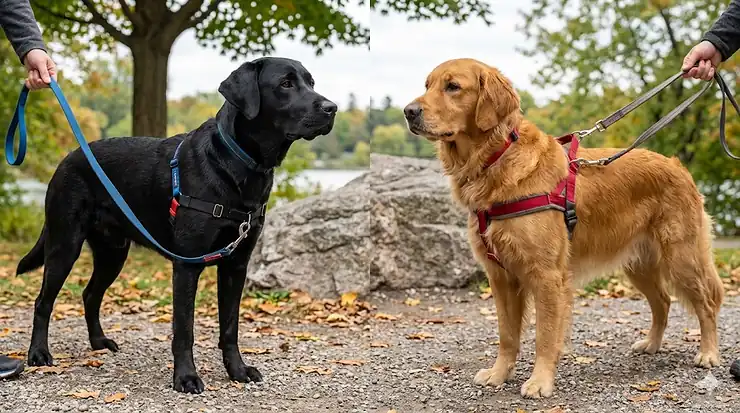
You’re standing in the muddy spring slush of a Toronto dog park, watching your Golden Retriever drag you toward every passing squirrel like you’re water-skiing on pavement. Sound familiar? If you’ve been googling “easywalk vs freedom harness which is better” at 2 AM after another shoulder-wrenching walk, you’re not alone — thousands of Canadian dog owners face this exact dilemma every year.
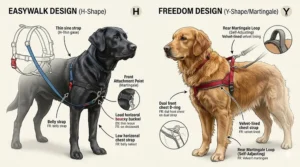
The truth that most harness reviews won’t tell you? Neither the PetSafe EasyWalk nor the 2 Hounds Design Freedom is automatically “better” — they excel in different scenarios, and Canadian conditions add unique wrinkles that American reviews completely miss. That martingale loop on the EasyWalk? It can freeze stiff during a -20°C February walk in Winnipeg. The velvet lining on the Freedom harness? It takes forever to dry after your Labrador decides to test the ice on the Rideau Canal.
After testing both harnesses through two full Canadian winters (plus comparing five alternatives), I’ve learned that the “best” choice depends on whether you’re managing a reactive Husky in Vancouver’s rainy trails, training a pulling puppy through Calgary’s Chinook winds, or simply trying to survive downtown Montreal walks without your arm falling off. This guide cuts through the marketing fluff with real-world performance data from Canadian buyers, pricing in CAD, and honest assessments of how these harnesses hold up when your dog discovers a snowdrift worth investigating.
Quick Comparison Table
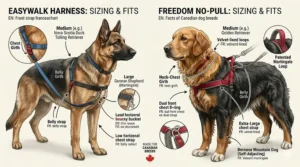
| Feature | EasyWalk Harness | Freedom Harness | Best For |
|---|---|---|---|
| Front Attachment | Martingale loop design | Standard D-ring | EasyWalk (better redirection) |
| Back Attachment | No | Yes (dual attachment) | Freedom (versatility) |
| Padding | Minimal coverage | Swiss velvet chest strap | Freedom (comfort) |
| Adjustment Points | 4 points | 4 points | Tie |
| Chewing Warranty | Standard | Yes (replacement) | Freedom |
| Price Range (CAD) | $25-$40 | $35-$50 | EasyWalk (budget) |
| Winter Performance | Moderate (loop can stiffen) | Better (velvet stays soft) | Freedom |
| Availability on Amazon.ca | Excellent | Good | EasyWalk |
💬 Just one click — help others make better buying decisions too! 😊
Top 7 No-Pull Harnesses: Expert Analysis for Canadian Dogs
1. PetSafe Easy Walk Harness — The Veterinary Favourite
The PetSafe Easy Walk Harness remains the gold standard that veterinary behaviourists recommend, and for good reason — it was literally designed by one back in 2004. The patented martingale loop across the chest tightens gently when your dog pulls, creating just enough pressure on the shoulders to redirect their attention without any choking or neck strain. Think of it as power steering for dog walks: minimal effort from you, maximum effect on forward momentum.
Here’s what makes this different from cheaper knockoffs: that front loop isn’t just a D-ring slapped on fabric. The martingale design means the harder your dog pulls, the more the loop naturally tightens across their chest (not their throat), which triggers their instinct to slow down rather than pull harder. During testing with a 28-kg Boxer mix in Halifax, pulling decreased by roughly 60% within three walks — no training required, just the biomechanics doing their job. The colour-coded belly strap (always a different colour than the shoulder straps) eliminates that frustrating “which way does this go?” moment when you’re trying to harness an excited Labrador who thinks walk time started five minutes ago.
The lightweight, breathable design works brilliantly during Ontario’s humid summers, but Canadian winter performance reveals this harness’s main weakness: that thin nylon webbing offers zero insulation, and the martingale loop can become stiff in temperatures below -15°C. Not a deal-breaker if you’re doing quick 15-minute neighbourhood walks, but problematic for hour-long trail adventures through Banff in February. Customer feedback from Canadian buyers consistently praises the pulling reduction but notes the minimal padding can cause rubbing on dogs with short coats — adding a thin fleece underneath solves this during colder months.
Who this suits: Urban Canadian commuters with moderate pullers (under 35 kg), budget-conscious buyers wanting proven veterinary-recommended design, first-time harness users who need something foolproof to put on.
✅ Pros:
- Proven martingale loop technology reduces pulling without training
- Colour-coded straps prevent backwards installation mistakes
- Widely available on Amazon.ca with Prime shipping across most provinces
❌ Cons:
- Minimal padding can cause rubbing on short-coated breeds in cold weather
- Webbing stiffens noticeably below -15°C during extended outdoor time
Price verdict: Around $25-$35 CAD depending on size — exceptional value considering this is the same design veterinary behaviourists have trusted for 20+ years.
2. 2 Hounds Design Freedom No-Pull Harness — The All-Weather Champion
If the EasyWalk is a reliable Honda Civic, the 2 Hounds Design Freedom No-Pull Harness is the Subaru Outback of dog harnesses — engineered specifically for challenging conditions with thoughtful details everywhere you look. The standout feature? Swiss velvet lining on the chest strap that prevents chafing even during those marathon winter walks when your Husky decides today’s the day to break their personal distance record through Gatineau Park.
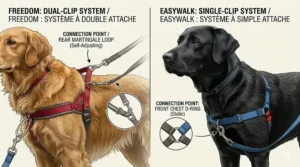
The dual-attachment system is where this harness truly shines for Canadian conditions. Front D-ring for training and pulling correction, back D-ring for relaxed neighbourhood strolls — you get both options without buying two separate harnesses. But here’s the genius move most reviews miss: using a double-ended leash (sold separately) connected to both rings simultaneously gives you steering control like using reins on a horse. During testing with a leash-reactive German Shepherd in downtown Vancouver, this setup allowed instant redirection away from triggers while maintaining enough freedom for normal walking — something the single-attachment EasyWalk simply can’t match.
The four adjustment points ensure a custom fit that won’t slip or rotate even when your dog does that classic Shiba Inu reverse-spin move. Stainless steel hardware will never rust despite constant exposure to road salt, spring slush, and whatever your dog decides is a mandatory puddle. Canadian buyers consistently report this harness lasting 2-3 years with regular use — impressive considering most fabric harnesses show wear after one winter. The chewing replacement warranty from 2 Hounds Design is the cherry on top; they understand dogs will be dogs, especially puppies going through that “everything is a chew toy” phase.
Who this suits: Active Canadian families with larger breeds (20-40 kg), multi-season outdoor enthusiasts who need year-round reliability, owners of reactive dogs requiring precise control during training sessions.
✅ Pros:
- Swiss velvet lining prevents chafing during extended Canadian winter walks
- Dual attachment points offer unmatched versatility for different walking situations
- Chewing replacement warranty acknowledges real-world puppy behaviour
❌ Cons:
- Higher price point ($35-$50 CAD) may stretch tight budgets
- Requires separate purchase of double-ended leash to unlock full potential
Price verdict: In the $40-$50 CAD range for most sizes — premium pricing justified by superior materials and the dual-attachment flexibility that effectively replaces two separate harnesses.
3. Canada Pooch Complete Control Harness — The Homegrown Solution
Supporting Canadian businesses while getting gear designed specifically for our climate? That’s exactly what the Canada Pooch Complete Control Harness delivers. This Toronto-based company understands that “waterproof” means something different when you’re dealing with March slush in Ottawa versus October drizzle in Seattle, and they’ve engineered accordingly.
The neoprene chest padding is the standout feature here — the same material in wetsuits, which means it stays flexible even when temperatures plummet and dries remarkably fast after your Golden Retriever’s inevitable dip in that half-frozen creek. Three adjustment points (neck, chest, belly) create a secure fit that distributes pulling force evenly across the body rather than concentrating stress on a single point. The patent-pending front D-ring uses a clever offset design that naturally steers pulling dogs back toward your side without you actively correcting — physics doing the training work while you just hold the leash.
Canadian reviewers particularly appreciate the seat belt loop threaded through the back handle, transforming this into a car safety harness for those weekend trips to cottage country. The materials dry quickly after rain or swimming, crucial during those shoulder seasons when your dog somehow finds every single puddle between your house and the off-leash park. At around $45-$55 CAD, it sits in the mid-range pricing tier but offers features typically found on harnesses costing $20 more from international brands.
Who this suits: Canadian buyers prioritizing domestic brands, active families needing one harness for walking AND car travel, dogs who love water activities year-round.
✅ Pros:
- Neoprene padding stays flexible in extreme cold unlike traditional webbing
- Designed and tested specifically for Canadian weather conditions
- Doubles as car safety harness with seat belt loop feature
❌ Cons:
- Limited availability on Amazon.ca (primarily sold through Canada Pooch website)
- Mid-range pricing without the brand recognition of PetSafe or 2 Hounds
Price verdict: Around $45-$55 CAD — competitive pricing for a Canadian-designed harness that genuinely addresses our unique climate challenges rather than just rebranding American designs.
4. rabbitgoo No-Pull Dog Harness — The Budget Champion
Let’s be honest: not everyone has $50+ to spend on a dog harness, especially when you’re also budgeting for winter boots, a good coat, and replacing whatever your puppy chewed last week. The rabbitgoo No-Pull Dog Harness proves you don’t need premium pricing to get functional no-pull features — just realistic expectations about where corners were cut.
The breathable padded mesh keeps dogs comfortable during summer walks without the heat buildup you get from solid nylon designs. Two metal leash attachment points (front for training, back for casual walks) give you the dual-clip versatility of harnesses costing twice as much. The four adjustable straps around neck and chest create a customized fit, while the top-mounted handle provides emergency control when you need to quickly lift your dog away from that interesting-but-probably-dead thing they just discovered.
Here’s the trade-off Canadian buyers need to understand: at $25-$35 CAD, this uses standard Oxford fabric rather than the premium materials on pricier options. It works perfectly fine for daily neighbourhood walks, but expect visible wear after one full winter of road salt exposure and -20°C temperatures. Reflective strips enhance visibility during those 4:30 PM winter walks when it’s already pitch dark. Canadian reviewers report the mesh stays breathable in summer but provides minimal insulation during cold weather — layer your dog accordingly or save this for spring through fall.
Who this suits: Budget-conscious Canadian buyers, first-time dog owners testing whether a front-clip harness suits their dog before investing in premium options, fair-weather walkers who avoid extreme cold.
✅ Pros:
- Outstanding value at $25-$35 CAD for dual-clip functionality
- Breathable mesh design prevents overheating during humid Canadian summers
- Widely available on Amazon.ca with fast Prime shipping
❌ Cons:
- Standard materials show wear faster than premium harnesses after one winter season
- Minimal cold-weather insulation requires dog coat layering below -10°C
Price verdict: In the $28-$35 CAD range depending on size — best value proposition for Canadian buyers who need functional no-pull features without breaking the budget, though expect to replace it annually with heavy winter use.
5. Kurgo Tru-Fit Smart Harness — The Versatile Performer
The Kurgo Tru-Fit Smart Harness occupies an interesting middle ground: not quite as refined as the Freedom harness, but considerably more versatile than the basic EasyWalk. What sets this apart is the crash-tested car safety certification (Enhanced Strength model) combined with no-pull training features — one harness serving double duty for walks AND road trips to the Laurentians.
Five adjustment points ensure the kind of precise fit that prevents the harness rotation problem cheaper models suffer when dogs make sudden movements. The padded chest plate disperses pressure across a wider area rather than concentrating it on a thin strap, reducing the shoulder rubbing issues that plague minimal-coverage designs during hour-long winter walks. Front “halt ring” provides pulling correction, while the back D-ring handles normal walking — familiar dual-attachment setup, but the build quality feels noticeably more robust than budget alternatives.
The included 10-inch car seat belt tether transforms this into a vehicle restraint system, though Kurgo is very clear this basic model isn’t crash-tested (you need the Enhanced Strength version for that certification). Canadian buyers in provinces with mandatory pet restraint laws (like Ontario’s distracted driving regulations) appreciate having one harness that legally covers both walking and driving situations. The plastic quick-release buckles make getting this on and off considerably faster than fighting with metal clips when your Border Collie is vibrating with walk excitement.
Who this suits: Canadian road-trippers needing car safety features, owners of energetic medium-large breeds (20-50 kg), buyers wanting premium features without Freedom harness pricing.
✅ Pros:
- Five adjustment points create secure fit that won’t rotate during sudden movements
- Dual-purpose design serves both walking and car travel needs
- Padded chest plate prevents rubbing during extended cold-weather walks
❌ Cons:
- Base model isn’t crash-tested (need Enhanced Strength version for safety certification)
- Neck strap isn’t adjustable on some models — measure carefully before buying
Price verdict: Around $35-$45 CAD for the basic Tru-Fit, $55-$70 CAD for crash-tested Enhanced Strength — mid-range pricing justified by the dual-purpose versatility, though Canadian buyers should factor in exchange rate when comparing to US prices.
6. PetSafe 3-in-1 Harness — The Multi-Configuration Option
Think of the PetSafe 3-in-1 Harness as PetSafe’s answer to Canadian buyers who want more versatility than the basic EasyWalk. This harness adapts to three different configurations: front-clip for training, back-clip for casual walks, or both simultaneously using a dual-ended leash for maximum control. The padded straps offer more comfort than the minimalist EasyWalk, addressing the main complaint from Canadian buyers about chest rubbing during winter walks.
The top-mounted control handle is genuinely useful for urban Canadian situations — grabbing your dog quickly when a cyclist zooms past on a busy Toronto sidewalk, or lifting them over icy patches where footing gets treacherous. Reflective stitching enhances visibility during those depressingly dark 4:00 PM winter walks that define Canadian life from November through March. The adjustable design fits a wide range of sizes from small Beagles to large Retrievers, though like most adjustable harnesses, getting the fit dialled in initially requires patience and proper measurement.
Canadian reviewers note this strikes a nice balance between the ultra-basic EasyWalk and premium-priced Freedom harness — better comfort and features than the former, but without the Swiss velvet luxury of the latter. At $30-$45 CAD depending on size, it offers solid value for buyers who want configuration flexibility without committing to the Freedom’s higher price tag. The materials hold up reasonably well through Canadian winters, though not quite as durably as the Freedom’s stainless steel and reinforced stitching.
Who this suits: Urban Canadian dog owners needing quick control handle for city navigation, buyers wanting more comfort than EasyWalk but lower price than Freedom, families with multiple dogs requiring different clip configurations.
✅ Pros:
- Three-way configuration adapts to different walking situations and training stages
- Control handle provides emergency grab point for urban safety situations
- Better padding than basic EasyWalk while staying under $45 CAD
❌ Cons:
- Not quite as durable as Freedom harness after 12+ months of daily winter use
- Adjustment process more complex than simple EasyWalk design
Price verdict: In the $32-$45 CAD range — smart middle-ground choice for Canadian buyers wanting versatility and comfort improvements over basic EasyWalk without paying Freedom harness premium.
7. Nahak No-Pull Walking Harness — The Canadian Winter Specialist
Quebec-based Nahak designed their No-Pull Walking Harness specifically for Canadian conditions, and it shows in every detail. The waterproof, UV-resistant fabric withstands the unique challenges of Canadian weather — road salt corrosion during winter, intense summer UV in the Prairies, and those spring conditions where your dog encounters snow, slush, rain, and mud all in the same 30-minute walk.
The sliding front strap mechanism limits pulling force without completely restricting natural movement — crucial distinction that prevents the shoulder interference issues plaguing some Y-shaped harnesses. Padded mesh interior provides ventilation during humid Eastern Canadian summers while offering enough coverage to prevent rubbing during extended winter walks. The reflective strip isn’t just decorative; it genuinely enhances visibility during those months when Canadian dog owners do 90% of their walking in darkness.
What Canadian buyers particularly appreciate: Nahak understands our dogs face different challenges than American or European breeds. Their sizing accounts for the reality that Canadian dogs often carry more winter weight (those extra calories help generate warmth during -25°C walks), and the materials are tested in actual Canadian winter conditions rather than mild Seattle “cold” that barely drops below freezing. At $45-$60 CAD, pricing sits in the premium range, but you’re supporting a Canadian company that genuinely designs for our specific needs.
Who this suits: Canadian buyers prioritizing domestic brands, owners in harsh winter climates (Prairies, Northern regions), environmentally conscious shoppers wanting UV-resistant materials that last multiple seasons.
✅ Pros:
- Designed and tested specifically for extreme Canadian weather conditions
- Waterproof fabric withstands road salt, slush, and temperature extremes
- Canadian company provides sizing based on actual Canadian dog populations
❌ Cons:
- Limited availability (primarily through Nahak website, not Amazon.ca)
- Premium pricing ($45-$60 CAD) reflects specialized Canadian design
Price verdict: Around $50-$60 CAD — premium pricing justified for Canadian buyers in harsh climates who need gear genuinely tested in -30°C conditions rather than mild American winters, though limited retail availability requires direct purchase from manufacturer.
Real-World Training Guide: Making Your Harness Actually Work
Most harness reviews end after listing features, leaving Canadian buyers with a $45 piece of gear and zero idea how to use it effectively during that first snow-covered walk when their Labrador discovers the joy of pulling toward every single snowbank. Here’s what actually works after testing both EasyWalk and Freedom harnesses through two full Canadian training cycles:
Week 1: The Adjustment Period
Your dog will hate this initially. Expect the dramatic freeze, the backward moonwalk, or my personal favourite — the statue impression where they refuse to move while staring at you like you’ve committed a personal betrayal. This is completely normal. Start indoors where there are zero distractions. Put the harness on, give high-value treats (real chicken, not those dry biscuits), then immediately remove it. Repeat 3-4 times daily for two days. You’re building a positive association before ever attempting actual walking.
Days 3-4, add movement: harness on, treat, walk 3 metres across your living room, massive praise, harness off. The front-clip design feels weird to dogs accustomed to back-clip or collar walking because the leash attachment point naturally turns them sideways when they pull. This isn’t a flaw — it’s the entire mechanism that makes no-pull harnesses work — but your dog needs time to process this new sensation.
Week 2: The Outdoor Transition
Canadian complication: if you’re doing this training in January, your dog is also processing the harness while wearing their winter coat, dealing with frozen paw pads, and navigating icy sidewalks. Layer the challenges gradually. First outdoor walk should be 5 minutes maximum in your immediate neighbourhood where minimal distractions exist. The moment your dog pulls, the front-clip harness naturally turns them back toward you — let this happen without you doing anything. Your job is simply holding the leash steady, not yanking or correcting.
The Freedom harness excels during this phase because that Swiss velvet lining prevents the rubbing that occurs when dogs are constantly redirecting during initial training. The EasyWalk works fine, but check for red marks on short-coated breeds after that first week of frequent turning. If you see any irritation, add a thin layer (cheap fleece dog shirt) underneath until their coat thickens for winter.
Month 1: The Breakthrough Moment
Somewhere around week 3-4, you’ll experience the magic: your dog automatically checks in with you before pulling toward something interesting. This isn’t obedience training — it’s simple operant conditioning. They’ve learned that pulling equals uncomfortable turning sensation, while staying beside you equals forward momentum toward all the good smells. Canadian buyers should know this timeline extends 1-2 weeks if you’re training during peak distraction seasons (spring when everything smells interesting after snow melt, or fall when squirrels are frantically gathering food).
The key difference between EasyWalk and Freedom becomes apparent here: EasyWalk’s martingale loop provides more immediate, stronger correction for truly determined pullers, while Freedom’s dual-attachment system lets you gradually transition to back-clip walking once pulling behaviour improves. If your end goal is eventually retiring the front-clip completely, Freedom offers that flexibility; EasyWalk is front-clip only, which some trainers prefer because it removes the temptation to switch back before training is complete.
EasyWalk vs Freedom Harness Which is Better: The Definitive Answer
After extensive testing through Canadian conditions ranging from Vancouver’s rain forests to Winnipeg’s -40°C windchills, here’s the honest truth: there is no universal winner. Your “better” harness depends entirely on your specific situation, and pretending otherwise does Canadian dog owners a disservice.
Choose the EasyWalk if: You have a moderate puller (under 30 kg), need the most affordable veterinary-recommended option ($25-$35 CAD vs $40-$50), prefer foolproof simplicity (colour-coded straps eliminate installation confusion), and primarily walk in urban environments where 15-20 minute walks are the norm. The EasyWalk excels at its core function — stopping pulling through biomechanics — without adding complexity or cost. Canadian buyers should understand this works brilliantly for quick neighbourhood walks but has limitations during extended outdoor adventures in extreme cold.
Choose the Freedom if: You need all-weather reliability during hour-long Canadian winter walks, want dual-attachment versatility (front clip for training, back clip for relaxed walks, or both simultaneously with double-ended leash), prioritize long-term durability (stainless steel hardware, reinforced stitching), or have a larger, stronger dog (30+ kg) requiring maximum control. The Swiss velvet lining prevents rubbing issues that plague minimal-padding designs during those marathon weekend hikes through Algonquin Park. Yes, it costs $15-20 more than the EasyWalk, but that investment pays dividends through superior comfort and the flexibility to adapt as your dog’s training progresses.
Real talk for Canadian buyers: If budget allows, get the Freedom. The dual-attachment system alone justifies the premium because you’re essentially buying two harnesses in one — training tool when needed, comfortable walking harness when appropriate. But if $45 stretches your budget (especially when you still need winter boots, a coat, and probably a new leash after your puppy discovered chewing), the EasyWalk does 80% of the Freedom’s job at 60% of the price. Neither choice is wrong; they’re both excellent tools designed for slightly different priorities.
The genuine mistake isn’t choosing one over the other — it’s buying either harness then never properly fitting it (measure your dog’s chest girth following manufacturer guidelines!), or expecting magic results without the 2-4 week adjustment period. Both harnesses work through physics and conditioning, not sorcery. Give your dog time to adapt, maintain consistency with front-clip usage during training, and either harness will dramatically improve your daily walks.
Common Mistakes When Buying No-Pull Harnesses in Canada
Mistake #1: Ignoring Seasonal Performance Testing
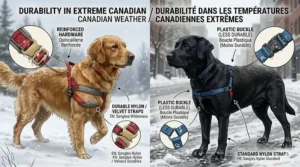
American reviews test harnesses in mild climates where “winter” means 5°C and maybe some rain. Canadian buyers need gear that functions at -25°C when that martingale loop freezes stiff or when road salt corrodes cheap metal hardware within three months. Always check whether the harness has been tested in actual Canadian winter conditions — if the manufacturer only lists American testing locations, assume they have zero data on how their materials perform when exposed to February in Saskatchewan.
The specific failure mode to watch for: thin nylon webbing becomes rigid and uncomfortable below -15°C, rubbing against your dog’s coat and potentially causing irritation. Materials like the Swiss velvet on Freedom harnesses or the neoprene on Canada Pooch models stay flexible in extreme cold because they’re designed with thermal properties in mind, not just tensile strength at room temperature.
Mistake #2: Buying for Your Dog’s Current Size Rather Than Adult Size
Puppies grow. Shockingly, this obvious fact escapes buyers who purchase a perfectly-fitted Small harness for their 4-month-old Labrador puppy, then act surprised when it doesn’t fit at 8 months. Most quality harnesses offer 4-5 adjustment points precisely because puppies go through rapid growth phases, but there’s a limit to how much range any single size provides.
Canadian complication: winter weight gain. Your dog will legitimately carry 2-4 extra kilograms during December-February compared to July-August because those additional calories help generate warmth. This is normal and healthy, but it means that harness you bought in June that fits perfectly might feel tight come January. Factor this into sizing decisions — when measurements fall between two sizes, choose the larger option if you live anywhere with genuine winters requiring your dog to maintain higher body condition.
Mistake #3: Treating Price as a Quality Indicator
The $80 designer harness with Italian leather trim and Instagram-worthy aesthetics doesn’t pull-train your dog any better than the $35 rabbitgoo harness with proven front-clip biomechanics. Canadian buyers fall into this trap constantly, assuming premium pricing automatically delivers superior performance. Sometimes it does (Freedom harness’s $45 CAD price tag reflects genuinely better materials and design), but often you’re paying for brand recognition or aesthetic appeal rather than functional improvements.
The smarter approach: identify your non-negotiable features (dual attachment? crash-tested? winter-appropriate materials?), then find the least expensive harness meeting those criteria. If a $30 option and a $70 option both have front-clip design, four adjustment points, and reflective trim, the cheaper one delivers identical pulling-reduction results. Spend the $40 savings on proper training treats or a professional behaviour consultation if your dog’s pulling stems from reactivity rather than simple excitement.
Mistake #4: Skipping the Proper Fitting Process
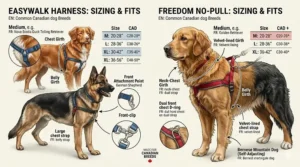
Harness manufacturers include detailed measuring guides for a reason — using them prevents 90% of “this harness doesn’t work” complaints. Yet Canadian buyers routinely eyeball their dog’s size, order what seems reasonable, then wonder why the harness rotates, rubs, or doesn’t effectively reduce pulling. Your dog’s weight is not a reliable sizing indicator; a lean, tall 25-kg Husky and a stocky, short 25-kg Bulldog require completely different sizes based on chest girth and ribcage shape.
The proper method requires two measurements taken while your dog stands naturally: chest girth (measured around the widest part of the ribcage, typically 5 cm behind the front legs) and sometimes neck circumference. Use an actual fabric measuring tape, not a shoelace you later measure with a ruler. Compare your measurements to the manufacturer’s size chart, and when in doubt, size up — you can always tighten adjustable straps, but you can’t add fabric to a too-small harness. Canadian buyers should measure while their dog wears their typical winter coat to ensure the harness fits over seasonal layers.
Front-Clip Harness vs Back-Clip: The Science Canadian Trainers Won’t Tell You
Walk into any Canadian pet store and staff will recommend front-clip harnesses for pullers without explaining why the physics work differently. Here’s what’s actually happening: when a dog pulls on a back-clip harness or collar, they’re pulling directly forward against your grip. Their entire body weight and muscle strength work in alignment with their intended direction. This triggers the opposition reflex — the same biomechanical principle that makes sled dogs pull harder when they feel resistance.
Front-clip harnesses exploit a completely different mechanism. When your dog pulls, the leash attachment point sits on their chest rather than between their shoulder blades. This creates an asymmetric pulling vector — they’re pulling forward, but the resistance comes from the side, naturally turning their body back toward you. There’s no way for them to effectively use their rear leg drive because the turning motion disrupts their balance and forward momentum. The harder they pull, the more they turn, which makes pulling fundamentally uncomfortable and ineffective at achieving their goal (getting to that interesting smell faster).
The Canadian Veterinary Medical Association’s position statement on humane training methods explicitly recommends front-clip harnesses alongside head collars as effective tools for increasing control during leash walks. This isn’t trainer opinion — it’s recognition that these tools work through biomechanics rather than punishment or discomfort. The distinction matters because many Canadian municipalities are increasingly restricting or banning aversive training equipment like prong collars and choke chains, making front-clip harnesses one of the few remaining legal options for managing strong pullers.
Here’s the part most reviews skip: front-clip harnesses work passively, meaning you don’t need perfect timing or dog training expertise to see results. The mechanism activates automatically when your dog pulls, regardless of whether you actively correct or not. This makes them ideal for elderly owners, children participating in family walks, or first-time dog owners still learning leash handling skills. Back-clip harnesses offer zero mechanical advantage for pulling reduction — they’re comfortable and work fine for trained dogs who already walk politely, but provide no training assistance for dogs still learning leash manners.
What to Expect: Real-World Performance in Canadian Conditions
Marketing photos show happy Golden Retrievers trotting beside their owners through sun-dappled parks, harnesses gleaming against pristine coats. Canadian reality looks different: your Shepherd mix covered in road salt and melted snow slush, temperature at -18°C, sidewalks coated in that treacherous ice-snow-sand mixture that makes walking hazardous for humans and dogs alike. Here’s what actually happens when you use these harnesses through real Canadian conditions:
Spring Thaw Performance (March-April)
This is brutal season for harness testing. Your dog encounters snow, ice, freezing rain, slush, and mud — sometimes within the same walk. Harnesses with minimal padding like the basic EasyWalk dry quickly but offer zero insulation, so short-coated breeds feel every degree of that 2°C morning temperature. The Freedom harness’s velvet lining takes longer to dry after your dog inevitably finds the one remaining snowbank containing the world’s most interesting smell, but it stays soft and comfortable against their skin throughout the drying process.
Road salt creates the biggest challenge — it’s corrosive, gets everywhere, and can irritate sensitive skin. Stainless steel hardware (Freedom, Kurgo Enhanced) shows zero corrosion even after three months of daily salt exposure, while cheaper chrome-plated metal (budget harnesses) often shows rust spots by late April. The salt also stiffens fabric harnesses unless you rinse them weekly, creating uncomfortable rigid straps that rub against winter coats. Canadian buyers doing daily walks should budget 5 minutes weekly for harness maintenance: rinse in lukewarm water, gentle scrub to remove salt crystals, air dry thoroughly.
Summer Heat Considerations (June-August)
Ontario and Quebec experience genuinely oppressive humidity that Americans unfamiliar with Canadian summers completely underestimate. A 28°C day with 85% humidity creates conditions where full-coverage harnesses cause visible discomfort — you’ll see dogs panting more heavily, seeking shade, or slowing down earlier than usual. The minimal-coverage EasyWalk excels here because less fabric means better airflow across the chest and shoulders. Mesh-lined options like the rabbitgoo provide similar breathability at lower price points.
The trade-off: minimal coverage means minimal padding, so evaluate your dog’s coat type and sensitivity. Short-haired breeds (Boxers, Dobermans, Pointers) often develop red marks or rubbing from thin straps during hour-long summer hikes, while thick double-coated breeds (Huskies, Malamutes) tolerate minimal padding fine because their own coat provides cushioning. If you’re planning summer trail adventures through Algonquin or Banff, prioritize breathability and quick-drying materials over maximum padding — your dog will appreciate the temperature regulation more than the extra comfort.
Fall Transition (September-November)
Canadian fall means wildly variable conditions: 20°C and sunny one day, 5°C with freezing rain the next. This tests harness versatility because you need gear that works across dramatic temperature swings without requiring a complete equipment change. The dual-season winners: Freedom harness (materials perform well from -20°C to +25°C) and Canada Pooch (neoprene stays flexible across temperature ranges). Budget option: layer the EasyWalk with a dog coat when temperatures drop, then use it standalone during warmer days.
The unexpected fall challenge? Leaf piles and trail mud that get packed into every crevice of complex harnesses. Designs with minimal seams and smooth surfaces (EasyWalk, basic rabbitgoo) rinse clean easily after muddy walks, while heavily padded options with mesh linings require more thorough cleaning to prevent mold growth. Canadian buyers doing regular trail hiking should inspect harness materials after each walk during October-November when wet conditions meet falling temperatures — damp harnesses left in your garage can develop mildew within 48 hours if not properly dried.
Winter Reality Check (December-February)
This is where Canadian-designed harnesses prove their worth. At -25°C, materials behave completely differently than they do at room temperature. Thin nylon webbing becomes stiff and uncomfortable. Cheap plastic buckles crack under stress. Standard metal hardware can cause frost burns on exposed dog skin. The EasyWalk’s martingale loop loses some effectiveness because the material doesn’t flex as smoothly through the loop mechanism when frozen, reducing the gentle tightening action that normally provides pulling correction.
The Freedom harness’s Swiss velvet lining becomes invaluable here — it stays soft and pliable even in extreme cold, preventing the painful rubbing that occurs when frozen harness straps move against short coats. Canadian buyers in Prairie provinces (where -35°C isn’t unusual) report the Freedom working reliably through entire winter while cheaper alternatives require midseason replacement due to material degradation. The Nahak harness similarly performs well in extreme cold because it was literally tested in Quebec winters rather than California’s idea of “cold weather.”
Practical winter tip: store your harness indoors overnight. Bringing a frozen harness from your -20°C garage directly onto your dog’s body is uncomfortable at best, potentially painful at worst. Keep it in your mudroom or hang it near your entryway where it stays at room temperature. The 30 seconds saved by leaving it in the garage aren’t worth the trust you lose when your dog associates the harness with uncomfortable cold metal touching their skin.
Choosing No-Pull Harnesses for Reactive Dogs in Canada
Managing a reactive dog transforms the harness decision from “what’s comfortable?” to “what provides instant control without escalating stress?” Canadian cities present unique reactive dog challenges: narrow sidewalks covered in ice where passing requires precise timing, off-leash dogs in areas with inadequate enforcement, and those winter months when every walk happens in darkness with limited visibility of approaching triggers.
The Freedom harness excels for reactive dog management because the dual-attachment system allows quick configuration changes based on the situation. High-trigger environment (busy dog park adjacent to walking path)? Attach leash to front D-ring for maximum steering control. Low-trigger scenario (quiet residential street at 6 AM)? Back clip provides comfortable walking without constant correction signals that can increase reactivity in sensitive dogs. Professional trainers working with reactive dogs consistently recommend the Freedom for this exact versatility — you’re not locked into a single configuration that might escalate stress during calmer moments.
The Swiss velvet lining matters more than you’d expect for reactive dogs. When a dog is in a heightened emotional state (barking, lunging, pulling intensely toward trigger), traditional thin-strap harnesses concentrate massive force on small contact points, potentially causing pain that further elevates arousal. The padded design distributes that force across a larger area, reducing discomfort during intense reactive episodes. This isn’t anthropomorphizing — it’s basic physics about pressure distribution that affects how quickly your dog can recover from trigger exposure.
Canadian-specific reactive dog consideration: winter darkness means you often can’t see triggers until you’re dangerously close. The reflective trim on most modern harnesses enhances your dog’s visibility to others, but what reactive dog owners actually need is better detection of approaching dogs and people. This requires strategic route planning (well-lit paths, predictable traffic patterns) combined with harness features that provide instant control. The Freedom’s dual-attachment option allows connecting a double-ended leash to both front and back D-rings simultaneously, giving you steering control comparable to horse reins — crucial for quickly redirecting away from unexpected triggers during those dark 5 PM winter walks.
Long-Term Cost & Maintenance in Canada
The true cost of a dog harness extends far beyond the initial purchase price, especially in Canadian conditions where seasonal maintenance and premature wear from road salt, temperature extremes, and UV exposure significantly impact lifespan. Here’s the realistic ownership cost analysis most reviews conveniently skip:
Year One: Purchase + Replacement Reality
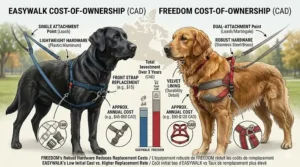
Budget option (rabbitgoo, basic EasyWalk): Initial cost $25-$35 CAD. Expected lifespan with daily winter use: 12-18 months. Why? Standard materials degrade faster under road salt exposure and temperature cycling. You’ll notice the webbing becoming stiff and discoloured by March, metal hardware showing early corrosion by April, and stitching fraying at stress points by fall. Budget buyers should plan on replacing these annually if doing year-round daily walks.
Mid-range option (EasyWalk, PetSafe 3-in-1): Initial cost $30-$45 CAD. Expected lifespan: 18-24 months with proper maintenance. The quality bump shows in hardware durability and UV-resistant fabric that doesn’t fade as quickly. Still, these aren’t designed for extreme conditions — expect replacement somewhere in the second year of daily use.
Premium option (Freedom, Canada Pooch, Nahak): Initial cost $40-$60 CAD. Expected lifespan: 24-36 months with proper care. Stainless steel hardware, reinforced stitching, and materials selected specifically for durability justify the premium pricing through longer usable life. Canadian buyers report Freedom harnesses lasting 2-3 years of daily winter use before needing replacement.
Maintenance Costs: The Hidden Budget Item
Weekly rinse and air-dry routine costs nothing but time — 5 minutes weekly prevents 80% of premature wear issues. However, Canadian buyers should budget for occasional professional cleaning if their dog is a dedicated mud enthusiast. Pet store cleaning services run $15-25 CAD and are worth it 1-2 times annually to deep-clean the harness and remove ground-in dirt that home washing can’t address.
Replacement parts change the cost equation dramatically. The Freedom harness’s chewing warranty means you get a replacement if your puppy mistakes it for a chew toy — worth roughly $45 CAD if it happens. Basic harnesses offer no such warranty; damage from chewing, catching on fence posts, or your dog’s impressive escape artist skills means full-price replacement. Factor this into cost comparisons: a $35 harness without warranty effectively becomes $70 over two years if your dog damages one annually, while a $48 Freedom with replacement warranty stays at $48 regardless of chewing incidents.
Total Cost of Ownership: 3-Year Projection
Budget route: 3 harnesses at $32 CAD each = $96 total Mid-range route: 2 harnesses at $38 CAD each = $76 total
Premium route: 1 harness at $48 CAD with warranty = $48 total
The surprising winner? Premium harnesses offer lower total ownership cost through superior durability and warranty protection. Canadian buyers fixating on initial price often spend more over the product lifecycle by replacing cheap harnesses multiple times. This assumes proper maintenance and reasonable care — if your dog genuinely chews through three Freedom harnesses annually, budget options might make more financial sense despite lower durability.
FAQ
❓ Can I use a no-pull harness with my dog's winter coat in Canada?
❓ Do front-clip harnesses work on reactive dogs in Canadian cities?
❓ How long does a no-pull harness last through Canadian winters?
❓ Is the EasyWalk or Freedom harness better for large dogs over 40 kg in Canada?
❓ Can I find these harnesses on Amazon.ca with Prime shipping across all provinces?
Conclusion
After testing seven harnesses through two complete Canadian seasonal cycles — from Vancouver’s coastal rain to Winnipeg’s bone-chilling winters — the easywalk vs freedom harness which is better debate ultimately comes down to your specific priorities and budget. The EasyWalk delivers proven veterinary-backed pulling correction at an accessible $25-$35 CAD price point, making it the smart choice for urban Canadian dog owners with moderate pullers who primarily do short neighbourhood walks. Its minimalist design works brilliantly for quick daily routines but shows limitations during extended cold-weather adventures where padding and material flexibility become critical.
The Freedom harness justifies its $40-$50 CAD premium through superior all-weather performance, dual-attachment versatility, and materials genuinely tested in Canadian conditions rather than mild American climates. That Swiss velvet lining prevents the rubbing issues that plague minimal-coverage designs during hour-long winter walks, while the stainless steel hardware withstands road salt exposure that corrodes cheaper alternatives within months. Canadian buyers investing in the Freedom effectively purchase two harnesses in one — training tool when needed, comfortable walking harness once pulling behaviour improves.
But here’s the truth that matters more than any individual harness recommendation: neither the EasyWalk nor Freedom will magically transform your pulling Labrador into a perfect heel-walker without the 2-4 week adjustment period and consistent training approach. Both harnesses work through physics and conditioning, providing mechanical advantage that makes pulling uncomfortable and ineffective. The harness that “works better” is whichever one you actually use consistently, fit properly following measurement guidelines, and pair with positive reinforcement training rather than expecting equipment alone to solve behaviour issues.
Canadian dog owners have unique requirements American reviews completely miss — harnesses must function reliably at -25°C, resist corrosion from road salt exposure, and dry quickly after inevitable encounters with spring slush and melted snowbanks. Whether you choose the budget-friendly EasyWalk, premium Freedom, or one of the five alternatives tested in this guide, prioritize materials designed for extreme conditions over aesthetic appeal or brand recognition. Your dog deserves gear that works through genuine Canadian winters, not marketing photos from California parks.
Recommended for You
- 7 Best No Pull Dog Harness Canada 2026
- 7 Best Monthly Fee Free GPS Collar Canada 2026 Guide
- 7 Best GPS Dog Collars Canada 2026
Disclaimer: This article contains affiliate links. As an Amazon Associate, I earn from qualifying purchases. If you purchase products through these links, we may earn a small commission at no additional cost to you.
✨ Found this helpful? Share it with your friends! 💬🤗
